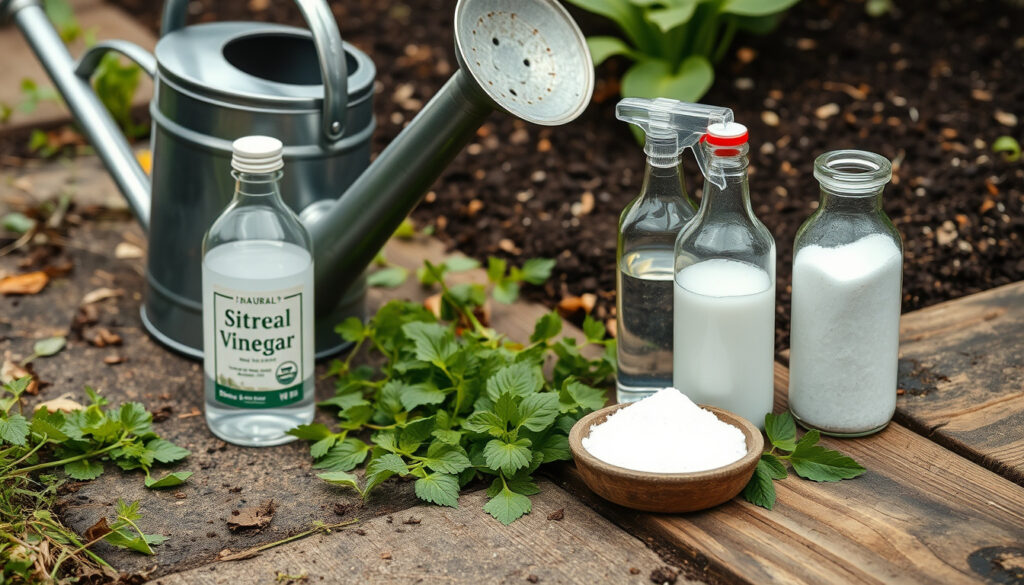
How to Get Rid of Weeds Naturally (Vinegar, Salt & More)
Anyone who has spent a sunny afternoon pulling dandelions knows the appeal of a spray-and-walk-away solution — but the fastest homemade fixes are the least permanent, and the lasting ones aren’t sprays at all. Household vinegar is only about 5% acetic acid, so a quick spray burns leaves while roots survive; by the end, you’ll know exactly when boiling water, salt, or a sheet of cardboard is the smarter move.
Household vinegar: about 5% acetic acid · Boiling water: 212°F / 100°C at sea level · Dish soap role: surfactant that helps sprays stick · Salt effect: dehydrates plant cells, lingers in soil · Fastest visible damage: top growth can wilt within hours
Quick snapshot
- Mulching suppresses weeds by blocking light and reducing seed germination (USDA NRCS (organic farming guidance)).
- Salt can remain in soil and damage desired plants after the target weed has died (Leafy Pixels (gardening guide)).
- Fast contact sprays burn what they touch; lasting control targets roots or blocks light. (USDA NRCS (organic farming guidance))
- Whether one salt-and-vinegar application kills deep-rooted perennials permanently.
- How long salt stays at plant-damaging levels in different soil types.
- Which bulk salt bag is cheapest near you; local prices vary too much for a single answer.
- Top-growth damage from boiling water or vinegar-salt sprays can appear within hours.
- Repeated cutting, mowing, or pulling weakens perennial weeds over time.
- Mulch or ground cover keeps new seedlings suppressed all season.
- Dig out taproots or smother the area to stop regrowth.
- Combine physical removal with a contact spray, then repeat.
- For large areas, sheet mulching beats chasing individual weeds.
Eight numbers and labels, one pattern: the fastest fixes are the least permanent.
| Label | What to know |
|---|---|
| Main DIY bases | Vinegar, salt, dish soap, boiling water, baking soda |
| Household vinegar | Usually 5% acetic acid |
| Boiling point | 212°F / 100°C at sea level |
| Fastest visible result | Top-growth damage within hours |
| Most permanent options | Root removal, mulch, or smothering |
| Dish soap’s real role | Surfactant, not a stand-alone killer |
| Salt’s long-term catch | Reportedly can keep treated areas barren for months or years |
| Best salt spots | Isolated cracks and hard surfaces where no plants are wanted |
What is the best homemade way to kill weeds?
How to get rid of weeds naturally without pesticides
- Combining methods beats relying on a single spray (Government of Manitoba (agriculture department)).
- Contact sprays handle the leaves; physical removal and smothering handle the roots.
- No recipe is best in every situation because vinegar, salt, boiling water, and hand pulling behave differently.
There is no single best homemade weed killer, because every method attacks a different part of the problem. Vinegar and boiling water are contact killers: they damage the leaves they touch. Salt changes the soil itself. Hand pulling and smothering remove or block the weed before it can regrow. The right answer depends on where the weed is and whether you want the soil to grow something else later.
How to get rid of weeds naturally with vinegar
Vinegar wins the visible battle and loses the underground war. The leaf dies fast; the root decides whether the weed comes back.
Household white vinegar is usually about 5% acetic acid, which is enough to damage young, tender leaves when applied in full sun. Spray it on a warm, dry morning and you will often see wilting by the afternoon. For weeds with taproots or rhizomes, treat vinegar as the first move, not the last: follow up by digging or repeat the spray until the root gives up.
How to get rid of weeds with boiling water
- Boiling water hits 212°F / 100°C at sea level — hot enough to rupture leaf cells on contact.
- It is best for paths, patios, and cracks where no plants are wanted.
- Perennial roots below the surface often survive and resprout.
Pouring a kettle straight onto weed clumps is the cheapest method in this guide, and it is satisfyingly immediate. The catch is precision: boiling water does not discriminate, so protect nearby plants and be careful carrying a full kettle down the garden.
The implication: the best homemade method is the one matched to the root system and the surface. Spray what you cannot dig; dig what you can.
Can I just pour salt on weeds to kill them?
Is there a large bag of salt that can kill weeds?
- Bulk rock salt, table salt, and water-softener salt can all work.
- Branded weed-killing salt is not required.
- The cheapest bag is usually the plainest one in the local hardware or grocery aisle.
Salt kills by dehydration: it pulls moisture out of plant cells and disrupts water uptake (Lawn Love (lawn care platform)). Dissolved in water, it is easier to control than dumping it straight from the bag, and it is especially useful in cracks and paving joints where you want nothing to grow.
What is the cheapest type of salt to kill weeds?
- Plain table salt is cheap and dissolves quickly.
- Rock salt is often sold in larger bags, so the price per kilogram is usually low.
- Water-softener salt pellets work in cracks, though they dissolve more slowly.
There is no magic formula to pay for. The cheapest option is whichever plain salt costs least per kilogram in your area; special weed-killing products just add a markup to the same chemistry.
Where salt is safe to use
- Salt-based treatments should not be used in lawns, garden beds, or near valued trees and plants (Ask Extension (university extension service)).
- Salt may suit isolated cracks in hard surfaces, but runoff into nearby soil is still a concern (Lawn Love, cited above).
- Salt lingers in soil and can damage plants long after the weed has died — the exact risk flagged in the quick snapshot above.
Think of salt as a soil sterilizer. It does not know a weed from a flower, and once it washes into a bed, it makes life harder for everything with roots.
The catch: salt is permanent in the wrong ways. It wins the weed battle, then keeps the soil hostile to whatever you plant next.
Does salt and fairy liquid kill weeds?
How salt kills weeds
- Salt pulls moisture from plant cells and raises the salinity of the soil around the roots.
- Because the effect is non-selective, the same spray that burns a weed will burn a flower.
This is the mechanism behind every salt-based recipe: the weed dies from dehydration, and the soil becomes harder for any new seedling to establish.
What washing-up liquid contributes
- Dish soap primarily acts as a surfactant, helping a spray spread over or cling to foliage (Ask Extension (university extension service)).
- Household dish detergents are not designed for outdoor application to plants.
- Washing-up liquid helps the mix stick, but it adds little killing power of its own.
Fairy Liquid is a brand of dish soap — the same logic applies to any mild detergent you already own. It helps a salt-and-vinegar solution cling to waxy weed leaves instead of beading up and rolling off. What it does not do is make the mix safe: the spray is still non-selective and still leaves salt behind.
When the salt-and-soap mix is not worth it
- Salt-and-soap sprays are non-selective and can damage soil.
- The mix is not recommended for lawns or flower beds, where the salt will hurt the plants you want to keep.
- Surface sprays rarely reach the crown, taproot, or rhizomes that let perennials regrow.
If you mix the three pantry staples and spray a whole bed, you will likely see brown leaves within a day — and a salty, unhappy bed by next month. That is why extension services warn against these recipes on lawns and borders, and why the smarter play is to reserve them for cracks and paving.
What this means: salt plus fairy liquid is a cheap driveway recipe, not a garden strategy. The soil pays the bill.
Will salt and vinegar kill weeds permanently?
Can I use straight white vinegar to kill weeds?
- Household white vinegar is usually 5% acetic acid — enough to damage young leaves on contact.
- Vinegar alone can kill annual weed tops, but many perennial weeds regrow from roots.
- Use it on a sunny day; dry conditions help the acid burn.
Straight white vinegar works, but it is a contact herbicide with a short reach. It disrupts leaf tissue wherever the spray lands, which makes it brilliant for seedlings in cracks and less impressive against an established dandelion.
How long does it take white vinegar and salt to kill weeds?
Expect wilting in hours and collapse in days — then watch for the resprout. A weed that comes back in week three was never killed; it was only burned.
- 0–6 hours: tender tops show visible wilting or browning.
- 1–3 days: many annual weeds collapse; deep-rooted perennials may regrow.
- 1–4 weeks: regrowth tells you whether the root actually died.
Salt adds staying power because salt residue reportedly persists in soil longer than vinegar and can keep treated areas barren for months or years (Lawn Love (lawn care platform)). That is helpful in a paved crack and harmful in a bed where you plan to plant next season.
What is the best salt to mix with vinegar to kill weeds?
- Plain table salt or rock salt is enough; expensive special salts are not necessary.
- Use a ratio that fully dissolves, so the spray does not clog your nozzle.
- Keep the mix off lawns, gardens, and any soil where you want future plants.
The exact ratio matters less than the application. The salt is what leaves a long-lasting residue; the vinegar is the fast-burning carrier. Together they suit paved areas where nothing should grow again, but they are the wrong tool near anything you value.
The pattern: vinegar and salt give quick visual feedback, but “permanent” is decided below ground. Expect to reapply — or dig.
What kills weeds down to the root overnight?
What kills weeds in one hour?
- Boiling water and strong vinegar-salt sprays can cause visible damage within an hour.
- That damage is to leaves and stems — not automatically the root (Leafy Pixels, cited above).
- Small annual weeds are the ones that die fast; perennials usually put up a second shoot.
If the goal is “gone by dinner,” a kettle of boiling water is your best natural bet for tender weeds in paving joints. The leaves collapse quickly and the soil gets no chemical residue. But the same heat that kills a seedling can leave a taproot untouched.
What kills weeds instantly?
Nothing natural kills a deep root “instantly.” What dies fast is the leaf; the root just sits underground and waits for the next rain.
Instant results exist only at the surface. Even the fastest sprays leave underground storage organs intact, so the weed’s energy reserves stay ready for regrowth.
How can I get rid of weeds naturally overnight?
- Pour boiling water on small weeds in paths and patios before bed; most will look sorry by morning.
- For deep-rooted weeds, spray in the evening, then dig the root the next day while the top is weakened.
- Repeat any time you see regrowth — consistency beats a single miraculous recipe.
Overnight “root kill” is the wrong sales pitch. What actually works overnight is making the weed visibly miserable; permanent removal still needs your hands, a trowel, or a layer of mulch.
Why this matters: the promise of overnight results sells the wrong tool. Fast top damage is easy; killing a dandelion’s taproot is the actual job.
What gets rid of weeds permanently?
How can I get rid of weeds in my garden permanently?
- Remove the root system or block light; leaf-burning alone is not permanent control.
- Digging out taproots and repeated hoeing are reliable physical methods.
- For woody or invasive weeds, digging out roots beats surface spraying.
Permanent natural control means making it impossible for the weed to photosynthesize or regrow. A thick layer of cardboard topped with mulch does exactly that: it blocks light and smothers the plants underneath (USDA NRCS organic farming guidance, cited above).
Will bleach kill weeds permanently?
- Bleach can kill weeds, but it is toxic to soil and is not a natural method.
- It can leave ground bare, contaminated, and difficult to replant.
- Bleach burns foliage but still does not guarantee the root is dead.
Bleach shows up in weed conversations because it works fast and visibly. The lasting effect is the problem: it is a soil sterilant, and the contamination remains long after the weed disappears. Skip it.
What is the best way to remove weeds from a large area?
- Sheet mulching — cardboard or fabric covered with mulch — suits big plots and paths.
- Cover crops compete with weeds for water, nutrients, and sunlight.
- Repeated cultivation or hoeing works if you can stay ahead of the seedlings.
For a large area, spraying individual weeds is a treadmill. Smothering or repeated cultivation removes the light and the opportunity, which is how “permanent” natural weed control actually happens.
The trade-off: permanent control trades speed for soil health. The quickest sprays leave the weakest result — and the busiest gardener.
Natural weed control methods compared
Six approaches, one pattern: the faster the visible kill, the shorter the lasting effect.
| Method | Best for | How it works | Watch out for |
|---|---|---|---|
| Boiling water | Paths, patios, cracks | Heat at 212°F / 100°C ruptures leaf cells on contact | Deep roots often resprout |
| Vinegar (5% acetic acid) | Young annual weeds in full sun | Acetic acid burns leaf tissue | Contact-only; perennials regrow |
| Salt | Cracks and paved areas | Dehydrates cells and disrupts water uptake | Lingers in soil; can keep areas barren |
| Salt + dish soap | Non-garden hard surfaces | Salt dehydrates; soap helps the mix cling to waxy leaves | Household detergents aren’t designed for outdoor use |
| Hand pulling / digging | Beds, borders, woody weeds | Removes the root system | Best done in moist soil, with follow-up |
| Smothering (cardboard + mulch) | Large areas, paths, future beds | Blocks light and reduces seed germination | Needs a few weeks of patience |
The pattern: every fast spray is a foliar burn; every lasting method works on roots or light. Choose the row that matches the surface you are protecting.
How to get rid of weeds naturally, step by step
- Identify the weed and the surface. A dandelion in a flower bed needs a different plan than a grass seedling in a patio crack.
- Pull or dig the root while the soil is moist. Hand pulling removes the whole plant when the ground is soft; for woody or invasive weeds, digging beats surface spraying.
- For paths, patios, and cracks, pour boiling water or spray a vinegar-salt mix. These are contact killers, so they suit places where nothing should grow.
- For beds and borders, smother instead. Lay cardboard, add a thick mulch layer, and let the lack of light do the work (USDA NRCS organic farming guidance, cited above).
- Repeat every 1–4 weeks. Combine prevention, physical removal, and direct treatment, and stick with it (Government of Manitoba, cited above).
- Prevent the next generation. Mulch, dense ground cover, or a cover crop stops weed seeds from germinating in the first place.
Natural weed control is a system, not a spray. The fastest recipes buy you a day; the steps above buy you a season.
Natural weed control: what to expect over time
One treatment tells you nothing; the timeline tells you everything.
| Timeframe | What you’ll see |
|---|---|
| 0–6 hours | Boiling water and vinegar/salt sprays cause visible wilting or browning on tender weed tops. |
| 1–3 days | Some treated annual weeds collapse; deep-rooted perennials may resprout. |
| 1–4 weeks | Repeated treatment, hand digging, or smothering stops regrowth. |
| Season-long | Mulch or dense ground cover prevents new weed seeds from germinating (USDA NRCS organic farming guidance, cited above). |
Why this matters: if the weed is back in week three, the root survived — switch from spraying to digging.
What we know — and what’s still unclear
Confirmed facts
- Organic weed management is generally most effective when multiple methods are combined rather than relying on one treatment (Government of Manitoba, cited above).
- Mulching suppresses weeds by blocking light and reducing seed germination — USDA NRCS organic farming guidance, cited above.
- Salt-based treatments should not be used in lawns, garden beds, or near valued trees and plants — Ask Extension guidance, cited above.
What’s unclear
- Whether a single salt-and-vinegar application kills deep-rooted perennial weeds permanently; results depend on weed age, soil, and rain in the days after spraying.
- How long salt stays at plant-damaging levels in different soil types. Reportedly it can persist for months to years, but local soil and rainfall change the answer (Lawn Love, cited above).
- Whether salt and dish soap mixes are worth using outside paved areas — the ingredients are not selective, and household detergents are not formulated for plants (Ask Extension, cited above).
- Which bulk salt is the cheapest in your market: rock salt, table salt, and water-softener salt all work, so the right bag is simply the one that costs least per kilogram near you.
The pattern: the confirmed claims point to physical removal and light-blocking as dependable controls, while the unresolved questions all involve salt’s variable, soil-dependent persistence.
What the experts say
“Household dish detergents are not designed for outdoor application to plants.”
Ask Extension (university extension service)
“Surface injury from dish soap may not kill a weed’s crown, taproot, rhizomes, or other underground storage organs.”
Leafy Pixels (gardening guide)
The upshot: two different sources, one shared message: a soapy spray damages the leaves it touches, but the weed’s survival organs sit below the spray’s reach.
The takeaway
For most home gardeners, the honest answer is not a single miracle spray — it’s a two-track plan. Use boiling water, salt, or vinegar where nothing green should grow, and use mulch, cardboard, and gloved hands where you want plants to thrive. For Pacific Brief readers managing a weedy driveway and a garden they actually like, the choice is clear: reserve the harsh stuff for the cracks and build soil health where you want growth — or spend the whole season pulling the same weeds twice.
Frequently asked questions
How often should I reapply a homemade weed killer?
Reapply whenever you see fresh green growth — typically every 1 to 4 weeks for annual weeds. Perennial weeds with taproots or rhizomes need repeated treatment or physical removal, because surface sprays rarely reach the underground parts that regrow.
Can I use salt and vinegar on my lawn?
No. Salt-based treatments should not be used in lawns, garden beds, or near valued trees and plants; the salt stays in the soil and can damage desired plants after the weed has died (Ask Extension guidance, cited above). Vinegar will also brown any grass it touches.
Does vinegar harm soil?
Household vinegar breaks down quickly, so its main effect is on the leaves it contacts. The longer-lived risk is salt: salt residue reportedly persists in soil and can keep treated areas barren for months or years (Lawn Love, cited above).
What natural method works best on driveway cracks?
Boiling water is the fastest no-cost option, and a salt-vinegar spray works well in isolated cracks where nothing should grow. Remember that runoff into nearby soil is still a concern (Lawn Love, cited above).
Are homemade weed killers safe for pets?
Vinegar and boiling water are far less toxic than herbicides, but salt builds up in soil and can harm earthworms and beneficial soil life (Ask Extension guidance, cited above). Keep pets off treated areas until sprays have dried.
Will boiling water kill weeds to the root?
Often not. Boiling water scorches exposed leaves quickly, but deep roots frequently survive and resprout. For permanent control, dig out the root or smother the spot with cardboard and mulch.
What’s the cheapest way to kill weeds naturally?
A kettle of boiling water costs almost nothing and works on paths and patios. Bulk table salt or rock salt is also cheap for paved areas, though salt is best kept away from garden soil.
The takeaway: match the method to the surface — fast sprays suit cracks, while roots and light are the battleground in beds.
More related posts
 Hell’s Gate Geothermal Reserve & Mud Spa Reviews
 Newcastle United Transfer News: Latest Signings & Rumours
 Lotto’s $20M Jackpot: Mistakes, Tax & Superdraw
 Battlefield 6 Release Date: October 10, 2025 Launch & 2026 Review
 Auckland Airport Arrivals Flight Tracker Today: Live Status
 Michael Hill Net Worth: Jewellery Empire, Yacht & Legacy
 Ultra Violette Sunscreen Recall in New Zealand: Lean Screen SPF
 Police Incident in Christchurch Today – Latest on Papanui Death Probe