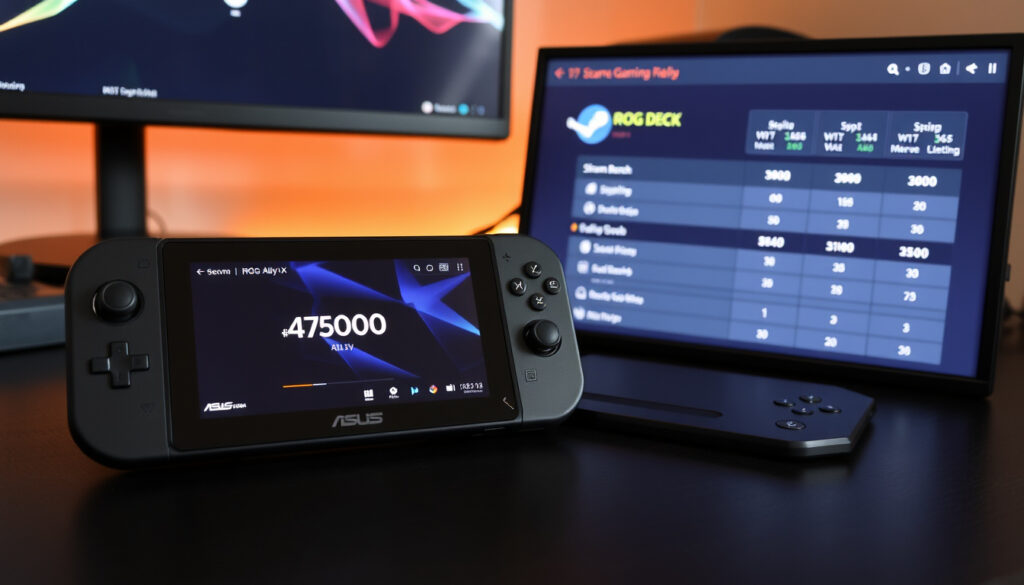
ASUS ROG Ally X Specs, Price & Steam Deck Comparison
Ask anyone who carries a handheld gaming PC on a long flight and you’ll hear the same math: battery life matters as much as how good the games look. The ASUS ROG Ally X pushes that math with an 80Wh battery and a 120Hz 1080p screen, while Valve’s Steam Deck — its main rival — ships with a 40Wh battery, per Valve’s own tech page, at a lower price.
Battery capacity: 80 Wh · Display refresh rate: 120 Hz · USB Type-C ports: 2 · Processor: AMD Z1 Extreme · Ergonomics: Redesigned for long sessions
Quick snapshot
- 80Wh battery — double the original Steam Deck’s 40Wh (ASUS product page)
- Up to 24GB LPDDR5X memory and a 7-inch 1080p 120Hz touchscreen (ASUS product page) (ASUS product page)
- 1TB storage configuration and microSD expansion in European listing data (Tech Insider comparison)
- Exact Irish street price — European references vary from €899.99 (Northreview) to higher refurbished listings (Focus Ireland tech roundup)
- Whether the “ROG XBOX Ally X20 2026” listing tag points to a real successor (Tech Insider) (Focus Ireland tech roundup)
- Some connectivity specs, like Wi-Fi 6E and Bluetooth 5.2, rest on lower-tier sources (Focus Ireland tech roundup)
- The ROG Ally X is still listed as an active product on ASUS’s US store at $799.99 (ASUS)
- No official discontinuation notice appears in the sources reviewed
- 2026-model talk comes from listing pages, not from ASUS (Tech Insider)
- Irish pricing should sharpen as retail and refurbished stock settles (marketplace observations)
- Watch ASUS’s official channel for any 2026 model confirmation before paying a premium (Tech Insider)
- The playable library keeps expanding through Windows storefronts like Xbox Game Pass and Epic (Focus Ireland tech roundup)
Nine specs in, one pattern: the Ally X is engineered around endurance — battery, memory, and screen headroom — more than any single headline number.
| Spec | Value | Source |
|---|---|---|
| Battery | 80 Wh | ASUS |
| Processor | AMD Ryzen Z1 Extreme | ASUS |
| Memory | Up to 24GB LPDDR5X | ASUS |
| Display | 7-inch FHD 1080p touchscreen, 120Hz, FreeSync Premium | ASUS |
| Ports | Dual USB Type-C | ASUS |
| Storage | 1TB configuration; microSD expansion | Tech Insider |
| Operating system | Windows 11 | Northreview |
| US list price | $799.99 | ASUS |
| European price reference | ≈ €899.99 | Northreview |
Is ROG Ally X better than Steam Deck?
Short answer: better at some things, not at others. The Ally X beats the Steam Deck on battery capacity, memory, and raw hardware. The Steam Deck family answers with a lower price, and in the OLED model, a richer screen.
Performance comparison
ROG Ally X: AMD Ryzen Z1 Extreme · up to 24GB LPDDR5X · ASUS product page — Steam Deck: custom AMD APU, 4 Zen 2 CPU cores, 8 RDNA 2 compute units · 16GB LPDDR5 · Valve’s tech page
In raw spec terms, the ROG Ally X is the faster machine on paper, and it backs that up with roughly 50 percent more memory and a 120Hz display. The debate is whether you need that much speed on a 7-inch screen, and whether Windows earns its keep as the everyday OS. For pure performance, the Ally X has the edge; for simplicity, the Steam Deck’s SteamOS is the easier daily companion.
Battery life comparison
ROG Ally X: 80Wh (ASUS) · Steam Deck: 40Wh (Valve’s tech page) · Steam Deck OLED: 50Wh (Tech Insider)
This is where the Ally X changes the conversation. The 80Wh pack doubles the original Steam Deck’s 40Wh battery and outstrips the Steam Deck OLED’s 50Wh cell by a wide margin — Tech Insider’s European comparison puts the OLED at 50Wh with a 7.4-inch OLED display at 90Hz and a weight of 640g. In practice, that capacity difference means hours more play time per charge: the difference between a flight that ends too soon and a game session that outlasts the flight.
Game library differences
- ROG Ally X runs Windows 11, Steam Deck runs SteamOS — Northreview’s comparison
- Windows 11 opens the door to PC storefronts like Xbox Game Pass and the Epic Games Store (Focus Ireland tech roundup)
- Steam itself is just a Windows app on the Ally X, which means the whole Steam library is available
This is the biggest strategic gap between the two handhelds. The Ally X is a Windows 11 PC with a controller bolted on, so it runs the full Windows ecosystem of launchers and stores; according to an Ireland-focused tech roundup, that includes Xbox Game Pass and the Epic Games Store. The Steam Deck is a console-style device: SteamOS, Steam as the center of gravity, and a deliberately simpler relationship with anything outside Steam.
The pattern: the Ally X out-specs the Steam Deck on battery and memory, but the Steam Deck OLED counters on price and screen quality — the right choice depends on which of those you value more.
The implication: the choice narrows to one question — do you value endurance or screen quality more?
Why is the Asus ROG Ally X so expensive?
The short answer: the ROG Ally X is a premium PC squeezed into a handheld frame, and premium parts cost real money.
Components and build quality
- Up to 24GB of LPDDR5X memory — high-end for any portable device (ASUS)
- 1TB storage configuration in European listings (Tech Insider)
- Dual USB-C ports plus microSD expansion for docks and extra storage (ASUS / Tech Insider)
None of these are budget parts. Bigger memory, faster storage, and a second USB-C port all push the bill of materials higher than a typical handheld. You’re also paying for the OS flexibility — Windows 11 is the reason the Ally X can run every major PC launcher, and that flexibility shows up in the price.
Battery size
The 80Wh battery is the most expensive-feeling part of the Ally X: it doubles the original Steam Deck’s 40Wh cell, and it’s the main reason the handheld keeps going long after smaller rivals have gone flat.
Big batteries are heavy and physically large. ASUS chose to spend the money on endurance rather than on making the chassis thinner, and in a category where battery anxiety is the loudest complaint, that trade is easy to defend.
Market positioning
- US list price: $799.99 (ASUS)
- European price reference: ≈ €899.99 (Northreview’s comparison)
- Refurbished Irish listings have appeared around €968 (marketplace listings)
The $799.99 US price already sits far above the Steam Deck family, and the gap widens in Europe, where the same hardware tends to list near €900. Irish refurbished stock has appeared even higher, close to €968, which makes the “premium” label literal rather than marketing.
Irish prices vary by retailer, date, and stock condition. The figures above are reference points from the cited sources, not guaranteed quotes.
The trade-off: you’re paying a premium for endurance and memory headroom. If those two things matter, the price is defensible; if they don’t, the Steam Deck OLED is the value answer.
The pattern: you pay for endurance, and the price holds up only if you actually use that endurance.
Did Asus stop making the ROG Ally X?
No — at least not according to anything official.
Current production status
- ASUS’s US store still lists the ROG Ally X at $799.99 as an active product (ASUS US store)
- No end-of-life notice appears in the sources reviewed
- The Ally X remains the current handheld in ASUS’s ROG Ally lineup (ASUS product page)
The scarcity pressure you sometimes see in online listings is a retail pattern, not a manufacturing one. There’s a difference between a product being hard to find and a product being discontinued — and based on the official store data, the Ally X is the former at worst.
Future models (ROG XBOX Ally X20 2026)
- European comparison data references a “ROG XBOX Ally X20 2026” listing tag (Tech Insider’s comparison data)
- ASUS has not officially announced a successor in the sources reviewed
- Treat future-model claims as unverified until ASUS confirms them
That 2026 tag looks like a placeholder or a speculative listing tag rather than a confirmed product. It is worth keeping on your radar, but it should not stop you from buying the current Ally X if the price is right.
The pattern: the ROG Ally X is still a current product, and the 2026 talk stays speculation until ASUS makes it official.
Can ROG Ally X play all games?
Nearly all of them — but “nearly” is doing real work in that sentence.
What games are compatible?
- Windows 11 means Steam, Xbox Game Pass, Epic, and other PC launchers can all be installed (Northreview / Focus Ireland tech roundup)
- Game compatibility follows the Windows PC catalog, not a console catalog (Northreview)
- If a game runs on a typical Windows laptop with an AMD APU, it will run on the Ally X at some settings
The library is effectively the entire Windows catalog, which is far larger than any single console’s. The 1080p 120Hz screen means demanding titles need some compromise on graphics detail, but the list of playable games is huge and growing.
Which games are free on ROG Ally?
Free games come from the PC ecosystem: free-to-play titles on Steam, periodic giveaways on Epic, and games included with Xbox Game Pass. Whatever is free on Windows is free here.
Because the Ally X is a Windows device, there is no separate handheld store to check. If a free game exists on PC, it is playable on the Ally X.
What games are incompatible?
- No verified list of incompatible games appeared in the sources reviewed
- The exceptions are the same ones you hit on any Windows PC: certain anti-cheat and DRM setups can refuse to cooperate
- In practice, most big releases work — compatibility is the rule, not the exception
The honest answer is a cautious yes, not an absolute one. If you are chasing a specific game, search “[game name] ROG Ally” before you buy, and treat forum anecdotes as data points, not guarantees.
Can you play without internet?
- Offline play depends on the game and the launcher, not the device
- As with any Windows PC, offline play works for games that support it, while some launchers want a check-in now and then
The Ally X does not lock you into an online-only console model. If the game respects offline mode, the handheld does too.
The upshot: the Ally X plays essentially the whole Windows catalog, and the exceptions are the same exceptions any PC gamer already knows.
The catch: the wider library comes with the responsibility of managing Windows updates, drivers, and launcher configurations.
Can I use the ROG Ally without an Xbox?
Yes — completely. The Xbox is a nice-to-have, not a requirement.
Can you play Steam games?
- Steam runs as a normal Windows application on the ROG Ally X (Northreview)
- The Steam Deck, by contrast, runs Valve’s SteamOS — a different, more locked-down system
You install Steam, log in, and your library is there. That is the core reason many people pick the Ally X over a Steam Deck: it does not funnel you into a single storefront.
Can you use as a PC?
- Windows 11 on the Ally X means desktop apps, browsers, and office software run natively (Northreview)
- Dual USB-C ports give you a path to docks, external monitors, and peripherals (ASUS)
Docked to a monitor, the ROG Ally X becomes a compact Windows desktop. It is not a heavy-workload workstation, but for everyday use, travel, and light productivity it is a real PC with gamepads attached. And if you already pay for Xbox Game Pass, those PC titles install directly on the device — no Xbox console involved, according to the Focus Ireland tech roundup.
The catch: the Ally X is a full Windows PC, which is its superpower and its responsibility — you manage updates, drivers, and launchers yourself.
What is the $2000 Steam game?
This one comes straight from search queries, so let’s clear it up: there is no single $2,000 Steam game at the center of the ROG Ally X story.
Understanding the $2000 Steam game reference
The “$2,000 Steam game” is community shorthand that floats around handheld gaming threads and speculative listings — not a verified product that ASUS or Valve have confirmed anywhere in the sources reviewed.
Some Steam listings carry eye-watering prices — niche collector items, ultra-expensive supporter packs, or deliberately priced curiosities. But the ROG Ally X is built for the mainstream catalog: the $20-to-$70 games that make up a normal library.
Are there Steam games that cost $2000?
- No verified $2,000 release appeared in the research for this comparison
- The phrase is best understood as a meme about Steam’s long tail of unusual listings, not a must-buy game
- For the Ally X buyer, the question that matters is “what will I actually play,” not “what is the most expensive thing on the store”
If you saw the number in a forum post or a video title, treat it as entertainment. The games worth buying on a handheld are the ones that respect your time — and your battery.
The upshot: don’t let a $2,000 question distract you from the actual decision — the Ally X’s value is in its library, not in any single overpriced listing.
ROG Ally X vs Steam Deck OLED: side-by-side
Three devices, one pattern: the Ally X spends its budget on battery and raw performance, while the Steam Deck OLED pushes back with a sharper screen and a lower price. Where a source didn’t state a value, the cell stays blank.
| Spec | ASUS ROG Ally X | Steam Deck (original) | Steam Deck OLED |
|---|---|---|---|
| Processor | AMD Ryzen Z1 Extreme (ASUS) | Custom AMD APU, 4 Zen 2 cores, 8 RDNA 2 CUs (Valve) | — |
| Memory | Up to 24GB LPDDR5X (ASUS) | 16GB LPDDR5 (Valve) | — |
| Battery | 80Wh (ASUS) | 40Wh (Valve) | 50Wh (Tech Insider) |
| Display | 7-inch 1080p touch, 120Hz, FreeSync Premium (ASUS) | 7-inch 1280×800, 400 nits (Valve) | 7.4-inch OLED, 90Hz (Tech Insider) |
| Weight | — | — | 640g (Tech Insider) |
| Operating system | Windows 11 (Northreview) | SteamOS (Valve) | SteamOS (Valve) |
| Storage | 1TB configuration; microSD (Tech Insider) | — | — |
| Ports | Dual USB Type-C (ASUS) | — | — |
| US list price | $799.99 (ASUS) | — | — |
The trade-off: the Ally X leads where endurance and performance matter; the OLED leads where screen quality and price matter. No column wins all three.
ASUS ROG Ally X specs at a glance
Ten rows, one takeaway: every spec on the sheet serves a session — battery, refresh rate, and memory all point to longer, smoother play.
| Spec | Value | Source |
|---|---|---|
| Processor | AMD Ryzen Z1 Extreme | ASUS |
| Memory | Up to 24GB LPDDR5X | ASUS |
| Storage | 1TB configuration | Tech Insider |
| Display | 7-inch FHD 1080p touchscreen, 120Hz, FreeSync Premium | ASUS |
| Battery | 80Wh | ASUS |
| Ports | Dual USB Type-C; microSD expansion | ASUS / Tech Insider |
| Connectivity | Wi-Fi 6E; Bluetooth 5.2 (listed in lower-tier sources) | Focus Ireland tech roundup |
| Operating system | Windows 11 | Northreview |
| US list price | $799.99 | ASUS |
| European price reference | ≈ €899.99 | Northreview |
What this means: most of the cost is inside the device, not on the screen — the Ally X is built for people who play long, not just people who want the prettiest demo unit in a shop.
Pros and cons of the ASUS ROG Ally X
Upsides
- 80Wh battery — double the original Steam Deck’s 40Wh (ASUS / Valve)
- Up to 24GB LPDDR5X memory for smoother multitasking (ASUS)
- 7-inch 1080p screen at 120Hz with FreeSync Premium (ASUS)
- Windows 11 opens Xbox Game Pass, Epic, and the whole PC catalog (Northreview / Focus Ireland tech roundup)
- Dual USB-C ports and microSD expansion for docks and storage (ASUS / Tech Insider)
Downsides
- US list price of $799.99, with higher prices in Europe (ASUS / Northreview)
- The Steam Deck OLED undercuts it considerably on price
- Windows 11 demands more setup than SteamOS — updates, drivers, launcher configs (Northreview)
- Irish pricing is inconsistent, with refurbished listings above €899 (Northreview)
- A possible 2026 successor adds purchase-timing uncertainty (Tech Insider)
The trade-off: the Ally X asks you to pay for endurance and flexibility; the Steam Deck OLED asks you to accept less battery for a lower price.
Confirmed facts vs what’s still unclear
Confirmed facts
- 80Wh battery confirmed by ASUS’s product page
- Up to 24GB LPDDR5X memory and a 7-inch 1080p 120Hz display (ASUS)
- Dual USB-C ports (ASUS)
- Steam Deck original: 40Wh battery, 16GB memory, 7-inch 1280×800 display at 400 nits (Valve)
- $799.99 list price on ASUS’s US store
What’s unclear
- Exact Irish street price — European references range from €899.99 to refurbished listings near €968 (Northreview)
- Whether the “ROG XBOX Ally X20 2026” listing tag points to a real successor (Tech Insider)
- Wi-Fi 6E and Bluetooth 5.2 details rest on lower-tier sources (Focus Ireland tech roundup)
- Full recharge time and noise-level comparisons aren’t pinned down in the sources reviewed
- The origin of the “$2,000 Steam game” reference remains a community mystery, not a verified fact
The pattern: the confirmed list is short and solid; the unclear list is where Irish buyers should do their own checking before handing over money.
What the makers and reviewers actually say
Three statements frame the whole comparison — one from each manufacturer’s official specs, and one from the European comparison data that ties them together.
The ROG Ally X includes a 7-inch 1080p touchscreen with a 120Hz refresh rate and FreeSync Premium.
ASUS product page
The Steam Deck has 16GB of onboard LPDDR5 memory.
Valve technical specification page
The Steam Deck OLED has a 7.4-inch OLED display with a 90Hz refresh rate.
Tech Insider, European handheld comparison
What this means: when the official spec sheets line up with an independent comparison, those are the numbers you can build a purchase decision on.
The verdict
The ROG Ally X makes sense only if you will actually use what it charges extra for. Irish buyers comparing it with the Steam Deck OLED face two honest options: pay the premium for an 80Wh battery and a full Windows library when endurance matters most, or keep the savings, take the OLED’s sharper screen, and plan charging stops more carefully. For Irish handheld gamers, the choice is clear: decide which you value more before you buy — because both devices are good enough that the wrong one is simply the one that does not match your habits.
Frequently asked questions
Does the ROG Ally X support Xbox Game Pass?
Yes. The ROG Ally X runs Windows 11 (Northreview), and Windows 11 gives you direct access to PC game stores including Xbox Game Pass and the Epic Games Store, according to the Focus Ireland tech roundup. No Xbox console is required.
Can I connect the ROG Ally X to an external monitor?
Yes — the handheld includes dual USB-C ports (ASUS), which is the standard connection path for docks and external displays. Plug in a USB-C dock and the Ally X behaves like a compact Windows desktop.
What operating system does the ROG Ally X run?
It runs Windows 11 (Northreview). That is the key difference from the Steam Deck, which runs Valve’s SteamOS.
How long does it take to fully charge the battery?
The sources reviewed do not pin down an exact charging time. The ROG Ally X has an 80Wh battery (ASUS) — double the original Steam Deck’s 40Wh (Valve) — so plan for a longer charge session than you might be used to.
Is the ROG Ally X quieter than the Steam Deck?
There are no comparable noise measurements in the sources reviewed, so treat quietness claims in forum posts as anecdotal. Fan behavior depends on the games you run and the performance profile you select.
Does the ROG Ally X have a headphone jack?
The spec sheets reviewed do not call out a headphone jack either way. Before buying, check the full I/O listing on ASUS’s official product page — that is the authoritative source for port details.
Can I upgrade the storage on the ROG Ally X?
The European comparison data confirms a 1TB configuration and microSD expansion (Tech Insider). Whether you can swap the internal drive yourself depends on the specific model, so confirm the storage layout on ASUS’s product page before you buy.
Is the ROG Ally X compatible with VR headsets?
There is no VR certification data in the sources reviewed. As a Windows 11 handheld, VR compatibility is the same question as on any Windows PC — and the integrated GPU’s performance limits apply.
Related reading
- Battlefield 6 Release Date — a major shooter to keep in mind for PC handhelds
- Samsung Galaxy Watch 8 Ireland Price — more Irish consumer tech pricing context
More related posts
 Tongariro Alpine Crossing Map: Distance, Time & Difficulty
 Chris Swann Property Development Liquidation: Verified Facts
 One Tree Point Dairy Menu & Prices – Takeaway in Bream Bay
 Shetland Season 8: Cast, Killer, and Ending Explained
 Houses for Rent Hamilton: Compare Ontario, Scotland & NZ
 Silver Ferns vs Australia Live Score: Diamonds Win in Extra Time
 163 cm in Feet: 5’4″ + Height Guide for Men & Women
 Does Noel Leeming Price Match? Policy, Examples & How to Request