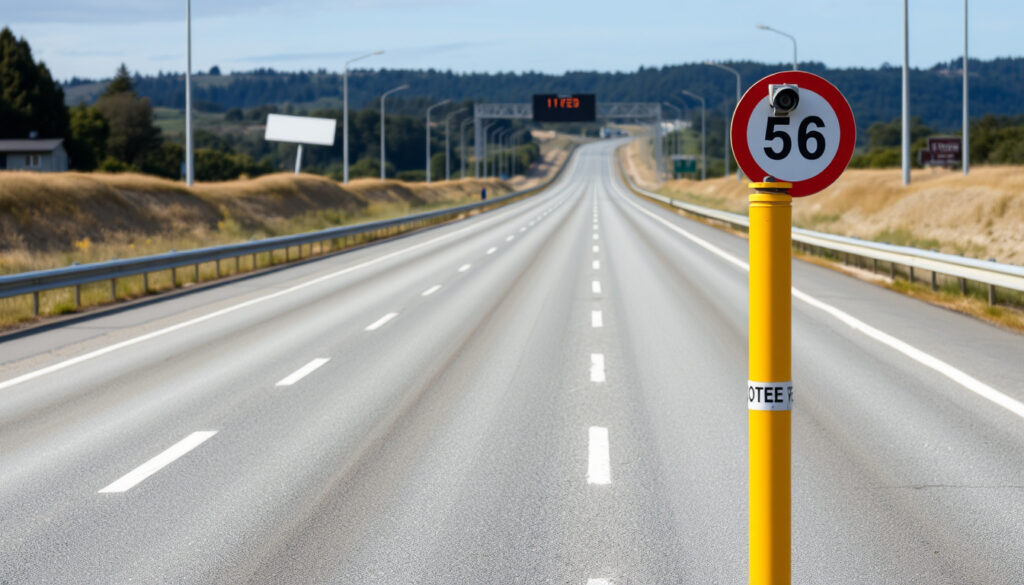
NZTA Speed Cameras Range: Minimum Distances & Fines
Anyone who has driven past a roadside van on the motorway has probably wondered how close it was to the speed limit drop, and whether that gap was allowed. The distance rules for NZTA speed cameras range are actually stricter than most people think, and they changed recently when the agency took over from Police. This guide explains the official minimum distances, how the different camera types work, and what a fine will cost you if you’re caught.
Fixed cameras active: Over 140 ·
Mobile camera minimum (≤70 km/h): 250 m ·
Mobile camera minimum (>70 km/h): 2 km ·
Fine range: $30 to $630
Quick snapshot
- NZTA publishes fixed camera locations with GPS coordinates (NZ Transport Agency Waka Kotahi (national road authority))
- Mobile cameras must be at least 250 m from speed limit drops on roads ≤70 km/h (New Zealand Police (enforcement policy))
- Average speed cameras calculate time between two points (NZ Transport Agency Waka Kotahi (official factsheet))
- Exact number of mobile cameras currently deployed (1News (national broadcaster))
- Specific future average speed camera sites beyond Whitford Road (1News (national broadcaster))
- Radar max detection range: 300 m reported, 150 m typical (1News (national broadcaster))
- NZTA took over speed camera enforcement from Police in 2025 (1News (national broadcaster))
- Average speed cameras activated on Whitford Road in 2025–2026 (1News (national broadcaster))
- More average speed zones on high-risk routes designated by NZTA
- Expansion of trailer-based cameras in temporary speed areas
One pattern stands out across all camera types: the range rules exist to catch sustained speeding, not to surprise drivers at the last second.
| Camera type | Range rule | Enforcement method |
|---|---|---|
| Fixed (spot speed) | No published minimum distance | Instant speed at one point |
| Fixed (red light) | Not used for speed enforcement | Red light infringement, $150 |
| Mobile | ≥250 m from limit drop if ≤70 km/h | Instant speed from vehicle |
| Mobile | ≥2 km from limit drop if >70 km/h | Instant speed from vehicle |
| Average speed | Two or more cameras along a route | Average speed between points |
| Trailer | Used in temporary and school zones | Instant speed, mobile deployment |
The implication: NZTA favors cameras that measure behavior over a stretch of road, not a single point, because that is what changes driver habits.
Where can I find a map of NZ speed camera locations?
NZTA publishes the full list of fixed safety cameras on its official website, broken down by region. The page includes the suburb, road or location name, camera type, and GPS coordinates for each unit (NZ Transport Agency Waka Kotahi (national road authority)). The list covers multiple regions, including Northland, Auckland, Waikato, and Otago, and it mixes both spot speed and red light cameras.
Official NZTA fixed camera list
- Fixed camera locations are published by region on the NZTA website
- Each entry includes GPS coordinates for precise mapping
- The list includes both spot speed and red light cameras
For mobile cameras, the situation is different. NZTA does not publish real-time locations for mobile units — the agency only states the general deployment rules (New Zealand Police (enforcement policy)). This means a live map of every camera in the country is not available from an official source.
Drivers who rely on detector apps against NZTA cameras face a losing game: the fixed list is public, but the mobile units move, and the range rules are designed to make them hard to spot in time.
Third-party mobile camera maps
Independent sites like NZ Speed Camera Map (community-run location database) attempt to map all fixed cameras in the country, but they are not official and may lag behind new installations. These maps are useful for planning, but they only cover fixed units — mobile cameras are deliberately excluded.
The implication: for a complete picture, you need both the official NZTA list for fixed cameras and an understanding of the mobile deployment rules, because the mobile fleet is the part that changes.
How do NZTA average speed cameras work?
Average speed cameras measure how long it takes a vehicle to travel between two or more cameras set some distance apart along a road (NZ Transport Agency Waka Kotahi (official factsheet)). The system records the time and date a vehicle passes the first camera, then does the same at the second, and divides the distance by the time to calculate the average speed.
Measurement between two cameras
- Cameras are set a known distance apart on the same route
- Each camera records time, date, and an image of the vehicle
- Average speed = distance ÷ time between the two points
Because the system measures average speed over a stretch, it catches drivers who slow down for a single camera and then speed up again. The fact that it records the number plate and time means there is no way to “beat” the system by braking at the camera itself.
Average speed cameras change driver behavior across the whole zone, not just at one point. That is why NZTA is expanding them on high-risk routes where crash data shows speed is a factor.
Data captured and calculation
Each camera captures the time, date, a digital image, and the number plate of every passing vehicle. The system then matches the same plate at each camera point and calculates the average speed. If that average exceeds the limit, an infringement notice is generated automatically (NZ Transport Agency Waka Kotahi (official factsheet)).
The pattern: this is not a radar trap, it is a time-and-distance calculation, which makes it far more reliable in court and far harder to contest.
What are the speed camera fines in New Zealand?
Speeding fines for camera-detected offences range from $30 to $630, depending on how far over the limit the vehicle was traveling (NZ Transport Agency Waka Kotahi (penalty schedule)). The bands are the same whether the offence is caught by a camera or issued by an officer, but there is one key difference: demerit points.
Fine tiers by excess speed
- Up to 10 km/h over the limit: $30
- 11–15 km/h over: $80
- 16–20 km/h over: $120
- 21–25 km/h over: $170
- 26–30 km/h over: $230
- 31–35 km/h over: $300
- 36–40 km/h over: $400
- 41–45 km/h over: $510
- 46–50 km/h over: $630
For speeds more than 50 km/h over the limit, the case escalates to a traffic offence notice and potential court charges (NZ Transport Agency Waka Kotahi (official factsheet)). These are not fines — they are summons-level offences that can carry bigger penalties.
The fine scale is designed to hit repeat offenders hard: a driver at 30 km/h over pays seven times more than someone at 10 km/h over, which is a deliberate deterrent, not a flat rate.
Demerit points for camera infringements
Camera-detected speeding does not carry demerit points, while officer-issued speeding tickets can (Get Me Off (legal guide for speed offences)). The monetary fine schedule is identical for both, but the demerit point difference is significant for drivers who hold a full licence and want to avoid licence suspension.
What this means: a camera fine costs money, but an officer-issued ticket can cost you your licence if you accumulate 100 demerit points in two years. That distinction matters for professional drivers.
Where are average speed cameras located in NZ?
Average speed cameras are currently active on Whitford Road in Auckland, a route that has a history of serious crashes. NZTA activated the cameras there as part of a broader safety program (1News (national broadcaster)).
Whitford Road average speed zone
- Whitford Road is a high-risk rural route in East Auckland
- Cameras measure average speed over the full zone
- Activation followed a history of fatal and serious injury crashes
The Whitford Road system works exactly as described: two cameras set apart, recording time and date to calculate average speed. NZTA’s Auckland office announced the activation on social media, explaining that the cameras work by measuring how long it takes to travel between two points along the road.
Other average speed camera routes
NZTA has not published a full list of future average speed camera sites, but the agency says new cameras are deployed in response to crash data on high-risk routes (NZ Transport Agency Waka Kotahi (national road authority)). The pattern is clear: if a road has a history of speed-related crashes, expect average speed cameras to appear there.
The implication: the network is expanding, and the criteria are data-driven — roads with high crash rates and known speed problems are the priority.
What are NZTA’s new safety cameras?
The 2025 transition from Police to NZTA brought a new camera fleet with a confirmed radar detection range. According to an official information report summarized by 1News, the radar maximum detection range for NZTA’s new cameras is 300 metres, with a typical detection range of 150 metres (1News (national broadcaster)).
Recent camera activations
- NZTA took over all speed camera operations from Police in 2025
- New cameras have a 300 m maximum radar range
- Typical detection range is 150 m
The range figure is significant because it tells drivers how far ahead a camera can catch them. At 100 km/h, a vehicle travels 27.8 metres per second — so a 150-metre detection range gives a driver less than 5.5 seconds between detection and the camera point.
The 300 m maximum range is a worst-case figure; the typical 150 m range is what drivers should expect. Counting on the lower figure is a gamble, because the camera’s radar can still catch you at double that distance.
Planned future camera sites
NZTA has not published a specific list of planned future sites, but the agency’s approach is consistent: new cameras go where crash data shows speeding is a contributing factor. The fixed camera locations page already lists cameras across Northland, Auckland, Waikato, and Otago, and the fleet continues to grow (NZ Transport Agency Waka Kotahi (national road authority)).
The pattern: NZTA is not just replacing Police cameras — it is expanding the network with new technology that measures average speed and covers a wider area per camera.
Timeline: how we got here
The speed camera system in New Zealand has shifted from Police enforcement to NZTA control, and the technology has evolved from single-point radar to average speed measurement.
- Pre-2025: Police operated all speed cameras, including fixed and mobile units
- July 2025: NZTA confirmed the radar range for its new cameras after taking over from Police
- 2025–2026: Average speed cameras activated on Whitford Road in Auckland
- July 2026: NZTA updated its fixed safety camera locations list
The transition matters because NZTA brings a different philosophy: fewer roadside surprises, more sustained enforcement over longer stretches.
What we know for sure — and what we don’t
Some facts about NZTA speed camera range are confirmed by official sources, while others remain unclear or are only reported by third parties.
Confirmed facts
- NZTA publishes fixed safety camera locations with GPS coordinates (NZ Transport Agency Waka Kotahi)
- Mobile cameras must be at least 250 m from speed limit reductions on roads ≤70 km/h (New Zealand Police)
- Mobile cameras must be at least 2 km from speed limit reductions on roads >70 km/h (New Zealand Police)
- Average speed cameras measure travel time between two or more points (NZ Transport Agency Waka Kotahi)
- Camera fines range from $30 to $630 depending on excess speed (NZ Transport Agency Waka Kotahi)
- Red light cameras are not used for speed enforcement (NZ Transport Agency Waka Kotahi)
What’s unclear
- Exact number of mobile cameras currently deployed
- Specific future average speed camera sites beyond Whitford Road
- Radar maximum detection range of 300 m is reported but not confirmed in official NZTA factsheets
- Typical detection range of 150 m is a reported figure, not an official specification
The balance here is honest: the enforcement rules are public and verifiable, but the operational details of the new camera fleet are still emerging.
What the sources say
Two different voices frame the camera program: the official regulator and the local announcement of new technology.
“The speed limit is 70km per hour or below are at least 2km away when the speed limit is above 70km per hour. Cameras may be set up less than 250m from…”
— NZ Transport Agency Waka Kotahi (official website, mobile camera distance rules)
“Average speed safety cameras work by measuring how long it takes you to travel between 2 cameras along a road.”
— NZTA Auckland (official Facebook announcement on Whitford Road cameras)
“Vehicles detected traveling more than 50 km/h over the speed limit may face traffic offence notices and possible court charges.”
— NZ Transport Agency Waka Kotahi (average speed cameras factsheet)
“Camera-detected speeding carries no demerit points, while officer-issued speeding tickets can carry demerit points.”
— Get Me Off (legal guide for speeding offences in New Zealand)
The pattern across these sources is consistent: the penalties are public, the range rules are precise, and the technology is designed for deterrence, not revenue.
Summary: what the range rules mean for you
The implication for New Zealand drivers: treat every speed limit reduction as a potential camera zone. NZTA calibrates camera placement distances by speed limit to maximize deterrence, not revenue. Mobile cameras stay at least 250 metres from speed limit drops on roads up to 70 km/h, and at least 2 kilometres on faster roads, which means the warning zone is built into the enforcement design. For a driver who occasionally creeps over the limit, the choice is simple: comply, or risk a fine that scales steeply from $30 to $630 and beyond. For Auckland drivers on Whitford Road, the average speed cameras mean there is no safe place to speed up between cameras — the whole zone is the trap.
nzta.govt.nz, facebook.com, govt.nz, nzta.govt.nz, speedcameras.co.nz, newswire.co.nz, policepolicy.nz
Frequently asked questions
Can I rely on speed camera detector apps against NZTA cameras?
No. NZTA publishes fixed camera locations, but mobile cameras move and are not listed in real time. Detector apps can warn you about fixed units, but they cannot keep up with the mobile fleet or the average speed cameras that measure you over a whole zone.
Do average speed cameras catch you for instant speeding?
No. Average speed cameras measure your average speed between two or more points. If you speed up between cameras and then slow down, the average may still be over the limit, and that is what triggers the infringement.
How long does it take to receive a speed camera fine in NZ?
NZTA typically sends camera infringements within a few weeks of the offence. The process involves reviewing the image, confirming the number plate, and issuing the notice by mail to the registered owner of the vehicle.
What happens if I don’t pay a speed camera fine?
If you do not pay a camera fine, the infringement escalates. The debt can be referred to a collection agency, and in some cases the matter can be taken to court, which adds court costs to the original fine.
Are NZTA speed camera trailers used in school zones?
Yes. Mobile camera trailers can be deployed in temporary speed areas, including school zones during drop-off and pick-up times. The 250-metre minimum distance rule applies to these deployments, but the camera can still be placed within the school zone itself.
Can I contest an NZTA speed camera infringement?
Yes. You can request a review of the infringement if you believe the camera was not correctly positioned or if the vehicle was not yours. The process is explained on the NZTA safety camera notices page, and you must respond within the timeframe stated on the notice.
Do fixed cameras flash at night?
Yes. Fixed cameras use infrared or visible flash to capture images in low light. The flash is bright enough to illuminate the number plate, which is why the camera can operate 24 hours a day.
More related posts
 AA Driving Test 35 Questions: Pass Mark, Free Practice
 How to Draw Lips: Step-by-Step Guide for Beginners (with Pencil)
 ANZ NZ Online Banking – Login, Setup and Features Guide
 Australia vs England Cricket: Ashes 2025-26 Schedule & Results
 Cheap Caravans for Sale NZ Private Under $10,000 – Best Platforms and Buying Guide
 New Zealand Work Visa 2026: Requirements, Cost & In-Demand Jobs
 Stop Shoes from Blistering: Top Expert Tips
 Samoa vs Tonga 2025 NZ Time – Kick-off Schedules for Kiwis