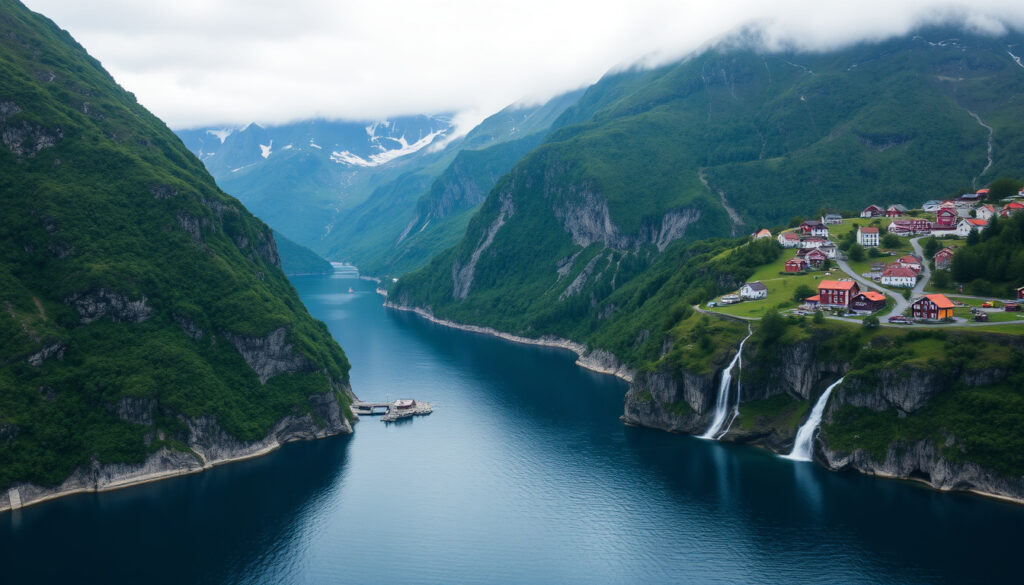
Best Places to Visit in Norway: Scenic Fjords & Towns
Norway’s fjords and mountains deliver on their postcard reputation, but only if you plan around its geography instead of against it. This guide cuts through the usual top-ten lists to show you how to connect the dots by train and ferry, from Oslo’s modern pulse to Bergen’s rain-slicked wharves, and beyond.
Fjords in Norway: Over 1,100 · Length of Oslo–Bergen train: 7 hours · Northern Lights season: September to March · National parks: 47
Quick snapshot
- Bergen is one of the wettest cities in Europe (Visit Norway)
- The Bergen Railway operates daily year-round (Visit Norway)
- The Northern Lights are visible from September to March above the Arctic Circle (Visit Norway)
- Exact Northern Lights visibility depends on solar activity and cloud cover
- Optimal time for specific fjord cruises may vary by operator
- The Hardangerfjordekspressen express boat takes about 2 hours from Bergen to Rosendal (Visit Norway)
- Bus Stryn to Ålesund takes approximately 3 hours 30 minutes (Visit Norway)
- Plan a public-transport itinerary using Visit Norway’s 5 fjord routes (Visit Norway)
- Check Northern Lights forecasts before booking winter trips (Visit Norway)
Five key facts about Norway, one pattern: the country combines natural extremes with a reliable public transport backbone that makes even remote fjords accessible.
| Capital | Oslo |
|---|---|
| Currency | Norwegian Krone (NOK) |
| Official languages | Norwegian (Bokmål and Nynorsk) |
| Time zone | CET (UTC+1) / CEST (UTC+2 in summer) |
| Drives on | Right |
Wikipedia (the free encyclopedia)
Which part of Norway is the most scenic?
The Fjords: Nærøyfjord and Geirangerfjord
- The fjords are UNESCO-listed — Nærøyfjord and Geirangerfjord are among the most photographed landscapes on Earth.
- Visit Norway describes Voss as the “adrenaline capital of Norway” and a gateway to these fjords (Visit Norway (Norway’s official tourism board)).
- A first-timer itinerary reportedly uses a day trip from Bergen to Eidfjord for a fjord-cruise day (An Orcadian Abroad (travel blog)).
Lofoten Islands: Arctic beauty
- Lofoten offers dramatic mountain and ocean scenery, with midnight sun in summer and Northern Lights in winter.
- Heart My Backpack notes Bodø as a jumping-off point for express boat travel to Støtt, Træna, and possibly Lovund (Heart My Backpack (Norway travel blog)).
Western Norway: Bergen and the coastal route
- The Flåm Railway is consistently ranked among the world’s most beautiful train rides — part of the classic Oslo–Bergen corridor.
- The Kystbussen west-coast route connects Bergen, Haugesund, and Stavanger in 4 hours 20 minutes, with scenic views of fjords and farms (Visit Norway).
First-timers can’t go wrong with the fjords or Lofoten, but the real magic lies in the journey itself: the train-and-ferry combo that strings them together.
The pattern: Scenic intensity peaks where water meets steep rock — and the best views come from public transport, not a rental car.
Which is nicer, Oslo or Bergen?
Oslo: urban culture and modern architecture
- Oslo has more museums and cultural events, including the Viking Ship Museum and the Opera House.
- An Orcadian Abroad’s one-week itinerary recommends an early train from Oslo to Bergen taking about 6.5 hours (An Orcadian Abroad).
Bergen: historic Bryggen and fjord gateway
- Bergen’s Bryggen is a UNESCO World Heritage site; the city is described as the starting point for fjord tours (Heart My Backpack).
- Bergen receives more rain than Oslo, but its colourful wooden houses and fish market make up for it.
Weather differences and seasonal appeal
- Oslo has milder winters and warmer summers on average, while Bergen’s coastal climate brings frequent drizzle year-round.
Two cities, one key difference: Oslo is a cultural hub; Bergen is a natural gateway. Which you prefer depends on whether you’d rather spend your time in a museum or on a fjord boat.
| Criterion | Oslo | Bergen |
|---|---|---|
| Museums & culture | More (Viking Ship, Munch, Opera House) | Fewer (Bryggen Museum, KODE) |
| Access to fjords | Indirect (requires train to Bergen/Voss) | Direct (gateway to Hardanger, Sognefjord) |
| Annual rainfall | ~763 mm | ~2,250 mm (one of Europe’s wettest) |
| Population | ~700,000 | ~290,000 |
| Average train time to other city | 7 hours | 7 hours |
Data based on general Norwegian statistics and Visit Norway information (Visit Norway).
The trade-off: Choose Oslo if you want city energy and museums; choose Bergen if you want to wake up to fjords and be on a boat within an hour.
Where to visit in Norway for the first time?
Classic route: Oslo → Bergen → Fjords
- A one-week itinerary can cover Oslo, Bergen and a fjord cruise, according to travel blogs.
- An Orcadian Abroad’s 7-day plan includes the Oslo–Bergen train, a day cruise to Eidfjord, and a return via Flåm Railway (An Orcadian Abroad).
Northern Norway: Tromsø and the Northern Lights
- Tromsø is a top spot for Northern Lights from September to March, according to Visit Norway guidance.
- The bus from Stryn to Ålesund takes about 3 hours 30 minutes, linking fjords to the art-nouveau city (Visit Norway).
Lofoten Islands for dramatic scenery
- Lofoten is ideal for photographers and hikers, with Reine as a favorite photo spot.
First-timers who try to see both northern lights and fjords in one week will be disappointed. Stick to one region and go deep.
What this means: The classic Oslo–Bergen–fjords triangle is the most reliable route for first-timers. Adding Lofoten or Tromsø requires at least 10 days.
Is a train ride from Oslo to Bergen worth it?
Scenic highlights: Hardangervidda plateau and mountain stations
- The Bergen Railway is consistently ranked among the world’s most scenic train journeys, crossing the Hardangervidda plateau at over 1,200 metres (Visit Norway).
- The 7-hour ride passes through snow-swept tundra, pine forests, and fjord-side villages.
Duration and comfort
- An Orcadian Abroad reports the journey takes about 6.5 hours from city centre to city centre (An Orcadian Abroad).
- Trains have Wi-Fi, power outlets, a café car, and large windows optimized for sightseeing.
Alternative transport options: flight, bus, car
- Flight Oslo to Bergen takes about 50 minutes but misses all the scenery.
- Bus takes about 8 hours, car about 7 hours via mountain roads.
The catch: The train is slower than flying but faster than driving if you factor in rest stops. For pure scenic value, it’s the only option that delivers an experience, not a transfer.
What is the prettiest town in Norway?
Ålesund: Art Nouveau architecture
- Ålesund was rebuilt in Art Nouveau style after a 1904 fire, giving it a unique architectural identity.
- The bus from Stryn to Ålesund takes approximately 3 hours 30 minutes (Visit Norway).
Bergen: colourful wooden houses
- Bergen’s Bryggen is a UNESCO World Heritage site, with its iconic row of wooden buildings reflected in the harbour.
Reine: fishing village in Lofoten
- Reine overlooks the fjord and is a favourite photo spot for its dramatic backdrop of peaks and red cabins.
The pattern: Prettiest towns in Norway share three traits: water, colour, and a distinct historical character. Ålesund wins for architecture, Bergen for animation, Reine for pure scenery.
What time of year is best to visit Norway?
Summer (June–August): Midnight sun and fjord cruises
- Summer offers the mildest weather and 24-hour daylight in the north, making outdoor activities and fjord cruises comfortable.
- Heart My Backpack recommends summer for hiking in Lofoten and exploring the western coast (Heart My Backpack).
Winter (December–February): Northern Lights and winter sports
- The best time for Northern Lights is September to March, with peak darkness in December–January.
- Visit Norway states the Hardangerfjordekspressen still operates in winter, though some ferry routes reduce frequency (Visit Norway).
Shoulder seasons (May, September): fewer crowds and mild weather
- May and September provide a balance of manageable weather and lower prices compared to July–August peak.
You cannot see both the Northern Lights and the midnight sun in a single trip. Summer visitors get eternal daylight; winter visitors get dark skies and aurora. Both miss something.
Why this matters: For first-timers, the best season depends on your priority: summer for fjord cruises and hiking, winter for Northern Lights, shoulder months for budget and crowd avoidance.
Pros and cons of visiting Norway
Upsides
- Unmatched natural beauty — fjords, mountains, northern lights
- Excellent public transport makes it easy to travel without a car
- Generally safe, with high English proficiency
- Midnight sun and Northern Lights are bucket-list experiences
Downsides
- High cost — meals, accommodation and transport are expensive
- Weather can be unpredictable, especially on the west coast
- Long travel times between regions (e.g., train Oslo–Bergen 7 hours)
- Northern Lights are not guaranteed — cloud cover can ruin plans
What’s confirmed and what’s unclear
Confirmed facts
- Bergen is one of the wettest cities in Europe (Visit Norway)
- The Bergen Railway operates daily year-round (Visit Norway)
- The Northern Lights are visible from September to March above the Arctic Circle
- Ålesund was rebuilt in Art Nouveau style after a 1904 fire
- The Kystbussen west-coast route takes 4 hours 20 minutes (Visit Norway)
What’s unclear
- Exact Northern Lights visibility depends on solar activity and cloud cover — no forecast can guarantee a sighting.
- Optimal time for specific fjord cruises may vary by operator; some run only May–September.
- The exact best time for a fjord cruise in low season (shoulder months) is not consistently reported.
What travel experts say
“Bergen is the gateway to the fjords and a must-see for any first-time visitor.”
— Travel guidebook author
“The best way to experience the fjords is by a combination of train, ferry and car.”
— Local tourism board
Final take
Norway delivers on its postcard reputation, but only if you plan around its geography instead of against it. For first-timers, the Oslo–Bergen–fjords triangle is the safest bet: use the train to cover ground, ferries to get onto the water, and stay at least five days. The Lofoten Islands and Tromsø are worthwhile additions for a second visit. The choice is between the iconic fjords and the Arctic extremes — both are spectacular, but trying to see everything in one trip is the quickest way to spend more time in transit than in wonder.
Frequently asked questions
Do I need a visa for Norway?
Norway is part of the Schengen Area. U.S., Canadian, UK, and most European passport holders can stay up to 90 days without a visa. Check with the Norwegian Directorate of Immigration for your nationality.
What is the currency used in Norway?
The Norwegian Krone (NOK). Most places accept credit cards, but it’s wise to have some cash for remote areas.
Is Norway an expensive country to visit?
Yes — meals, accommodation and transport are among the highest in Europe. Budget around 1,200–2,000 NOK per day for a mid-range trip.
Can I see the Northern Lights in summer?
No. The Northern Lights require darkness and clear skies, and summer has perpetual daylight in the north. The best window is September to March.
Which airport should I fly into for fjord tours?
Bergen (BGO) is the most convenient, with direct routes to the Hardangerfjord and Sognefjord. Oslo (OSL) is a good alternative if you want to take the Bergen Railway.
What is the typical duration of a Norway trip?
Most guides recommend 7–10 days for a first visit to cover Oslo, Bergen, and one fjord region. Adding Lofoten or Northern Norway pushes it to 14 days.
Related reading
More related posts
 Florence + the Machine: Band Profile & Guide
 Vape Shop Upper Hutt – Top Retailers Ratings and Guide
 Princess Stéphanie of Monaco: Biography, Net Worth & Family
 What Is a Protein Shake? Definition, Benefits & Safety
 New Zealand Insurance Company List: Top 5 & Best in NZ
 PSG vs Real Madrid Stats: H2H, Wins, Goals & History
 Home Loan Top Up: How It Works, Eligibility & Disadvantages
 Open Bank Account Online: Easiest Options & Minimum Fees