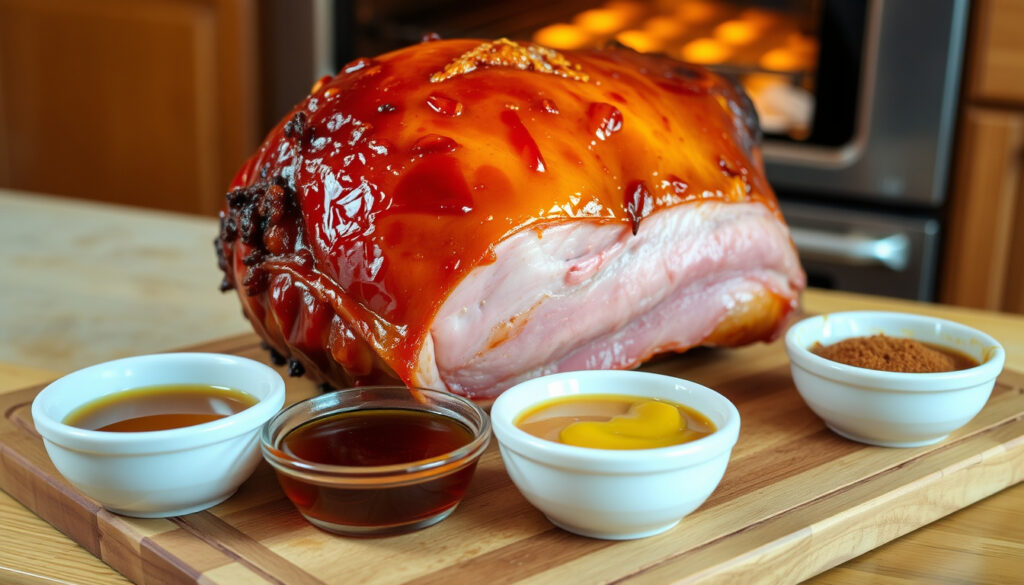
How to Glaze a Ham: Timing, Recipes & Mistakes to Avoid
There’s a moment when a perfectly glazed ham comes out of the oven — glossy, sticky, and irresistible. Food Network warns that applying the glaze too early leads to burnt sugar, so the window matters: the final 30 minutes of baking. Master that timing, pick a glaze that sticks, and you’ll get a caramelized crust every time.
Average number of glaze ingredients: 3-5 ·
Typical glaze baking temperature: 350°F (175°C) ·
Most common glaze base: Brown sugar and honey ·
Total glazing time range: 15–30 minutes
Quick snapshot
- Glaze is best applied in the last 30 minutes of cooking (Food Network)
- Brown sugar thickens when heated, helping the glaze set (Food Network)
- Mustard acts as an adhesive so the glaze clings to the meat (Food Republic)
- Whether adding water to the pan affects glaze consistency
- Optimal scoring depth for fat rendering
- Total baking time: 15–18 minutes per pound at 350°F (Kristine’s Kitchen Blog)
- Glazing window: last 30–45 minutes of baking (Jess Pryles)
- Baste every 15 minutes for a glossy, sticky finish (Food Republic)
- Let the ham rest 15 minutes before carving
- Serve warm or at room temperature
Five key at-a-glance values, one theme: the glaze window is short but decisive.
| Fact | Value |
|---|---|
| Most popular glaze base | Brown sugar + honey + mustard (Food Network Kitchen) |
| Average glazing time | 30 minutes (last phase of baking) (KitchPrep) |
| Common glaze thickener | Brown sugar |
| Ideal glaze temperature | 350°F (175°C) |
| Number of glaze layers | 2–3 (Fabulessly Frugal) |
| Recommended internal temp (fully cooked ham) | 140°F (60°C) (Kristine’s Kitchen Blog) |
| Finish condition | Uncovered, baste every 5–15 minutes |
What is the best way to glaze ham?
Preparing the ham surface
Before a single brush stroke, score the fat in a diamond pattern about 1/4-inch deep. KitchPrep notes that scoring allows the glaze to seep into the cuts and creates those sought-after caramelized ridges. If the ham has a rind, remove it first, leaving a thin layer of fat.
Applying the first layer
Heat the ham covered (with foil) for most of its cooking time. About 30 to 45 minutes before the target internal temperature, remove the foil and brush on the first coat of glaze. Food Network advises against applying glaze any earlier: the sugar will burn before the meat is fully heated.
Re-glazing during baking
Return the ham to the oven uncovered and brush another layer every 15 to 20 minutes. Food Republic calls this “the secret to a glossy, sticky finish.” Some cooks prefer a tighter cadence — every 5 to 10 minutes — for an even thicker crust.
A home cook who skips the scoring and starts glazing at the wrong time faces two distinct failures: a pale crust or a blackened sugar shell. The 30-minute rule is your insurance.
Do you put glaze on ham before or after cooking?
Glazing a raw ham vs. pre-cooked ham
Most hams sold in supermarkets are already fully cooked or “cook-before-eating.” For a pre-cooked ham, the goal is reheating to 140°F internal, not cooking from raw. KitchPrep advises waiting until the ham reaches about 110 to 115°F before applying any glaze. For a fresh (raw) ham, start glazing when the internal temp hits 120°F.
The final 30-minute rule
Regardless of ham type, the glaze always goes on in the final phase. Food Network Kitchen simmers its glaze until reduced by half, then brushes it on when the ham is 30 minutes from done. That late application gives the sugar enough heat to caramelize without burning.
Why late application prevents burning
Sugar begins to burn at around 320°F. The typical 350°F oven exceeds that threshold, so only a thin layer of glaze exposed for a short time can achieve caramelization without turning bitter. Snake River Farms recommends heating glaze ingredients on the stovetop first until the sugar dissolves and the mixture thickens, then applying to the hot ham.
The implication: glaze timing isn’t negotiable. Apply too early and you get a crust of char; too late and the glaze stays runny.
What glaze should I use for ham?
3-ingredient brown sugar glaze
The simplest combination is brown sugar, honey, and Dijon or yellow mustard. Food Network calls this the “classic” base. The brown sugar provides the thickness, honey adds sweetness, and mustard delivers the tang that prevents the glaze from being cloying.
Easy honey mustard glaze
A step richer: honey, brown sugar, Dijon mustard, and a pinch of cloves. Delish simmers the mixture for 10 to 15 minutes until it reduces by about half, then paints it onto the ham in layers.
Christmas ham glaze variations
For holiday tables, add spices like cinnamon, allspice, or ginger. Food Network Kitchen includes orange zest, orange juice, soy sauce, vinegar, and cinnamon for a complex sweet-savory finish.
Maple glaze alternative
Substitute maple syrup for honey to dial back the sweetness and add a smoky note. RecipeTin Eats uses maple syrup, Dijon, and black pepper, baking the ham at 320°F (160°C) for a stickier result.
- Brown sugar + honey + mustard: simplest pantry option
- Honey + brown sugar + mustard + cloves: classic holiday mix (Delish)
- Maple syrup + Dijon + pepper: less sweet, more savory (RecipeTin Eats)
The trade-off: the higher the sugar content, the faster the glaze browns. Maple-based glazes give you a slightly wider window before burning.
How many hours to glaze a ham?
Total cooking time based on ham weight
Plan on 15 to 18 minutes per pound at 350°F for a fully cooked ham. Kristine’s Kitchen Blog recommends using a meat thermometer; pull the ham at 140°F internal temperature.
Glazing window: last 30–45 minutes
That means for a 10-pound ham cooking roughly 2.5 to 3 hours, the glaze goes on at the 2-hour mark. Jess Pryles suggests starting the glaze about 20 minutes before the end and reapplying every 5 minutes for a thick crust.
Basting frequency every 15 minutes
During the glazing phase, baste every 15 minutes. If the pan looks dry, Food Network Kitchen adds a splash of water to the bottom to prevent the drippings from burning.
The total “glazing time” isn’t the baking time — it’s the last half-hour. A cook who misinterprets “how many hours to glaze” and slathers glaze at the start will end up with a charred exterior and undercooked interior.
What are some common ham glaze mistakes?
Applying glaze too early
This is the most frequent error. Food Network explicitly warns that early application causes the sugars to burn before the ham finishes cooking.
Not scoring the fat
Without scoring, the glaze sits on top of the fat layer and slides off. KitchPrep recommends cutting through the fat — not into the meat — in a diamond pattern so the glaze can penetrate and caramelize in the cuts.
Using too much liquid
A runny glaze drips off and pools in the pan. Brown sugar acts as a natural thickener; Snake River Farms notes that simmering the glaze for about 15 minutes on the stove thickens it enough to cling.
Skipping basting
One coat of glaze rarely produces the glossy, sticky finish people expect. Food Republic says multiple thin coats, each baked on for 5–10 minutes, build the crust.
Clarity check
Confirmed facts
- Glaze is best applied in the last 30 minutes of cooking (Food Network)
- Brown sugar thickens when heated, aiding adhesion (Snake River Farms)
- Mustard helps the glaze stick to the meat (Food Republic)
- Finishing the ham uncovered yields a caramelized crust (Food Network Kitchen)
What’s unclear
- Effect of water in the pan on glaze consistency — no controlled tests available
- Optimal scoring depth for fat rendering — advice ranges from 1/8 to 1/4 inch
“Mix together the mustard, honey and sugar, then generously brush half over the ham. Roast for 15 mins, then brush with the remaining glaze.”
BBC Good Food — Glazed Ham Recipe
“Remove rind from ham; slather with maple glaze then bake for 2 hours, basting with more glaze every 20 to 30 minutes.”
RecipeTin Eats — How to Make Glazed Ham
“The best ham glaze is all about the layer. Brush on a coat, let it set for 10 minutes and repeat.”
Delish — How to Cook a Ham
For the home cook preparing a holiday centerpiece, the choice is clear: score the fat, wait until the final 30 minutes, apply thin coats every 15 minutes, and pull the ham at 140°F. Anything else risks a burnt crust or a wet, unset glaze.
Frequently asked questions
Can I glaze a ham without honey?
Yes. Use maple syrup, agave, or additional brown sugar as substitutes. The glaze may be less sticky without honey’s natural viscosity.
Should I cover ham while glazing?
No. The ham should be uncovered during the glazing phase so the sugar caramelizes. Covering traps steam and prevents a sticky crust.
Can I use maple syrup for ham glaze?
Absolutely. RecipeTin Eats uses maple syrup, Dijon mustard, and pepper for a less sweet, smokier finish.
How do I store leftover glaze?
Store in an airtight container in the refrigerator for up to a week. Reheat gently on the stove or microwave before reusing.
Is it necessary to score the ham before glazing?
Yes. Scoring creates channels for the glaze to penetrate and allows the fat to render, resulting in better caramelization. KitchPrep recommends a 1/4-inch deep diamond pattern.
What internal temperature should the ham reach?
For a fully cooked ham, reheat to 140°F (60°C) at the center. For a fresh ham, cook to 145°F (63°C) and rest before serving.
Can I glaze a ham the day before serving?
You can prepare and apply the glaze, then refrigerate the glazed ham. Reheat uncovered at 325°F to crisp the crust, but expect a less glossy finish than freshly glazed.
More related posts
 Auckland Airport Rental Cars: Compare Prices & Fees
 Herald Morning Quiz Today: How to Play
 Porsche 911 Turbo S – 2026 Price, Specs and Performance
 Good Cop Bad Cop – How the Technique Works
 ANZ Term Deposit Rates 2025: Current Rates & Comparison
 Southern Lights New Zealand: Viewing Guide & 2026 Forecast
 Hear Me Out Characters: Best, Weirdest & Tier List Guide
 Hawkes Bay Marathon 2025: Start Times, Route, Registration