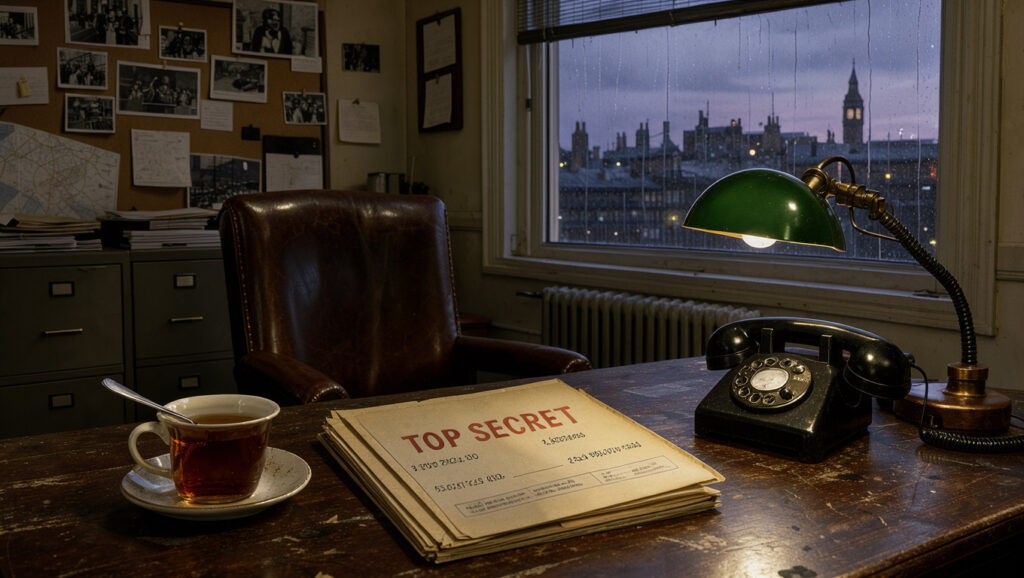
Tinker Tailor Soldier Spy: Plot, Mole, Setting, and Rating
The mole stays the same across three versions of Tinker Tailor Soldier Spy, but almost everything around him changes. Le Carré’s 1974 novel, the 1979 BBC miniseries and the 2011 film agree on who the traitor is and split over how the reveal lands, how long the story runs and where it ends.
Film release: 16 September 2011 in the UK and Ireland (Wikipedia (encyclopedia reference)) · Earlier adaptation: 1979 BBC miniseries (AdaptationDB (adaptation database)) · Story setting: 1973, Cold War England (Reason (libertarian magazine review)) · Lead role in the 2011 film: Gary Oldman as George Smiley (Reason, libertarian magazine review)
Quick snapshot
- The 2011 film runs 127 minutes (Christian Science Monitor (national newspaper review))
- Bill Haydon is the mole, and in the 2011 film a door swinging open delivers the reveal (Time Out (city listings and reviews))
- The film omits the New Delhi prison flashback of Smiley confronting Karla (Reason, libertarian magazine review) (Flickchart (film community blog))
- Karla’s backstory arrives through Oldman speaking to an empty chair, and the sources do not show Smiley capturing him (Flickchart (film community blog))
- The BBC miniseries aired from 10 September to 22 October 1979 (AdaptationDB, adaptation database) (Los Angeles Times (metro newspaper archive))
- The miniseries runs roughly 5.5 hours over six episodes on the Acorn Media DVD edition (Los Angeles Times (metro newspaper archive))
- The 2011 film replaces the final exposure with wordless scenes set to “La Mer” (Meadowparty (Keith Law’s review blog))
- The novel strongly implies Prideaux killed Haydon, and the supplied sources do not cover his later life (Wikipedia, encyclopedia reference) (Meadowparty (Keith Law’s review blog))
The dates and ratings are where the three versions most clearly diverge, so they belong in one table before the questions start.
| Fact | Value |
|---|---|
| Novel publication | 1974, by John le Carré (Wikipedia, encyclopedia reference) |
| Story setting | 1970s England, Cold War; 1973 in Reason’s summary (Reason, libertarian magazine review) |
| Earlier adaptation | 1979 BBC miniseries, seven parts (Wikipedia, encyclopedia reference) |
| Miniseries broadcast | Begins 10 September 1979, ends 22 October 1979 (AdaptationDB, adaptation database) |
| Film release, UK and Ireland | 16 September 2011 (Wikipedia, encyclopedia reference) |
| Film release, United States | 9 December 2011 (Los Angeles Times (metro newspaper critics)) |
| Film running time | 127 minutes (Christian Science Monitor, national newspaper review) |
| US rating | R (Christian Science Monitor, national newspaper review) |
| UK rating | 15, as listed by the LA Times and not confirmed elsewhere in the research (Los Angeles Times, metro newspaper critics) |
Who was the real mole in Tinker Tailor Soldier Spy?
In the novel, George Smiley hunts a Soviet mole inside the British service, and that mole is Bill Haydon (Wikipedia, encyclopedia reference). The 2011 film keeps Haydon as the mole, but the way each version delivers the reveal is where they split.
Who is Karla in Tinker Tailor Soldier Spy?
- Karla is the Soviet figure Smiley pursues, and the 2011 film drops the New Delhi prison flashback of their confrontation (Reason, libertarian magazine review).
- In the 1979 miniseries, Patrick Stewart plays Karla without speaking (Flickchart, film community blog).
- In the 2011 film, Karla’s backstory arrives through Gary Oldman speaking to an empty chair (Flickchart, film community blog).
How do the three versions handle the reveal?
- The novel reveals Haydon after interrogation, then has him killed before a planned exchange, with Prideaux strongly implied as the killer (Wikipedia, encyclopedia reference).
- The novel and the 1979 miniseries both stage the Haydon killing, while the 2011 film replaces the final exposure with wordless scenes set to “La Mer” (Meadowparty, Keith Law’s review blog).
- In the 2011 film, the mole is identified when a door swings open, and Time Out says some viewers may find the reveal underwhelming, which it describes as Le Carré’s intent (Time Out, city listings and reviews).
- The film moves the Prideaux rendezvous from Czechoslovakia to Budapest and shifts the Tarr backstory from Hong Kong to Istanbul, according to Time Out (city listings and reviews).
The 2011 film keeps the mole and trims the staging that makes the novel’s exposure feel earned. That trade is why critics split, and it explains why the ending reads as mood rather than arrest.
Upsides
- Keith Law found the 2011 film extremely faithful to the plot (Meadowparty, Keith Law’s review blog).
- At 127 minutes, the film fits into a single sitting, while AdaptationDB puts the 1979 miniseries at approximately 290 minutes (AdaptationDB, adaptation database).
Downsides
- Tony Macklin called the film a “fair-to-middlin’ film” and argued it received immense critical overrating (Tony Macklin (film critic’s site)).
- Ray Bennett argues the novel’s pleasures lie in atmosphere and character rather than plot, which a plot-led film struggles to carry (The Cliff Edge (film critic’s blog)).
What critics made of the 2011 film
Critics who liked the film and critics who did not are arguing about the same thing: how much the film trusts a viewer to keep up with its shifting timeframes and tangled plot.
“a superb new adaptation of the 1974 spy novel”
Manohla Dargis, The New York Times, quoted by Los Angeles Times (metro newspaper critics)
“condenses the book’s already thick atmosphere into pea-soup fog”
Dana Stevens, Slate, quoted by Los Angeles Times (metro newspaper critics)
“a choppy and unconvincing shadow of the celebrated 1979 BBC series”
Ray Bennett, The Cliff Edge (film critic’s blog)
“It was an aesthetic choice as much as a moral one.”
The film’s mole, as quoted in Christian Science Monitor (national newspaper review)
The trade-off: the film hands you the answer faster, but it shrinks the staging that makes the answer feel earned, and that is exactly where the reviews part company.
The pattern: the mole never changes across versions, so the real choice is how much staging a reader wants.
Why is Tinker Tailor Soldier Spy rated R?
The 2011 film is rated R in the US for violence, some sexuality and nudity, and language (Christian Science Monitor, national newspaper review). That label describes a category of content, which is different from a list of specific moments.
What violence does the film show?
- The US rating names violence first, followed by some sexuality and nudity, and then language (Christian Science Monitor, national newspaper review).
- The supplied sources describe the film’s violence only as a category and do not single out a particular scene.
- Critics describe the film’s tone as dense atmosphere rather than spectacle (Los Angeles Times, metro newspaper critics).
The implication: an R label here describes a mood more than a moment, so viewers who want to know what to expect will get categories rather than scenes.
What year is Tinker Tailor Soldier Spy set in?
The story is set in the 1970s, at the height of the Cold War, and Reason’s summary of the novel’s setting puts the action in 1973 (Reason, libertarian magazine review).
When was the novel published?
- : John le Carré publishes the spy novel (Wikipedia, encyclopedia reference).
- : the BBC miniseries begins broadcast (AdaptationDB, adaptation database).
- : the miniseries broadcast ends (AdaptationDB, adaptation database).
- : the film opens in the UK and Ireland (Wikipedia, encyclopedia reference).
- : the film opens in the United States (Los Angeles Times, metro newspaper critics).
Runtime is where the 1979 miniseries and the 2011 film diverge most sharply. The Los Angeles Times describes the miniseries as roughly 5.5 hours over six episodes on the Acorn Media DVD edition (Los Angeles Times, metro newspaper archive), while AdaptationDB gives approximately 290 minutes (AdaptationDB, adaptation database). The two figures differ by roughly forty minutes, so treat any exact runtime as a range.
The pattern: the setting stays fixed across versions, but the calendar and the runtime do not, so readers comparing the three should anchor to the dates rather than the length.
Was Tinker Tailor Soldier Spy based on a true story?
The novel is a work of fiction, a 1974 spy novel by John le Carré (Wikipedia, encyclopedia reference), and the film adapts it rather than documenting events. According to The A.V. Club (pop-culture review site), le Carré loosely drew the story from the real-life case of Kim Philby.
Is the novel based on real events?
- The 2011 film adapts the novel rather than documenting real events (Wikipedia, encyclopedia reference).
- The story is set at the height of the Cold War, the period that shapes its themes (Reason, libertarian magazine review).
- The research points to no single documented case behind the plot, so the Philby link describes texture rather than a record of events.
The catch: a loose inspiration is not a documented case. Readers looking for facts about real people should not treat the novel as a record of who did what.
Does Smiley ever catch Karla?
The supplied sources do not establish a capture in any version, so the honest answer is narrower than a yes or no. The 2011 film omits the New Delhi prison flashback in which Smiley confronts Karla and conveys the confrontation through Oldman’s dialogue instead (Reason, libertarian magazine review).
What is Karla’s role in the story?
- George Smiley is played by Alec Guinness in the 1979 BBC serial (Wikipedia, encyclopedia reference) and by Gary Oldman in 2011, a version Reason calls more physically fit than Guinness’s bookish Smiley (Reason, libertarian magazine review).
- In the 2011 film, Smiley swims, and the plot moves from London to Budapest, Istanbul and Moscow before returning to London (Vanity Fair (celebrity and film magazine)).
- Karla is the Soviet figure Smiley pursues, and the sources do not show that chase ending in capture in any version.
Confirmed facts
- The film runs 127 minutes (Christian Science Monitor, national newspaper review).
- The film is rated R in the US (Christian Science Monitor, national newspaper review).
- Bill Haydon is the mole in the novel and in the 2011 film (Wikipedia, encyclopedia reference).
- The film opened in the UK and Ireland on 16 September 2011 (Wikipedia, encyclopedia reference).
What’s unclear
- The UK rating of 15 appears in the LA Times listing, but the research has no second confirmation (Los Angeles Times, metro newspaper critics).
- Whether Bill and Jim were lovers: the supplied inputs do not establish this.
- Jim Prideaux’s fate after the story’s events: no supplied source covers it.
- Whether Smiley captures Karla: the answer depends on the version, and the sources do not settle it.
- Verified critic scores: no Rotten Tomatoes or Metacritic score for the 2011 film is backed by a verified source.
The catch: the film gives Smiley a fitter, swimming lead and a route across several cities, yet it leaves the Karla rivalry without a verified ending. Viewers who need a clean payoff will not find one in the evidence here.
The book, the miniseries and the film agree on who the mole is and disagree on almost everything around him, from runtime to the final scene. A reader who wants the full mole arc should start with the book, while a reader who accepts a shorter route ending on wordless scenes can start with the film.
Related reading: What Is an Idiom? Definition and Examples · Shetland Season 8: Cast, Killer and Ending Explained
Frequently asked questions
Is Tinker Tailor Soldier Spy worth reading?
For most readers, yes. The novel gives the full mole arc, which the 2011 film trims, and the film’s reveal arrives through a door swinging open (Time Out, city listings and reviews).
What happened to Jim Prideaux after Tinker, Tailor?
The supplied sources do not cover his life after the story’s events. They do say the novel strongly implies Prideaux killed Haydon (Wikipedia, encyclopedia reference).
What happened to Smiley after Smiley’s People?
None of the supplied sources cover what happens to Smiley after Smiley’s People, so this article cannot give a verified answer. The book itself is the place to check that.
Were Bill and Jim lovers in Tinker Tailor Soldier Spy?
The supplied inputs do not establish a relationship between them, so this article does not confirm one. The 2011 film does change how Peter Guillam is depicted, as Flickchart notes (Flickchart, film community blog).
Why did he shoot him at the end of Tinker Tailor Soldier Spy?
In the novel, Haydon is killed before a planned exchange, and Prideaux is strongly implied as the killer (Wikipedia, encyclopedia reference). The research does not give Prideaux’s motive, and the 2011 film replaces the final exposure with wordless scenes set to “La Mer” (Meadowparty, Keith Law’s review blog).
More related posts
 The Ordinary Vitamin C: Which Product Is Best? Uses & Mixing Tips
 Sports Bar Near Me – Top Tampa Bay Picks
 Auckland to Vancouver Flight Time: 13 Hours Non-Stop
 Cast of The Conjuring: Last Rites – Full Cast Guide
 Stop Shoes from Blistering: Top Expert Tips
 Best Football Gifts for Boys: Top Picks for Ages 5-10
 Best Unlimited Data Mobile Plan NZ: Compare Costs & Providers
 Drift Boss Math Playground: Free Play, Records & Tips