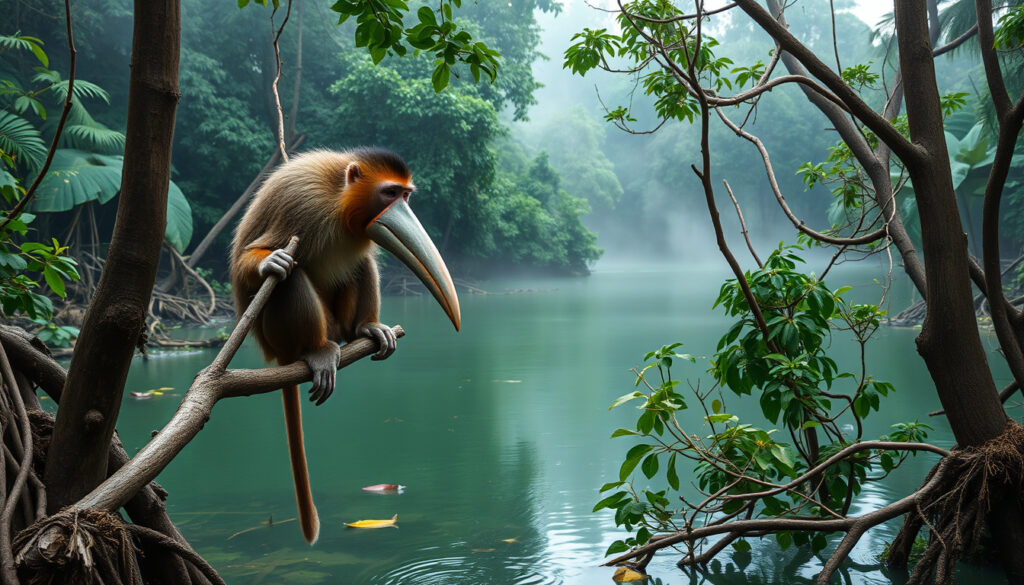
Monkey with Big Nose – Proboscis Facts, Habitat, Survival
Among the world’s primates, one species stands out for an unmistakable feature that has puzzled scientists and captivated observers for generations. The proboscis monkey (Nasalis larvatus) carries the largest nose of any primate—a pendulous appendage that can exceed 10.2 centimeters in adult males and dangle well below the mouth. This endangered primate, endemic to the island of Borneo, has evolved a face unlike any other monkey, transforming what might seem like a simple anatomical quirk into a complex instrument for survival.
Often nicknamed the “Dutch monkey” for its potbellied, big-nosed resemblance to colonial settlers depicted in historical paintings, the proboscis monkey represents one of evolution’s more striking experiments. Beyond its unusual appearance lies a sophisticated biological system: males wield their substantial noses as vocal amplifiers, social signals, and badges of dominance within complex harem structures. As habitat loss accelerates across Borneo’s mangrove forests, researchers are racing to understand this remarkable species before population declines become irreversible.
What Is the Monkey with the Big Nose?
The proboscis monkey is an arboreal Old World monkey species scientifically classified as Nasalis larvatus. Distinguished by the males’ oversized, pendulous noses, this primate ranks among Borneo’s most recognizable—and most endangered—mammals. Unlike other primates that rely primarily on visual displays or physical strength for social communication, the proboscis monkey has developed a nasal system that functions as both a sound amplifier and a status indicator.
Adult males develop the characteristic elongated nose as they mature, reaching lengths exceeding 10.2 centimeters that often drape below the mouth. Females and juveniles possess much smaller, upturned noses, though these remain proportionally larger than those of typical primates. The species exhibits extreme sexual dimorphism: males can reach up to 76 centimeters in body length and weigh as much as 22.68 kilograms, while females remain significantly smaller. This size difference reflects the species’ complex social organization centered on harem-based breeding systems.
Nasalis larvatus
Borneo rainforests and mangroves
Males have large pendulous nose
Endangered (IUCN)
Key Insights on the Proboscis Monkey
- The oversized nose amplifies vocalizations, creating distinct individual signatures for identification in dense forests
- Male nose size correlates with social status—harem males average 0.44 normalized nose size versus 0.21 for bachelor males
- The species excels at swimming, using webbed feet to cross rivers and forage in aquatic environments
- A folivorous diet specialized for tough, toxin-laden mangrove leaves has driven evolution of multi-chambered stomachs
- Population estimates range broadly from 7,000 to 50,000 individuals due to difficulties in accurate counting
- Habitat destruction from palm oil expansion and deforestation represents the primary extinction threat
- The species was first scientifically described in 1781, though indigenous communities had long documented its presence
| Fact | Details |
|---|---|
| Body Size | Males: 66-76 cm body length, up to 20 kg; Females significantly smaller |
| Nose Length | Males exceed 10.2 cm, pendulous, hanging below the mouth |
| Nose Function | Resonates vocalizations and signals status for mating |
| Diet | Primarily folivorous; mangrove leaves with specialized digestion |
| Social Structure | Harem groups (one dominant male with multiple females) or bachelor groups |
| Conservation | Endangered due to habitat loss from deforestation and palm oil |
| Swimming Ability | Excellent swimmers with webbed feet; aquatic travel is common |
| Group Size | Wild groups typically contain 10-30 individuals |
Why Do Proboscis Monkeys Have Such Large Noses?
The proboscis monkey’s most distinctive feature serves multiple evolutionary purposes that researchers have only begun to fully understand. A 2025 study from the University of Osaka revealed that the oversized nose functions as a sophisticated acoustic instrument, amplifying vocalizations to create distinct individual signatures that aid identification in dense forest environments.
Acoustic Amplification and Vocal Communication
When male proboscis monkeys produce their characteristic “brays”—loud, resonant calls that echo through mangrove forests—their pendulous noses dramatically enhance the sound. Computational simulations of nasal passages, validated through CT scans and acoustic tests on physical replicas, demonstrate that the nose’s unique shape boosts specific sound frequencies called formants. These resonant properties create vocal signatures as distinctive as human voices, allowing individuals to be recognized across considerable distances.
Research published in Science Advances confirms that the nasal architecture acts like a biological amplifier, with larger noses producing more pronounced formant frequencies. This acoustic advantage proves particularly valuable in the species’ preferred habitats—dense mangrove forests where visual contact remains limited and sound travels effectively through layered vegetation.
A 2025 study confirmed that proboscis monkey noses function as acoustic resonators, with the pendulous structure boosting specific sound frequencies that create individual vocal signatures. This helps males communicate and establish identity within dense forest habitats.
Social Status and Sexual Selection
Beyond acoustic function, the nose serves as a powerful visual signal within the species’ complex social hierarchy. The 2018 research by Koda and colleagues established that nose size functions as a “badge of status,” correlating directly with a male’s ability to maintain a harem group. Dominant males holding harems display normalized nose sizes averaging 0.44, while subordinate bachelor males average only 0.21.
This sexual dimorphism ties to mate guarding and competition. Larger noses signal male quality, status, and dominance to both potential mates and rival males. The visual display allows females to assess potential partners without physical confrontation, while deterring competitors through status signaling rather than aggressive encounters. The resonance properties of larger noses may also appeal to females, paralleling how nasalized vowels in human speech influence perceptions of attractiveness.
Skull Structure and Anatomical Adaptations
The proboscis monkey’s skull features specialized nasal cartilages that support this extraordinary appendage—structures unique among primates. Unlike canine species where elongated snouts serve as weapons for predation or defense, the proboscis monkey’s nose remains entirely non-aggressive. Instead, reinforced cartilaginous frameworks anchor the pendulous flesh, distributing the substantial weight while maintaining flexibility for vocal manipulation.
Where Do Proboscis Monkeys Live?
Proboscis monkeys exist as a Borneo-endemic species, found exclusively within the boundaries of three nations: Malaysia, Indonesia, and Brunei. Their distribution concentrates along the island’s northern coastal regions and river systems, with populations centered on the Malaysian states of Sabah and Sarawak, Indonesian Kalimantan, and Brunei Bay areas.
Habitat Preferences and Specialization
The species demonstrates strong habitat preferences centered on mangrove forests, coastal areas, and riverine environments. They rarely venture far inland, instead remaining tightly associated with the interface between land and water where mangrove ecosystems thrive. This specialization makes them particularly vulnerable to coastal development and explains why population centers often coincide with protected river delta systems.
These primates spend the majority of their lives in the forest canopy, descending primarily for water crossings and aquatic foraging. Their remarkable swimming ability—enhanced by partially webbed feet—allows them to cross wide rivers and move between forest fragments separated by water. This aquatic proficiency distinguishes them from most primates and shapes their ecological niche within Borneo’s wetland environments.
Geographic Distribution and Population Concentrations
Current population distributions reflect historical habitat patterns now fragmented by agricultural expansion. Protected areas including reserves in Sabah and Kalimantan maintain core populations, though these exist as isolated patches within a matrix of palm oil plantations and degraded forest. The species’ inability to survive away from watery, forested habitats limits their capacity to adapt to landscape changes that other primates might weather.
Proboscis monkeys depend almost entirely on intact mangrove and riverine forests. Their habitat specificity means that even moderate forest disturbance can eliminate local populations, making protected area networks critical for species survival.
What Do Proboscis Monkeys Eat?
The proboscis monkey’s digestive system represents one of the most remarkable adaptations among primates. As strict folivorous specialists, they consume tough mangrove leaves that prove unpalatable and often toxic to most other primates. This dietary specialization has driven evolution of an elaborate multi-chambered stomach system capable of breaking down heavily defended plant materials.
Digestive Adaptations and the Potbelly
The species’ characteristic potbellies serve not as fat reserves but as visible evidence of their specialized digestive chemistry. Multi-chambered stomachs house symbiotic bacteria that ferment cellulose and neutralize the toxic compounds found in mangrove foliage. This fermentation process resembles that of ruminants like cattle, representing a striking case of convergent evolution between primates and hoofed mammals.
The digestive apparatus allows proboscis monkeys to extract nutrients from plant materials that competitors cannot process. Young mangrove leaves, shoots, and occasional fruits supplement the leaf-heavy diet, but the core nutritional strategy centers on leaf fermentation. This adaptation opened an ecological niche that few competitors could exploit, allowing the species to thrive in wetland environments where fruit-eating primates would struggle to find adequate nutrition.
Foraging Behavior and Aquatic Feeding
Despite their arboreal nature, proboscis monkeys readily forage in and around water. They swim to reach aquatic vegetation, sometimes feeding while partially submerged. This behavioral flexibility supplements their leaf-based diet with occasional aquatic plants and invertebrates. Groups typically feed in the morning and late afternoon, resting during the hottest midday hours in shaded canopy locations.
Proboscis Monkey Timeline
The scientific understanding of proboscis monkeys has evolved significantly since their first formal description, with research accelerating as conservation concerns intensify.
- 1781 – Species first scientifically described by European naturalists, establishing the binomial Nasalis larvatus
- Early 20th century – Field observations document unusual social structure and distinctive vocalizations
- 1970s – IUCN conservation assessments begin tracking population status and habitat trends
- 2000s onward – Palm oil expansion accelerates habitat loss, prompting increased research attention
- 2018 – Koda et al. publish landmark study on nose function and sexual selection in Science Advances
- 2025 – University of Osaka team releases computational acoustic analysis confirming vocal amplification function
What We Know vs. What Remains Uncertain
| Established Information | Remaining Uncertainties |
|---|---|
| Nose functions as vocal resonator, confirmed by acoustic modeling and CT scan validation | Precise mechanism of nasal formants during different call types requires additional study |
| Nose size correlates with harem-holding status through sexual selection processes | Whether females actively prefer larger noses or simply follow dominant males remains debated |
| Population declining from habitat destruction across Borneo | Exact population numbers disputed; estimates range from 7,000 to 50,000 individuals |
| Folivorous diet specialized for mangrove leaves with multi-chambered stomach | Full range of bacterial species involved in leaf fermentation not yet characterized |
| Endemic to Borneo; habitat limited to coastal and riverine forests | Historical range prior to human settlement not definitively established |
Biology and Ecology Context
The proboscis monkey represents a remarkable evolutionary experiment in primate diversification. As the sole surviving member of the Nasalis genus, this species diverged from other colobine monkeys millions of years ago, developing unique adaptations that allow it to exploit ecological resources unavailable to competitors. The mangrove specialist niche, previously untapped by primates, became the species’ exclusive domain.
Within Borneo’s ecosystem, proboscis monkeys play important roles as foliovores controlling vegetation composition and as prey for large predators like clouded leopards and pythons. Their dependency on intact mangrove forests makes them indicator species for wetland ecosystem health—populations decline as forests disappear, signaling broader environmental degradation that affects numerous other species.
Human activity has dramatically reshaped the landscape the proboscis monkey evolved to inhabit. Palm oil plantations, logging operations, and coastal development have eliminated the majority of historical mangrove habitat. The species’ specialized diet and habitat requirements leave little flexibility for adaptation, explaining why population declines have proven so severe and why recovery efforts face such challenges.
Expert Sources and Insights
“The prominent noses of proboscis monkeys play a crucial role in vocal communication, enhancing individual identity through acoustic resonance properties that create distinctive vocal signatures.”
— University of Osaka research team, Phys.org 2025
“Larger noses of harem males audiovisually advertise status to conspecifics, serving as a badge of status that signals dominance and reproductive fitness without physical confrontation.”
— Koda et al., Science Advances 2018
“Potbellies built for toxin-breaking feasts represent evolutionary marvels—their multi-chambered stomachs allow proboscis monkeys to extract nutrition from mangrove leaves that no other primate can digest.”
— One Earth, Species of the Week
Conservation and Viewing
The proboscis monkey’s future remains precarious despite growing conservation attention. The IUCN Red List classifies the species as Endangered, with populations continuing to decline as habitat conversion accelerates. Protecting the remaining mangrove forests of Borneo represents the single most effective conservation intervention currently available.
Several protected areas across Malaysian and Indonesian Borneo offer opportunities to observe wild proboscis monkeys in their natural habitat. River cruises through protected mangroves provide the most reliable viewing opportunities, with habituated groups often visible in forest canopy along watercourses. Wildlife tourism centered on proboscis monkey viewing generates economic incentives for local communities to protect rather than convert forest habitat.
Supporting organizations working on Borneo conservation provides another avenue for contributing to species survival. These groups work on habitat protection, scientific research, and community engagement to reduce threats and promote sustainable land use in proboscis monkey habitat areas.
The Monkey with the Big Nose: A Summary
The proboscis monkey stands as one of Earth’s most distinctive primates, its pendulous nose representing a remarkable convergence of acoustic engineering and social signaling. Males amplify their calls through nasal resonance while simultaneously broadcasting status to potential mates and rivals, all while females and juveniles navigate the same mangrove forests with their own proportionally large but upturned noses. This species offers a masterclass in how sexual selection shapes anatomy, driving the evolution of features that seem absurd until their function becomes clear.
Yet the proboscis monkey faces an uncertain future. Borneo’s relentless deforestation for palm oil continues shrinking available habitat, fragmenting populations and limiting the species’ capacity to recover. The conservation challenges mirror those affecting countless other species, but the proboscis monkey’s extreme specialization makes it particularly vulnerable. What survives in Borneo tomorrow depends on decisions made today—choices that will determine whether this extraordinary primate remains a living presence or joins the growing list of species known only from photographs and preserved specimens.
For those interested in the intersection of art, culture, and natural history, the proboscis monkey’s nickname as the “Dutch monkey” offers fascinating connections. Just as observers have long drawn parallels between primate and human features, artists and writers continue finding inspiration in the animal kingdom’s diversity—exploring themes captured in resources like guides on depicting human forms and stories of dramatic natural landscapes.
Frequently Asked Questions
What is the scientific name for the monkey with the big nose?
The proboscis monkey’s scientific name is Nasalis larvatus. It belongs to the colobine subfamily of Old World monkeys and represents the only surviving species in its genus.
How big is a proboscis monkey’s nose?
Adult male proboscis monkeys can develop noses exceeding 10.2 centimeters (4 inches) in length, often hanging well below the mouth. Females and juveniles have much smaller, upturned noses.
Why do male proboscis monkeys have big noses?
Male proboscis monkey noses serve two primary functions: acoustic amplification for vocal communication and visual status signaling for sexual selection. Larger noses produce more resonant calls and indicate higher social status within harem groups.
Where can I see proboscis monkeys in the wild?
Proboscis monkeys are endemic to Borneo and can be observed in protected mangrove areas across Malaysia, Indonesia, and Brunei. River cruises through protected reserves offer reliable viewing opportunities.
Are proboscis monkeys endangered?
Yes, the IUCN Red List classifies proboscis monkeys as Endangered due to ongoing population decline from habitat loss, primarily through deforestation for palm oil plantations.
What do proboscis monkeys eat?
Proboscis monkeys are folivorous specialists that primarily consume mangrove leaves. Their multi-chambered stomachs contain bacteria that ferment and detoxify these tough, plant-defensive compound-rich materials.
Can proboscis monkeys swim?
Yes, proboscis monkeys are excellent swimmers and regularly cross rivers and swim between forest fragments. Their partially webbed feet assist with aquatic locomotion, and they sometimes forage while partially submerged.
How were proboscis monkeys discovered?
The species was first scientifically described in 1781 by European naturalists, though indigenous communities throughout Borneo had long documented and named the species before colonial contact.
More related posts
 Anytime Fitness St Johns: Costs, Hours & Amenities
 Contents Insurance for Students – Complete UK Guide
 ASB Raises Fixed Rates – Latest Changes and Bank Comparisons
 100 Pounds in kg: Calculator, Formula & Common Conversions
 What’s the Weather Tomorrow – NYC Highs Reach 83-85°F
 Antonov An-225 Mriya: Destruction, Status and Rebuild Plans
 Lotto’s $20M Jackpot: Mistakes, Tax & Superdraw
 Best Stourbridge Fish and Chips: Takeaways, Menus & Delivery