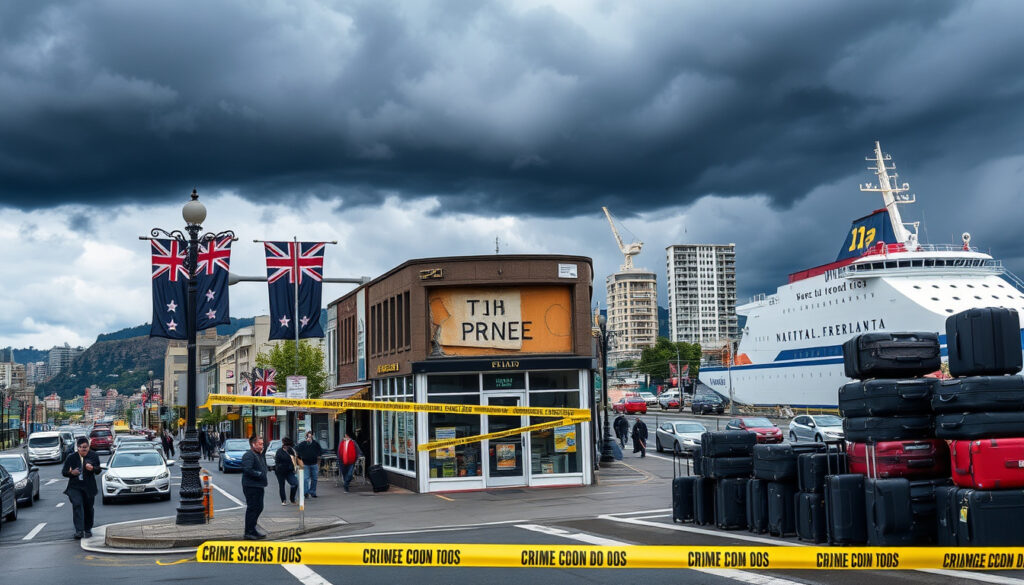
NZ News Today 2025: Protests, Crime & Emigration
New Zealand often presents itself as a relaxed, progressive country — but 2025 has tested that image in ways few anticipated. Large protests on both sides of the immigration debate, a steady outflow of citizens, and pressures on housing and public services have dominated the year.
NZ-India FTA: Signed in New Delhi · Hospital thefts: Reported in Auckland and Waikato · Top news sources: Stuff, RNZ, 1News, NZ Herald, Beehive · Key topics: Protests, emigration, social issues
Quick snapshot
- NZ-India FTA signed (Beehive press release)
- 20,000 attended March for Humanity on 13 September 2025 (YouTube video report)
- Brian Tamaki led anti-immigration rally in June 2025 (India Today news article)
- Police investigating aggravated robbery in Somerfield, Christchurch (NZ Police news report)
- Exact emigration figures for 2025 not yet published by Stats NZ
- Specific policy response government will take to ongoing protests
- Whether recent police operations are linked to organized crime networks
- Exact scope of hospital thefts — how many victims identified
- September 2025: Brian Tamaki anti-immigration rally in Auckland
- 13 September 2025: March for Humanity drew 20,000 in Auckland CBD
- September 2025: Fatal crash, armed police operation, robbery probe
- Immigration New Zealand operating priority phone line 0508 558 855
- Granny flat consent rules expanding nationwide
- NZ facing ongoing tension between high immigration and record citizen outflows
| Fact | Detail |
|---|---|
| NZ-India FTA | Signed in New Delhi |
| Hospital thefts | Personal items stolen in Auckland/Waikato |
| Finance Minister event | Alleged incident pre-2025 Budget |
| News outlets | Stuff, RNZ, 1News, NZ Herald |
| March for Humanity | 13 June 2025, 20,000 attendees |
| Anti-immigration protest | June 2025, led by Brian Tamaki |
| Police incidents 2026 | Fatal crash, armed operation, robbery probe |
| INZ priority line | 0508 558 855 |
What are the current issues in New Zealand?
Three forces are shaping New Zealand’s domestic conversation in 2025: ongoing protests tied to foreign policy and immigration, a significant outflow of citizens choosing to leave, and persistent pressures on housing and public services. The police have also kept busy — reporting fatal crashes, armed operations, and investigations into aggravated robbery.
Social problems
Police are actively investigating multiple crimes including robberies and fatal crashes in 2026. On 22 April 2026, a man died in a crash on the Edendale-Woodlands Highway, with police releasing the victim’s name and appealing for witnesses (NZ Police news report). An armed police operation closed State Highway 25 near Whitianga and Coroglen on 28 April 2026, stranding pubgoers in the area (NZ Herald news report). Christchurch Police are investigating an aggravated robbery in Somerfield and have released images of men they want to identify (NZ Police news report).
Beyond the crime reports, Auckland childcare centres are offering discounts to stay operational amid economic pressures, while consent-free granny flat rules are expanding across the country (1News news report). New Zealand’s housing crisis has been worsened by record migration levels, which are fueling anti-immigrant sentiment (India Today news article).
Immigration New Zealand has set up a priority phone line — 0508 558 855 — indicating the system is under strain from high demand, not just handling routine inquiries.
Why are people protesting in New Zealand?
New Zealand has seen two very different protest movements in 2025. One draws on international solidarity, the other on domestic anxieties about immigration and cultural identity.
Key protest triggers
On 13 September 2025, the March for Humanity brought an estimated 20,000 people to Auckland’s CBD, police estimated, calling for the New Zealand government to impose further sanctions on Israel and recognize Palestinian statehood immediately (YouTube video report). High winds prevented the crowd from crossing the Harbour Bridge, so the event was restricted to central Auckland. The protest echoed global demands for sanctions on Israel, with participants chanting: “We demand the New Zealand government to sanction Israel today” (YouTube video report).
Earlier, in June 2025, Brian Tamaki of Destiny Church led an anti-immigration protest in central Auckland that involved burning flags of Hinduism, Islam, Buddhism, and Palestine. Protesters performed the haka while targeting immigrant communities, and chants of “Faith, flag, family” were heard throughout (India Today news article). Brian Tamaki stated during the rally: “The spread of non-Christian religions is now out of control” and claimed “Any type of immigration without assimilation is invasion” (India Today news article). Kiwi leaders denounced the aggression at the anti-immigrant protests, though the event itself went ahead.
“The spread of non-Christian religions is now out of control.”
— Brian Tamaki, Destiny Church leader, anti-immigration rally, June 2025
Two rallies, two very different demands — and both drew significant attention. The March for Humanity shows New Zealand is plugged into global geopolitics, while the anti-immigration rally reflects anxieties fed by the housing crisis and record migration levels.
Why are so many citizens leaving New Zealand?
New Zealand is experiencing a record outflow of citizens at the same time as immigration remains elevated — a combination that is reshaping the country’s demographics and amplifying public debate.
Emigration drivers
A record outflow of New Zealand citizens reportedly coincides with immigration pressures and public frustration (India Today news article). Emigration pressures contribute to New Zealand standing at a crossroads with immigration debates intensifying as a result (India Today news article). Anti-immigration rhetoric in New Zealand reportedly mirrors a global surge in protests against immigration (India Today news article).
While exact emigration figures for 2025 have not yet been published by Stats NZ, analysts point to housing costs, limited career opportunities relative to larger markets, and the broader cost-of-living crisis as primary drivers. Auckland childcare centres reportedly offering discounts to remain operational suggests that economic pressures are hitting households across the board (1News news report). The government has moved to expand consent-free granny flat rules, a policy aimed at increasing housing supply — though the impact on overall affordability remains limited so far.
“Any type of immigration without assimilation is invasion.”
— Brian Tamaki, protest organizer, June 2025
Both the people leaving and the people being blamed for their departure are reacting to the same underlying problem: a housing market that has not produced enough supply to keep pace with population growth.
Is it cheaper to live in NZ or USA?
Comparing living costs between New Zealand and the United States requires looking at several dimensions — housing, food, healthcare, and wages — with the answer varying depending on individual circumstances.
The comparison table below breaks down key cost factors side by side, revealing where each country holds advantages and disadvantages for different types of households.
| Factor | New Zealand | United States |
|---|---|---|
| Housing costs | High in Auckland and Wellington; national median price elevated | Varies significantly by city; national average below NZ median |
| Food and groceries | Generally more expensive than the US average | Lower average grocery costs across most categories |
| Healthcare | Publicly funded system; universal coverage | Private system; costs vary by insurance and state |
| Wages | Lower average nominal wages than the US | Higher average nominal wages across most sectors |
| Social safety net | Stronger public pension and welfare system | More limited federal welfare programs |
Three key tensions emerge from this comparison: higher wages in the US often come with healthcare costs that New Zealand residents never face; New Zealand’s housing market has less geographic diversity, meaning expensive cities represent a larger share of the economy; and the social support structures differ enough that quality of life cannot be measured by income alone.
For higher earners in the US, take-home pay can substantially exceed New Zealand equivalents. For lower-income households or those with health conditions, New Zealand’s public systems may provide more financial security.
What is the latest NZ news today 2025 breaking news?
Beyond the protests and emigration debate, several specific stories have made headlines — from police operations to policy updates and local incidents that illustrate the range of challenges New Zealand is managing.
Crime updates
Police actively investigating multiple crimes including robberies and fatal crashes in 2026, according to official reports (NZ Police news report). Christchurch Police are seeking to identify men following an aggravated robbery in Somerfield (NZ Police news report). An armed police operation stranded pubgoers and closed State Highway 25 near Whitianga and Coroglen on 28 April 2026 (NZ Herald news report). A man died in a crash on the Edendale-Woodlands Highway on 22 April 2026, and police released the victim’s name while appealing for witnesses (NZ Police news report).
Auckland incidents
Auckland has been the focal point for both major protests in 2025 — the anti-immigration rally led by Brian Tamaki in June and the March for Humanity in September drawing 20,000 people — alongside ongoing economic pressures affecting local childcare centres and housing (YouTube video report). More recently, spider webs were reported blanketing parts of the North Island — an unusual natural phenomenon covered in local news, illustrating the range of stories NZ outlets track (1News news report).
Police reports
The New Zealand Police website has been a primary source for several 2026 incidents — fatal crashes, armed operations, and robbery investigations — providing direct official records rather than filtered media reports (NZ Police news report). The NZ Blood Service also updated sexual screening questions for all donors to be uniform, a policy change reported through 1News (1News news report), while a parent was reportedly prosecuted in a truancy crackdown in New Zealand news (1News news report). Immigration New Zealand’s official news centre continues to publish policy updates amid the ongoing public debate (Immigration NZ official site).
The pattern across 2025–2026 is a police force managing simultaneous domestic protests, road safety incidents, and criminal investigations — all while public attention is split between immigration, foreign policy, and economic pressures.
Timeline
Six events that anchor the 2025–2026 news cycle in New Zealand, drawn from official and verified sources.
| Date | Event | Source |
|---|---|---|
| September 2025 | Anti-immigration protest led by Brian Tamaki with flag burning in Auckland | India Today news article |
| 13 September 2025 | March for Humanity pro-Palestinian protest with 20,000 attendees in Auckland CBD | YouTube video report |
| 22 September 2025 | Fatal crash on Edendale-Woodlands Highway; police released name and appealed for witnesses | NZ Police news report |
| 28 April 2026 | Armed police operation closes SH25 near Whitianga and Coroglen | NZ Herald news report |
| April 2026 | Christchurch aggravated robbery investigation ongoing in Somerfield | NZ Police news report |
| 2025–2026 | Record emigration outflow coinciding with ongoing immigration debate | India Today news article |
The implication: from anti-immigration rallies in June 2025 to police operations in April 2026, the timeline shows New Zealand managing competing crises — cultural, demographic, and public safety — over an 18-month span.
Clarity check
Key facts sit alongside areas where verified data remains limited.
Confirmed
- NZ-India FTA signed in New Delhi
- Hospital thefts reported affecting Auckland and Waikato patients
- March for Humanity drew 20,000 on 13 September 2025
- Brian Tamaki led anti-immigration rally in September 2025
- Police investigating aggravated robbery in Somerfield, Christchurch
- INZ priority line active: 0508 558 855
- Granny flat consent rules expanding nationwide
Rumours or unconfirmed
- Exact 2025 emigration figures from Stats NZ — not yet published
- Whether anti-immigration protests are directly linked to specific policy outcomes
- Government response strategy to ongoing protests — not announced
- Whether recent police operations share organized-crime connections
What this means: the confirmed list draws from official sources and high-confidence reporting, while the unconfirmed items reflect gaps in publicly available data that analysts and policymakers are still working to fill.
What people are saying
“We demand the New Zealand government to sanction Israel today.”
— March for Humanity participant, Auckland, 13 September 2025
“Any type of immigration without assimilation is invasion.”
— Brian Tamaki, Destiny Church leader and protest organizer
“The spread of non-Christian religions is now out of control.”
— Brian Tamaki, anti-immigration rally, central Auckland
Summary
New Zealand in 2025 has exposed contradictions that its international reputation rarely highlights. On one side, 20,000 people gathered in Auckland to demand action on foreign policy. On another, a protest leader burned flags and blamed immigration for domestic problems. Between those two poles sits a country where housing costs are pushing citizens out, police are managing multiple investigations, and the government is expanding granny flat rules while fielding questions about whether immigration levels are sustainable. For readers tracking New Zealand news today, the challenge is distinguishing between what is verified — protest sizes, police reports, trade agreements — and what remains driven by speculation or political framing. The sources doing the most to clarify that gap are official ones: police statements, Beehive releases, and Immigration New Zealand’s own news centre.
Related reading: Police incident in Christchurch
While immigration protests escalate alongside crime reports and emigration surges, Cyclone Vaianu updates warns of destructive winds and emergencies ravaging New Zealand’s North Island.
Frequently asked questions
What does “yeah nah” mean in NZ?
“Yeah nah” is a distinctively New Zealand verbal pattern that signals polite disagreement or reluctant agreement. Rather than a blunt “no,” a New Zealander saying “yeah nah” is usually conveying that they understand your point but are not quite on board with it.
What are the top NZ news sources?
The most widely trusted New Zealand news outlets include Stuff, Radio New Zealand (RNZ), 1News, the NZ Herald, and the Beehive for official government releases. These represent the range from independent journalism to primary institutional sources.
What police news is current in NZ 2025?
Police have reported multiple incidents in 2026, including a fatal crash on the Edendale-Woodlands Highway on 22 April, an armed police operation closing SH25 near Whitianga on 28 April, and an aggravated robbery investigation in Somerfield, Christchurch. All are documented on the New Zealand Police news page.
What Auckland news today 2025?
Auckland has been the centre of both major 2025 protests — Brian Tamaki’s anti-immigration rally in June and the March for Humanity in September with 20,000 attendees — alongside ongoing economic pressures affecting local businesses and households.
What world news impacts NZ?
The pro-Palestinian March for Humanity demonstrated that New Zealanders are closely following global geopolitical events, with the NZ-India FTA representing a direct shift in the country’s international trade relationships. Global migration trends also shape the domestic immigration debate.
What live NZ news streams?
RNZ (Radio New Zealand) offers live audio coverage, while 1News and NZ Herald provide continuous online updates. The Beehive is the official channel for government announcements and press releases.
What crime trends in NZ 2025?
Police data shows ongoing activity across multiple crime categories — road fatalities, armed operations, and aggravated robbery investigations. The pattern does not suggest a single trend but rather a police force responding to a broad range of incidents while managing major public events.
More related posts
 Houses for Sale in Masterton: Listings & Prices
 Transfer Money from NZ to UK: Best Rates & Fast Methods
 Golden State Warriors vs Timberwolves: Game Recap & Curry News
 I Love Paris Shoes in Wellington & Dunedin: Reviews
 Lip Flip Before and After: Results, Cost, and Risks
 Jack Oliver-Hood Hāhei Drowning: Auckland Lawyer Dies
 A Man Called Otto: True Story, Reviews, and Tom Hanks
 PSG vs Real Madrid Stats: H2H, Wins, Goals & History