Spanish Classes Online NZ: Compare Costs & Providers
Few things beat the satisfaction of ordering a coffee in Spanish and actually being understood. If you’re in New Zealand and ready to pick up the language, the good news is you don’t need to travel further than your living room — we’ve compared the top local online Spanish providers, their real costs, and the free resources that can supplement your learning.
Average cost for an 8-week beginner online course in NZ: NZ$180 (Spanish Institute) ·
Number of dedicated online Spanish schools in NZ: 3 major providers (Spanish Institute, Speak Spanish, Viva Spanish) ·
FSI estimate for professional fluency: 600–750 class hours ·
Percentage of high-frequency words in everyday Spanish: 80% of conversation uses only 20% of vocabulary (Pareto principle)
Quick snapshot
- Spanish is a Category I language for English speakers (U.S. Foreign Service Institute — government language training body)
- Spanish Institute offers 8-week online courses for $180 (Spanish Institute — NZ-based provider)
- Which free program works best depends on individual learning style
- Exact time to fluency varies by person and study consistency
- No clear timeline signal — this is a present-moment comparison, not a breaking news story
- More NZ providers may launch online Spanish offerings as demand grows
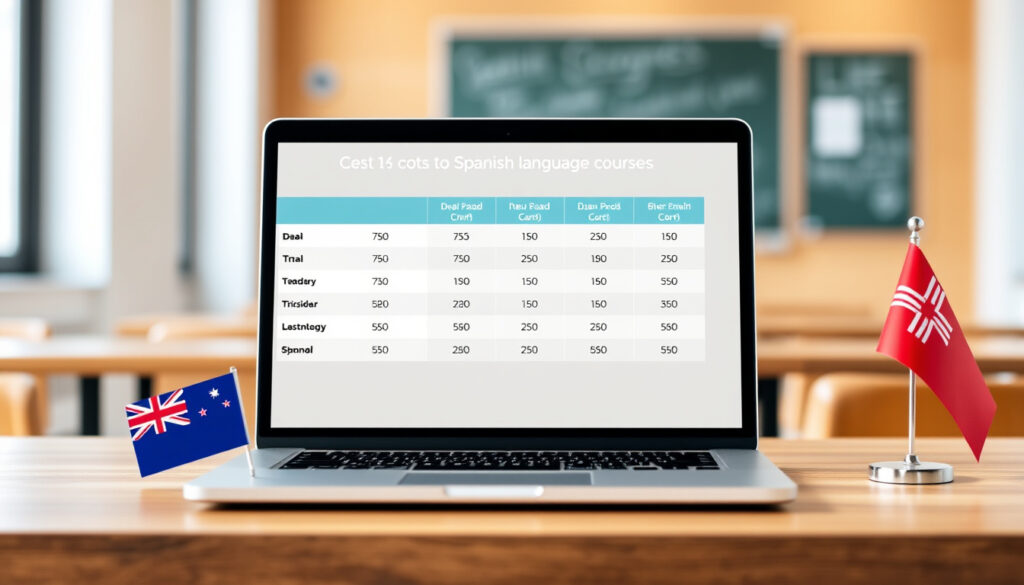
5 NZ-based online providers, one pattern: live-instruction courses cluster around $170–$200 for 8 weeks, while private tutoring and self-paced apps offer cheaper-per-month alternatives with less structure.
| Provider | Format | Price (NZ$) | Duration |
|---|---|---|---|
| Spanish Institute | Live online group (Zoom) | $180 | 8 weeks |
| Hispanic Club NZ | Live online group (Google Meet) | $170 | 8 weeks |
| Viva Spanish | Live online group (Zoom) | $195–$210 | 8 weeks |
| EarthDiverse | Live online (Zoom) + recordings | $200 (waged) / $175 (unwaged) | 8 × 1-hour sessions |
| Papanui High School (Adult Ed) | In-person (Christchurch) + online resources | $144 | 7 weeks |
The pattern: group courses from $170 to $210 per term offer a structured path with a live teacher, which suits most beginners — but the price gap is small enough that choice should hinge on schedule, teacher quality, and class size rather than cost alone.
How long does it realistically take to learn Spanish?
The U.S. Foreign Service Institute — government language training body classifies Spanish as a Category I language — the easiest group for native English speakers. They estimate 600–750 class hours to reach professional working proficiency. For a New Zealander studying 1–2 hours daily, that translates to roughly 6–12 months of consistent effort to hit a solid B1 level where you can hold conversations comfortably.
Can I become fluent in 3 months in Spanish?
Not realistically for most people. The 600–750 hour FSI benchmark means even an intensive 5-hour-per-day program would stretch beyond 3 months. What is achievable in 3 months: basic conversational ability, ordering food, introducing yourself, and understanding simple dialogue. Some learners do reach A2 or early B1 with disciplined daily practice, but full fluency in 3 months is a marketing promise, not a typical outcome.
What is the 80/20 rule for Spanish?
The Pareto principle holds that about 80% of everyday conversations use only 20% of the full vocabulary. In Spanish, focusing on the most common 500–1000 words — greetings, basic verbs, numbers, time expressions — lets a beginner understand and be understood surprisingly quickly. Apps like Memrise — language learning app with spaced repetition and Duolingo — freemium gamified language app structure their beginner tracks around this high-frequency vocabulary.
The takeaway: you don’t need 10,000 words to start speaking. Prioritise the common 20% and you’ll unlock 80% of what you hear in daily conversation.
What is the best free online program to learn Spanish?
For zero-cost options, several platforms offer strong beginner content. Duolingo — freemium gamified language app provides a free tier with structured lessons, while Memrise — language learning app with spaced repetition uses native-speaker video clips. StudySpanish.com — dedicated Spanish learning site with free grammar and pronunciation lessons offers free grammar and pronunciation drills — and it’s the resource Victoria University of Wellington — university with a dedicated language learning centre links to for its students.
You can also find free content on YouTube — channels like Butterfly Spanish — popular YouTube educator with clear grammar explanations cover beginner and intermediate topics at no cost.
Is there a 100% free Spanish learning app?
Yes, Duolingo — freemium gamified language app remains fully functional on its free tier — no payment required for the core course. Busuu — freemium language learning platform with community feedback also offers free content, though some features require a subscription. The catch with free apps: they work best as supplementary practice alongside a structured course, especially for speaking and listening confidence.
The reality: free apps are excellent for vocabulary building and daily habit, but paid courses provide the live feedback and conversation practice that move beginners toward real fluency.
What is the easiest way for an older person to learn Spanish?
For older learners, live online classes with a patient instructor tend to work better than self-paced apps alone. Spanish Institute — NZ provider with small-group Zoom classes offers small group Zoom sessions where you can ask questions in real time. Superprof NZ — tutor marketplace where 99% offer a free first lesson has tutors who offer the first lesson free, so you can test compatibility.
Self-paced apps like Duolingo — freemium gamified language app are accessible and low-pressure. Supplementing with Spanish-language TV shows, podcasts (try Radio Ambulante), or music builds passive listening without effort.
The pattern: older learners benefit most from a combination of live instruction for accountability and flexible self-study for repetition — and NZ providers clearly cater to this with evening class options.
For a retiree in Tauranga or a busy professional in Wellington, the biggest barrier isn’t course content — it’s schedule and confidence. Live online classes remove the commute and let you learn at your own kitchen table.
What is the hardest part of learning Spanish?
For English speakers, two areas consistently trip up learners. The subjunctive mood — used for doubt, emotion, and hypotheticals — has no direct equivalent in English, so it requires a mental shift. The rolled ‘r’ (perro vs pero) is physically difficult for many adults whose mouths haven’t learned the trill.
Accent-wise, the fastest and clearest speech is often Castilian Spanish — standard northern Spanish dialect with clear pronunciation, which is widely considered the easiest to follow for learners. Caribbean and Andalusian accents, with their dropped consonants and rapid delivery, are typically the hardest to understand at first.
What is the most difficult Spanish word to say?
Many learners struggle with ferrocarril (railroad) and otorrinolaringólogo (ear-nose-throat doctor). The repeated ‘r’ sounds in quick succession — especially the rolled ‘r’ followed by another — make them tongue-twisters even for intermediate speakers.
What is the hardest sentence to say in Spanish?
“El perro de San Roque no tiene rabo, porque Ramón Ramírez se lo ha robado” is a classic tongue-twister that combines the rolled ‘r’, repeated vowels, and quick consonant shifts. It’s a good drill for practising that trill.
What is the hardest Spanish accent to understand?
The Dominican and Cuban accents, along with the Andalusian accent from southern Spain, are often cited as the most challenging. They tend to drop final consonants, aspirate ‘s’ sounds, and speak at a faster pace.
What’s the easiest Spanish to understand?
Castilian Spanish from northern and central Spain, and the Colombian accent (particularly from Bogotá), are both praised for clear enunciation and slower rhythm. Many international Spanish media use a neutral Latin American accent for this reason.
What are 20 basic Spanish words?
- Hola (hello)
- Adiós (goodbye)
- Gracias (thank you)
- Por favor (please)
- Sí (yes)
- No (no)
- ¿Cómo estás? (how are you?)
- Bien (good/well)
- Agua (water)
- Comida (food)
- Amigo (friend)
- Familia (family)
- Casa (house)
- Libro (book)
- Escuela (school)
- Trabajo (work)
- Tiempo (time/weather)
- Dinero (money)
- Grande (big)
- Pequeño (small)
The implication: the hardest parts — subjunctive, rolled ‘r’, fast accents — are predictable. Knowing them in advance means you can target your practice, and every NZ course we reviewed dedicates class time to exactly these trouble spots.
The subjunctive grammar will frustrate you for weeks. But once it clicks, you unlock more natural expression — and NZ online classes with live instructors can guide you through that hurdle faster than an app alone.
What are the best Spanish classes online in NZ?
For New Zealanders, the choice comes down to three local providers with dedicated online offerings, plus community education options.
Spanish Institute
- 8-week online course: $180 (Spanish Institute — NZ-based provider with qualified teachers from Spain and Latin America)
- Live Zoom classes with small groups
- Teachers from Spain and Latin America
- Free materials included, no hidden contracts
Hispanic Club NZ
- 8-week online course: $170 (Hispanic Club NZ — online Spanish school with classes via Google Meet)
- Google Meet sessions
- Taught by expert teachers from Spain or Latin America
- Small class sizes, no membership fees
Viva Spanish
- 8-week beginner course: $195 (Viva Spanish — NZ-based Spanish school with private and semi-private Zoom lessons)
- Beginner 1 at $195; levels 2–4 at $210 each
- Price includes GST and written materials
- Private and semi-private Zoom lessons
EarthDiverse
- 8-week term: $200 (waged) / $175 (unwaged) (EarthDiverse — community language school offering live-streamed Zoom classes and recordings)
- Live Zoom classes plus video recordings posted 1–2 days after
- Term 1 2025 starts week of 10 February
Papanui High School Adult Education
- 7-week course: $144 (Papanui High School Adult and Community Education — Christchurch-based community education provider)
- In-person in Christchurch, plus online resources
- Part 1 starts Tuesday 11 February 2025; Part 2 starts Wednesday 12 February
Are there free Spanish classes online in NZ?
While no NZ provider offers a full free course, Victoria University of Wellington — university with a dedicated language learning centre provides free practice resources including StudySpanish.com links and Aula Internacional online exercises for self-guided learning. These are not structured classes, but they complement paid courses well.
What Spanish classes online in NZ are for adults?
All three major providers — Spanish Institute, Hispanic Club NZ, and Viva Spanish — target adults. EarthDiverse’s pricing explicitly offers a lower rate for unwaged learners, making it accessible regardless of income.
What Spanish classes online in NZ are for beginners?
Every provider listed above has a beginner track. Spanish Institute and Hispanic Club NZ specifically highlight beginner suitability, while Viva Spanish’s Beginners 1 course is designed for complete novices.
Are there Spanish classes in Auckland?
Yes, though online courses remove location restrictions. Spanish Institute, Hispanic Club NZ, and Viva Spanish all serve Aucklanders through their online platforms. For in-person options in Christchurch, Papanui High School’s community education programme offers a budget-friendly alternative.
What are the reviews of Spanish Institute NZ?
Spanish Institute emphasises qualified teachers from Spain and Latin America, small class sizes, and no hidden fees. As a Tier 2 provider with a longstanding NZ presence, it’s the most commonly cited option across Kiwi search results for structured online Spanish learning.
Free or cheap apps like Duolingo build vocabulary but don’t teach you to hold a conversation. A live instructor — even for just one term — provides the speaking practice and error correction that an algorithm can’t. For a Kiwi adult serious about speaking Spanish, the $170–$200 investment in a live course is the fastest path past “Hola, ¿cómo estás?”
Upsides
- Live instruction from qualified native speakers
- Affordable term pricing ($170–$210 per 8-week block)
- Small class sizes (under 12 students typically)
- No hidden fees or contracts at Spanish Institute and Hispanic Club
- Video recordings available at EarthDiverse for review
Downsides
- No fully free NZ-based course available
- Private tutoring (Superprof, Lingua Learn) costs $44–$85 per hour
- Some providers (Papanui) are location-specific for in-person
- Course schedules may not suit shift workers
Related reading: Spanish Institute online Spanish courses · Hispanic Club NZ online Spanish classes for beginners
vivaspanish.co.nz, coursecompare.co.nz, new.grabone.co.nz, nzvoice.nz, lingua-learn.nz
Frequently asked questions
How much do Spanish classes online cost in NZ?
Group courses range from $144 (Papanui High School, 7 weeks) to $210 (Viva Spanish, 8 weeks). The typical price is around $170–$200 for an 8-week beginner term. Private tutoring via Superprof averages $44 per hour (Superprof NZ — tutor marketplace with 99% offering free first lessons).
Are online Spanish classes effective?
Yes, when they include live interaction. Studies of language acquisition consistently show that real-time conversation practice with a fluent speaker accelerates progress far beyond app-only learning. NZ’s online providers all offer live video sessions, which replicate much of the classroom experience.
Can I learn Spanish online for free in NZ?
You can access free resources like StudySpanish.com, Duolingo, and YouTube, plus Victoria University of Wellington’s practice links. But there is no free structured course from an NZ provider — budget at least $170 for a proper live class term.
What qualifications do online Spanish teachers have?
Spanish Institute states its teachers are qualified and come from Spain and Latin America. Hispanic Club NZ similarly hires expert teachers. For private tutors on Superprof, qualifications vary — the platform’s value is that you can try a free first lesson to assess quality.
Do I need to buy a textbook?
Spanish Institute includes free materials. Viva Spanish includes written materials in its price. EarthDiverse provides resources digitally. Victoria University uses Aula Internacional textbooks for its own courses, but its free online practice resources don’t require a purchase.
How do I choose between group and private classes?
Group classes ($170–$200 per term) are best for structure, peer practice, and lower cost. Private lessons ($44/hour average on Superprof) suit self-directed learners who want personalised pacing. Many learners combine a group course with private tutoring for the fastest progress.
Is there a trial lesson available?
Superprof states 99% of its tutors offer a free first lesson. Among the group providers, you can usually enquire directly for a trial or introductory session — check their websites for details.
Are there evening classes for working adults?
Yes. Spanish Institute, Hispanic Club NZ, Viva Spanish, and EarthDiverse all offer evening sessions to accommodate working schedules. Papanui High School’s adult education programme also runs weekday evening classes for its Christchurch in-person option.
For a New Zealander starting from zero, the clearest path is a live online group course for $170–$200 to build foundational speaking confidence, supplemented by a free app for daily vocabulary practice. Private tutoring can accelerate progress once you’ve covered the basics. The choice matters: spending 8 weeks in a structured course with a qualified teacher is the difference between knowing 20 words and actually holding a conversation. A Kiwi learner in 2025 faces a simple decision: invest in one term of live instruction, or risk another year of app-based frustration.
More related posts
 Sending Money to Australia by Post – Legal Risks and Safe Alternatives
 USB-C to USB-C Cable: Uses, Speeds, and Buying Tips
 Filco Farm & Sport: Nelson Harley, Yamaha, Triumph Dealer
 b.box Lunch Box: Leakproof, BPA-Free, Whole Fruit Design
 Get a Free Business Insurance Online Quote in Ireland
 Tongariro Alpine Crossing Map: Distance, Time & Difficulty
 Download Free Logo Canva Freelogopng: Step-by-Step Guide
 Good Cop Bad Cop – How the Technique Works