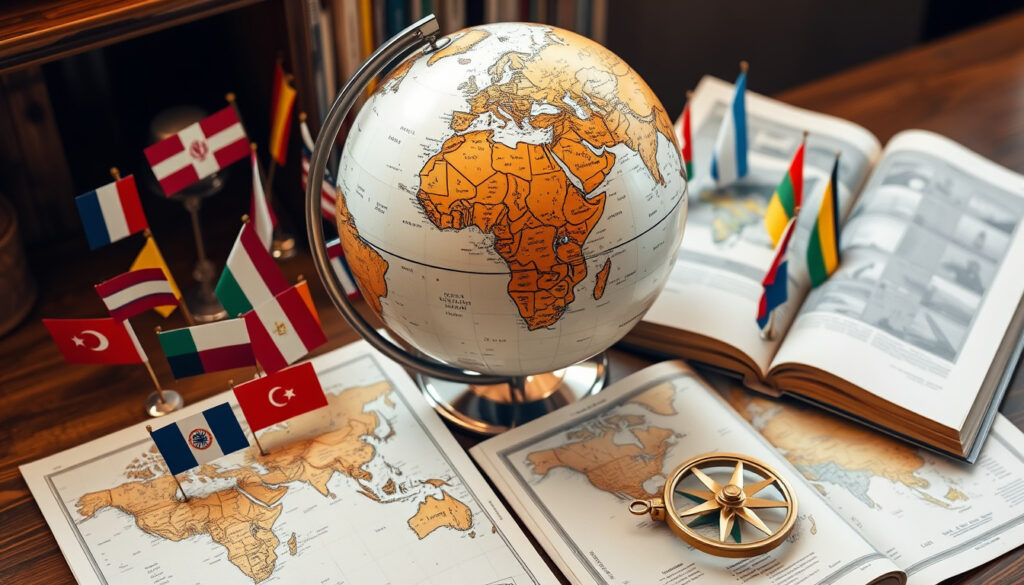
Countries of the World: Nations, Continents & Facts
Anyone who has tried to answer a simple question — “how many countries are there?” — knows the feeling: the map looks settled, but every atlas gives a slightly different number. The answer depends on whether you count UN members, observer states, or places that simply call themselves countries.
Recognized sovereign states: 195–197 (UN members + observers) ·
Newest country: South Sudan (2011) ·
Largest country by area: Russia (17.1 million km²) ·
Smallest country by area: Vatican City (0.44 km²)
Quick snapshot
- UN membership stands at 193; the two non-member observer states are the Holy See and the State of Palestine (U.S. Congressional Research Service (official U.S. legislative research agency)).
- ISO 3166 lists countries, dependent territories, and special areas — not just sovereign states (ISO 3166 Maintenance Agency (international standards body)).
- 1990 — East Germany dissolves (ISAN Registry (audiovisual identification standards)).
- ISO assigns new alpha-2 and alpha-3 codes after UN notification (ISO 3166 Maintenance Agency (international standards body)).
Six numbers settle most map arguments — if you know which list they come from.
| Fact | Value | Reference |
|---|---|---|
| Total UN member states | 193 | United Nations (official UN member-state list) |
| UN observer states | 2 (Vatican City, Palestine) | U.S. Congressional Research Service (official U.S. legislative research agency) |
| Newest UN member | South Sudan (2011) | U.S. Congressional Research Service (official U.S. legislative research agency) |
| Largest country | Russia (17.1M km²) | CIA World Factbook (U.S. government geographic reference) |
| Smallest country | Vatican City (0.44 km²) | CIA World Factbook (U.S. government geographic reference) |
| Number of continents (standard) | 7 | Common geographic convention |
Are the 195 countries?
Not exactly — but the confusion is understandable. The official UN roll has 193 member states (United Nations (official UN member-state list)). Add the Holy See and the State of Palestine, both non-member observers, and you get the number people often quote as 195 (U.S. Congressional Research Service (official U.S. legislative research agency)). The 195 figure is a practical compromise, not a legal definition.
How many sovereign states are there?
- The baseline is UN membership: 193 member states (United Nations (official UN member-state list)).
- The U.S. Congressional Research Service identifies two non-member observer states: the Holy See and the State of Palestine (U.S. Congressional Research Service (official U.S. legislative research agency)).
- That arithmetic gives you 195 — the most common “official-looking” total.
What about non-UN members?
- ISO 3166 lists 249 official short names, but that list includes dependent territories and special areas (ISIN Organization (registered codes reference)).
- The ISO stresses that a country code is not proof of independent statehood (ISO 3166 Maintenance Agency (international standards body)).
Which counting system should you trust?
Different lists answer different questions: “Who is a UN member?” and “What appears on an international code list?” are not the same.
Three counting systems, one pattern: each step adds territories and special cases.
| Counting method | What it counts | Example total |
|---|---|---|
| UN member states | Sovereign states in the UN General Assembly | 193 (United Nations (official UN member-state list)) |
| UN + observer states | Adds Holy See and Palestine | 195 |
| ISO 3166-1 | Countries, dependent territories, and special areas | 249 (ISIN Organization (registered codes reference)) |
The catch: 195 is a useful rule of thumb, but it is not written into international law.
The implication: The counting method determines the answer, not a single number.
What’s the world’s newest country?
If “newest” means the most recently admitted UN member, the answer is South Sudan. It joined in 2011 (CIA World Factbook (U.S. government geographic reference)).
South Sudan’s path to membership
- South Sudan became an independent state in 2011 after decades of conflict.
- It was then admitted as a UN member state (United Nations (official UN member-state list)).
- New member states receive new ISO alpha-2 and alpha-3 codes after UN notification (ISO 3166 Maintenance Agency (international standards body)).
How new countries are formed
- Territories gain a measure of self-rule or independence.
- They seek diplomatic recognition from other states.
- They ask to join the UN and international coding systems.
Why this matters: New countries do not appear on maps by accident. They are admitted through a political process, and official code lists update only after that process happens.
Which continent is Antarctica on?
Antarctica does not sit on another continent — it is a continent. The more useful question is whether it behaves like one on a list of countries.
Antarctica as a continent
- Antarctica is a geographic continent, not a country.
- It has no native population and no permanent residents in the usual sense.
- Its governance is shaped by the Antarctic Treaty System, not by a national government.
Is Antarctica a country?
- No. It has no sovereign government recognized as a UN member state.
- The seven-continent model still counts Antarctica because “continent” is a geographic label, not a political one.
The pattern: Antarctica is the continent that breaks the “country” assumption — a landmass with geography but no nation-state.
What are the top 10 biggest countries in the world?
The order at the top of the list is stable. Russia is the largest country by area at about 17.1 million km² (CIA World Factbook (U.S. government geographic reference)), followed by Canada, the United States, China, and Brazil.
Ranking the largest nations by area
Area rankings change when you include inland water or Antarctic claims; the top five are stable either way.
Five names lead every serious ranking; the order rarely changes.
| Rank | Country | Area note |
|---|---|---|
| 1 | Russia | Largest country by total area (CIA World Factbook (U.S. government geographic reference)) |
| 2 | Canada | Second-largest by total area |
| 3 | United States | Third-largest by total area |
| 4 | China | Fourth-largest by total area |
| 5 | Brazil | Fifth-largest by total area |
What this means: If someone asks for the world’s ten largest countries, clarify whether they mean total area. The top of the list is stable, but the lower half varies by source.
What is the 10 smallest country?
The word “smallest” is the problem. Most rankings use area, and on that basis Vatican City comes first at 0.44 km² (CIA World Factbook (U.S. government geographic reference)).
The microstates that keep turning up
“Smallest” can also mean population. If it does, the list changes completely.
- Vatican City is the smallest country by area.
- Monaco and Nauru usually appear in the world’s ten smallest by area.
- European microstates dominate the area-based list, with a few Pacific island nations mixed in.
Vatican City, Monaco, Nauru
- Vatican City: 0.44 km² (CIA World Factbook (U.S. government geographic reference))
- Monaco: roughly 2 km² in standard references.
- Nauru: one of the smallest island states in the Pacific.
The trade-off: Microstates may be tiny in area, but they are still sovereign. That is why the definition of “country” matters more than the count.
Which country is vanished?
No country disappears without a trace, but some stop being states. The clearest examples are written into historical code lists.
Historical countries that no longer exist
- East Germany (the German Democratic Republic) dissolved in 1990 when Germany reunified (ISAN Registry (audiovisual identification standards)).
- Yugoslavia split into several successor states in the 1990s and 2000s.
- The ISO historical code lists keep these names searchable so old records still make sense.
Why countries disappear
- Merger: East Germany merged into a unified Germany (ISAN Registry (audiovisual identification standards)).
- Dissolution: a state breaks into separate states, as Yugoslavia did.
- Codification: old codes are retired, but the historical entries remain.
Why this matters: “Vanished” countries rarely disappear from the map — they get absorbed or split, and the old names live on in code lists.
Timeline: when the map changed
Four moments show how fluid the global list really is.
| Year | Event | Reference |
|---|---|---|
| 1945 | UN founded with 51 member states | United Nations (official UN member-state list) |
| 1990 | East Germany dissolves; Germany reunifies | ISAN Registry (audiovisual identification standards) |
| 2011 | South Sudan becomes independent | CIA World Factbook (U.S. government geographic reference) |
What to watch: The next change to the list is more likely to come from political recognition than from geography.
Confirmed facts
- UN membership stands at 193 member states (United Nations (official UN member-state list)).
- The two non-member observer states are the Holy See and the State of Palestine (U.S. Congressional Research Service (official U.S. legislative research agency)).
- South Sudan is the most recently admitted UN member (U.S. Congressional Research Service (official U.S. legislative research agency)).
- Russia is the largest country by area; Vatican City is the smallest (CIA World Factbook (U.S. government geographic reference)).
Why these matter: These four facts anchor every other country count. Once you know them, the “195 vs 197” debate becomes a question of which extra territories you include.
What’s unclear
- The exact number of countries if you count partially recognized states and dependent territories.
- How “most loved” or “kindest” nationality should be measured — polls are snapshots, not facts.
- Whether the seven-continent model stays the best framework for everything from atlases to school curricula.
The takeaway: The remaining disagreements are political and definitional, not geographic.
Voices on how countries are counted
“An ISO 3166 country-code entry should not automatically be interpreted as proof of independent statehood.”
ISO 3166 Maintenance Agency (international standards body)
“ISO 3166-1 contains 249 official short names and corresponding alpha-2 codes.”
ISIN Organization (registered codes reference)
The implication: A single map rarely tells the whole story. The institution behind the list decides what counts as a country.
The big picture
The map you see depends on who drew it. Anyone publishing a list of countries should make the underlying rule visible: UN membership gives you 193, adding observer states gives you 195, and ISO codes remind you that territories are not the same as sovereign nations. For teachers, journalists, and travelers, the practical move is to state the counting rule out loud — or your readers will inherit someone else’s political assumptions.
Frequently asked questions
What is the most loved nationality?
No official body ranks “most loved” nationalities. Opinion polls get attention, but their results vary by year, sample, and the wording of the question.
Which nationality is the kindest?
Kindness is not a measurable national border. Surveys tend to capture reputation or stereotype, not day-to-day behavior, so treat any ranking as opinion.
What is the least loved country?
There is no authoritative “least loved” country. Media rankings and perception surveys reflect political context at a specific moment.
What country will be gone in 2050?
No country has an expiration date. Some low-lying island states face serious climate risk, but sovereignty is a political status that does not disappear automatically because of flooding risk.
What is the most forgotten country on Earth?
There is no metric for a “most forgotten” country. Unrecognized or rarely covered places often appear in those discussions.
What country will appear in 2027?
No country is scheduled to appear in 2027. Bougainville is sometimes mentioned because of its independence referendum, but the referendum result has not yet produced an independent state.
What are the 7 regions of the world?
A common geographic model splits the world into seven regions: North America, South America, Europe, Africa, Asia, Oceania, and Antarctica. Other models use five or six regions.
The common thread: If a question about countries starts with “most,” a pollster’s opinion, not a registry, is doing the work.
Related reading
- Why Does Trump Want Greenland? — the island is a territory, not a country, and that distinction drives the debate.
- Fiji Things to Do — see how a Pacific island nation fits into the countries of the world map.
The distinction between territory and sovereign state drives both of these stories.
More related posts
 Auckland to Vancouver Flight Time: 13 Hours Non-Stop
 Black Pearl Cafe Menu: Prices, Locations & Ordering
 Lotto’s $20M Jackpot: Mistakes, Tax & Superdraw
 Pork Roast Cooking Times: Per Kg, Pound & Calculator
 The Ordinary Vitamin C: Which Product Is Best? Uses & Mixing Tips
 Womens Clothing Stores NZ: Top Online & In-Store Picks