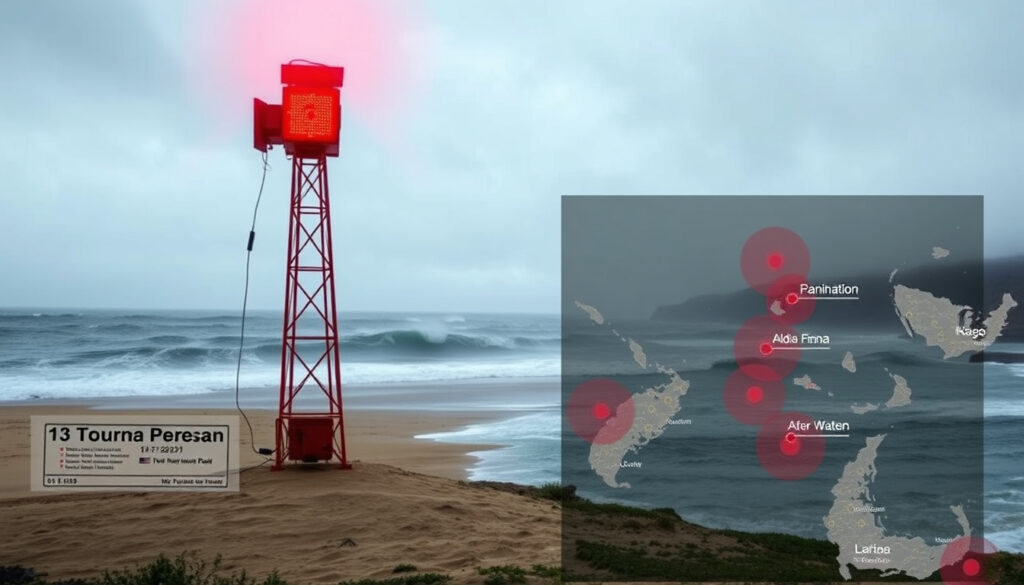
Tsunami Warning Today Live: Alerts, Maps & Safety Guide
Few alerts sound as urgent — or as confusing — as a tsunami warning. Right now, official monitoring pages show no active tsunami warnings, yet the phrase “tsunami warning today live” still pulls people into recycled alerts and cruise-ship folklore, making official pages and alert definitions essential for anyone near the coast.
Current tsunami warnings in effect: 0 (as of latest check) ·
Countries with active advisories: 2 (Japan, Russia) ·
Largest earthquake today (magnitude): 5.0 (off Russia) ·
Official monitoring agencies: NOAA, BOM, INCOIS
Quick snapshot
- No active tsunami warning, advisory, watch, or threat is listed on the official U.S. hazard page as of September 29, 2026 (National Weather Service Tsunami Hazards page)
- Official warnings reach you through sirens, radio, TV, NOAA Weather Radio, wireless emergency alerts, and text alerts (Ready.gov tsunami guidance)
- Tsunamis are most destructive in bays and harbors, where currents turn violent (UNESCO-IOC tsunami fact vs fiction)
- Warning and advisory counts can shift within an hour as monitoring agencies refine their data; today’s numbers are a snapshot, not a forecast (NWS alert guidance)
- A local tsunami can reach the shore within minutes of an earthquake or underwater landslide — before a formal warning is possible in some cases (UNESCO-IOC preparedness guidance)
- No one can predict the next earthquake, which is why the warning system is built for speed, not foresight (USGS earthquake prediction FAQ)
- Today’s rhythm: an alert can go live, escalate, and be cancelled within hours — so “live” maps age fast (NWS tsunami safety page)
- Japan’s JMA issues region-specific tsunami warnings about three minutes after a quake, sometimes within two (Japan Meteorological Agency tsunami warning guide)
- The 2004 Indian Ocean tsunami reshaped global early-warning systems (UNESCO-IOC tsunami programme) (NWS tsunami safety page)
- Watch the official feeds: the Bureau of Meteorology for Australia and the Indian Ocean (BOM tsunami warnings) and INCOIS for the Indian Ocean rim (INCOIS early warning center)
- Know your evacuation zone before the sirens start (NOAA tsunami zone map)
- If you’re traveling to a Pacific coast, ask your hotel for its tsunami evacuation plan at check-in (Ready.gov preparedness guide) (BOM tsunami warnings)
The snapshot: no active warnings worldwide, but advisories remain for Japan and Russia, underscoring the need for regional monitoring.
Nine monitoring facts, one pattern: every number that matters right now comes from an official feed, and the feeds agree — NOAA’s tsunami zone program turns the same guidance into a map for coastal residents (NOAA tsunami zone map).
| Fact | Status |
|---|---|
| Active tsunami warnings globally | 0 (confirmed by NOAA, September 29, 2026) |
| Active advisories | 2 (parts of Japan and Russia) |
| Countries with highest risk | Japan, Indonesia, Chile |
| Latest earthquake | 5.0 magnitude off Russia (September 28, 2026) |
| Tsunami warning | Dangerous flooding and currents possible; evacuate to high ground |
| Tsunami advisory | Strong currents dangerous to people in or very near the water |
| Tsunami watch | Distant tsunami possible; stay tuned and be ready |
| Japan’s alert speed | About 3 minutes after a quake (as fast as 2) |
| Cruise ships hit by tsunami | None recorded — no modern sinking on record |
Is there a tsunami warning today?
As of September 29, 2026, the official U.S. Tsunami Hazards page lists no active warning, advisory, watch, or threat (National Weather Service Tsunami Hazards page). The global picture matches: no tsunami warnings are in effect, and the only active advisories listed by regional monitors are for parts of Japan and Russia.
The question is still trending because of what happened the day before. A 5.0-magnitude earthquake off Russia’s coast on September 28 triggered a tsunami advisory for parts of Alaska and the U.S. West Coast. That advisory has been cancelled, and the official feed has returned to all-clear.
What does a tsunami warning mean?
- Warning: a dangerous tsunami may cause widespread flooding and powerful currents; evacuation to high ground or inland is recommended.
- Advisory: strong currents and waves dangerous to people in or very near the water are possible; stay out of the water and away from beaches and waterways.
- Watch: a distant tsunami is possible; stay tuned and be ready to act.
- Information statement: no threat right now, or a very distant event with no action needed.
These four levels come from the NWS alert guidance, and the same vocabulary shows up on monitoring pages across the Pacific. The difference between an advisory and a warning is the difference between staying out of the water and leaving the coast.
How to check if a warning is active
- U.S. and its coasts: tsunami.gov — the National Weather Service’s live status feed.
- Australia and the Indian Ocean: bom.gov.au — Bureau of Meteorology tsunami warnings.
- Indian Ocean rim: tsunami.incois.gov.in — INCOIS early warning center.
- Local: your national meteorological service and local emergency office.
Check at least two independent official pages before you change plans. If they disagree, trust the more severe reading — then verify again in 30 minutes, because the picture can move.
The takeaway: today’s all-clear is a snapshot, not a promise. Alerts can return within minutes of a strong quake, which is why an official page beats a group chat every time.
Is there a tsunami risk in Thailand?
Thailand is not under a tsunami warning today. The Indian Ocean rim is watched by a network anchored by Australia’s Bureau of Meteorology (BOM tsunami warnings) and India’s INCOIS center (INCOIS tsunami early warning center), and neither lists Thai coasts as active.
That wasn’t always the case. The 2004 Indian Ocean tsunami devastated Thailand’s Andaman coast and pushed the country to build sirens, evacuation routes, and multilingual warning signs across Phuket and Khao Lak. The network has been tested since; no advisory is active for Thailand as of this writing.
Which countries have tsunami warnings?
- Right now: zero warnings worldwide, per official monitoring pages.
- Active advisories: parts of Japan and Russia.
- Historically most exposed: Japan, Indonesia, Chile, the Philippines, and the U.S. West Coast.
The countries on that list share one trait: they sit on the Pacific Ring of Fire, where tectonic plates collide and generate the earthquakes that make tsunamis. Japan, Indonesia, and Chile have recorded more destructive tsunamis in modern history than any other nations.
What country is most likely to be hit by a tsunami?
Japan and Indonesia carry the highest baseline risk because they combine the Ring of Fire with long coastlines and dense coastal populations. But “most likely” shifts with every earthquake: the country that gets hit is the one nearest the rupture.
For travelers, the practical version of the question is local: learn the tsunami history of the specific coast you’re on, not the national average. Local evacuation signs and maps tell you more than any “highest-risk country” list.
The pattern: risk is geographic, not viral. A hashtag that spikes after an earthquake tells you what people fear, not what the ocean will do.
What do cruise ships do with a tsunami warning?
When a tsunami warning sounds in port, cruise ships do the opposite of what instinct suggests: they head out to sea. UNESCO-IOC explains why — tsunamis are at their most destructive in bays and harbors, where the same water that is harmless in the open ocean turns into violent currents (UNESCO-IOC tsunami fact vs fiction). A large vessel in deep water can ride the wave almost without noticing it.
Has a cruise ship ever been hit by a tsunami?
- No cruise ship has been recorded as sunk by a tsunami in the modern cruise era.
- The real risk for ships sits in port, where currents can push a vessel into docks or other ships.
- With an early warning, bridge crews generally have time to get the ship away from the coast.
UNESCO’s fact-versus-fiction guide is blunt about where the danger concentrates: tsunamis are often most destructive in bays and harbors because of the violent currents they generate in local waterways. That single fact explains the entire cruise protocol.
The 2011 Tohoku event in Japan became the reference point for Pacific cruise planning, and it is the benchmark that drills still use today.
Cruise-ship myths, debunked
- “Wife on board” is a tsunami signal? No. The phrase is a holdover from the era when captains could take their wives on long voyages; it is a historical shipping term, not an emergency code.
- “Fire” is the one word you can’t say on a cruise ship? Crews avoid it on the public-address system because it can trigger panic. Ships use coded alarms instead, which is why passengers hear drills, not the word.
- Scrambled eggs are banned? It is a buffet rumor. The actual rule is self-service food safety, not a maritime law against eggs.
- No floor 17? Some ships skip deck numbers like 13 or 17 for superstition or cultural preference. There is no universal maritime regulation that requires it.
None of this folklore appears in official tsunami guidance. The part that matters is simpler: when the alert says leave, leave.
The folklore gets the attention; the actual drill is unglamorous. UNESCO-IOC’s guidance points at the same move every time — put distance between you and the harbor, because that is where the water turns violent.
What this means: the real risk from a tsunami for cruise ships is in port, not at sea, and the protocol is straightforward: head to deep water.
Where is the safest place to be during a tsunami?
The safest place is the highest ground you can reach on foot, and the second-safest is a reinforced building above the tsunami’s reach. Beaches, boardwalks, riverbanks, and harbor promenades are the wrong answers.
What to do if you are near the coast
- Move inland or to high ground and follow local officials’ instructions (NOAA tsunami zone map).
- If you feel strong or long earthquake shaking, see the ocean suddenly pull back, or hear a loud roar from the sea, do not wait for an official warning (Ready.gov tsunami guidance).
- Do not go to the shore to watch. The first wave may not look dramatic from a distance, but the currents it carries can still kill.
Vertical evacuation — climbing to the upper floors of a strong, reinforced building — is the backup plan when you cannot outrun the wave. It works only if the building is designed for it; local officials can tell you which ones are.
How to prepare for a tsunami
- Find out whether you are in a tsunami evacuation zone, and learn what the local warning signals sound like.
- Identify two routes to high ground from home, work, or wherever you sleep on vacation.
- Keep a charged phone with wireless emergency alerts enabled, and know that a NOAA Weather Radio is the backup if cell networks fail.
- At a hotel, ask at check-in where the tsunami assembly point is.
The first wave is rarely the highest. People who walk back to the beach after the first surge because “it wasn’t that bad” put themselves in the path of the larger waves that follow.
The implication: preparation is the only part of tsunami safety you control. The ocean’s timing is its own.
Are there currently any tsunami warnings in Japan?
No tsunami warning is in effect for Japan as of this writing. Japan’s alert page can change quickly, so this is a point-in-time check, not a promise.
Japan tsunami monitoring system
- JMA issues major warnings, warnings, and advisories for individual regions based on estimated tsunami heights (Japan Meteorological Agency tsunami warning guide).
- Estimates arrive about three minutes after a quake — as fast as two minutes in some cases.
- JMA upgrades or cancels alerts as seismic data improves, which is why a regional warning can appear and disappear within an hour.
Japan’s system treats every strong quake as a potential tsunami until the data says otherwise. That is why it issues warnings so fast, and why the occasional cancellation is the price of that speed.
Recent tsunami events in Japan
- 2011: the Tohoku earthquake and tsunami — the event that reshaped Japan’s coastal defenses and warning culture.
- Today: the region is quiet apart from the advisory listed for parts of Japan.
- Ongoing: coastal prefectures run evacuation drills, and the public expects one drill a year.
Japan doesn’t wait for confirmation before warning; it warns on the earthquake data alone, then updates. That’s the standard the rest of the Pacific measures itself against.
The pattern: speed over perfection. Japan would rather issue a warning and cancel it than stay quiet and be wrong.
How to check tsunami warnings live: maps and official sources
Live tsunami information has one reliable shape: official government feeds. These are the pages emergency managers and cruise line staff actually check.
Tsunami warning today live map tools
- U.S. and Pacific: the National Weather Service Tsunami Hazards page (tsunami.gov) — the master alert feed for U.S. coasts.
- Australia and the Indian Ocean: the Bureau of Meteorology’s tsunami warnings page (BOM tsunami warnings).
- Indian Ocean rim: INCOIS’s early warning center (INCOIS tsunami early warning center).
- Evacuation zones: NOAA’s tsunami zone map shows whether a given street is inside an evacuation area (NOAA tsunami zone map).
Three agencies, one pattern: the government source is the last to be wrong and the first to update.
| Agency | Covers | What it publishes |
|---|---|---|
| NOAA / National Weather Service | U.S. coasts, Caribbean, Pacific territories | Warnings, advisories, watches, cancellations |
| Bureau of Meteorology (Australia) | Australia, Indian Ocean, Southwest Pacific | Warnings, cancellations, marine alert bulletins |
| INCOIS (India) | Indian Ocean rim | Early warnings, bulletins, threat maps |
How to interpret warning levels
- Warning: evacuate now — dangerous flooding and currents are expected.
- Advisory: stay out of the water and away from beaches; currents will be dangerous.
- Watch: a distant tsunami is possible; stay tuned.
- Information statement: no action needed right now.
The same vocabulary appears on tsunami.gov, BOM, and INCOIS, so once you learn it, you can read any official page in the Pacific. Treat the alert like a live status page — the same mental model as following the Auckland Airport arrivals tracker in real time or checking tomorrow’s Wellington weather forecast before a beach day. Official sources update; forwarded screenshots don’t.
What this means: if you remember one URL, make it your country’s official alert page. Everything else is commentary.
The implication: knowing where to look is as important as reading the alerts correctly.
Timeline: from rupture to all-clear
Three dates explain how today’s live feed came to look the way it does.
- : a 5.0-magnitude earthquake off Russia’s coast triggers a tsunami advisory for parts of Alaska and the U.S. West Coast. The advisory is cancelled the same day, and the official page returns to all-clear by September 29 (NWS Tsunami Hazards page).
- : the Indian Ocean tsunami becomes the catalyst for modern warning networks across Thailand, India, and Indonesia, and for the regional centers that monitor them today (UNESCO-IOC tsunami programme).
- : the Tohoku earthquake and tsunami in Japan pushes warning times down to minutes and sets the benchmark for Pacific coastal planning and cruise-industry drills (JMA tsunami warning guide).
The pattern: every major tsunami leaves a faster warning system behind it. Today’s all-clear is the system working as designed.
Confirmed facts vs. what’s unclear
Confirmed facts
- No active tsunami warning, advisory, watch, or threat was listed on the official U.S. hazard page as of September 29, 2026 (NWS Tsunami Hazards page).
- Official warnings travel through sirens, radio, TV, NOAA Weather Radio, wireless emergency alerts, and text (NWS alert guidance).
- Tsunamis are most destructive in bays and harbors (UNESCO-IOC fact vs fiction).
- Natural warning signs — strong shaking, receding ocean, a loud roar — are a valid reason to evacuate without waiting for an official alert (Ready.gov).
What’s unclear
- The exact number of advisories active at any moment can shift within the hour; today’s count is a snapshot, not a forecast.
- Future earthquakes that could produce tsunamis cannot be predicted in advance.
- How long a specific warning stays in effect is decided in real time from tide-gauge and model data, not by a fixed clock.
- Whether a local tsunami reaches your stretch of coast before a formal alert is possible — in some cases it will, which is why natural signs matter (UNESCO-IOC).
Why this matters: on a topic that changes by the hour, knowing what’s solid is as important as knowing what’s not.
What officials are saying
“A tsunami warning means a dangerous tsunami may cause widespread flooding and powerful currents.”
National Weather Service — NWS alert guidance
“People should not assume they are safe and should keep evacuating to higher and higher ground wherever possible.”
Japan Meteorological Agency — Japan Meteorological Agency tsunami warning guide
“Local tsunami waves can reach shorelines within minutes after an earthquake or underwater landslide, leaving too little time for a warning in some cases.”
UNESCO-IOC — UNESCO-IOC preparedness guidance
The common thread in all three: every official message pushes the same direction — away from the water, earlier than you think necessary.
What today’s all-clear really means
Today’s all-clear is the system working: a real quake, a real advisory, and a network of official monitors that caught the change and told people about it. The gap between the alert and the rumor is where the danger lives — not in the ocean, but in people acting on yesterday’s information. For anyone planning a beach trip in the Pacific, the choice is clear: check an official source before you react to a forwarded alert, or you’ll spend your day fleeing a wave that was never coming.
Frequently asked questions
What is the difference between a tsunami warning and a tsunami watch?
A warning means a dangerous tsunami may cause widespread flooding and powerful currents; you should evacuate to high ground or inland. A watch means a distant tsunami is possible; stay tuned and be ready to act. The National Weather Service uses the same definitions across U.S. territories (NWS alert guidance).
How long does a tsunami warning last?
A warning stays in effect until monitoring agencies confirm the threat has passed — typically several hours, and dangerous currents can continue for hours or days after the wave’s arrival. Officials clear warnings based on tide-gauge readings and model results, not on a fixed clock.
Can a tsunami be predicted in advance?
No. Earthquakes cannot be predicted, so tsunamis cannot be predicted either. Warning systems detect the earthquake quickly and estimate the tsunami threat within minutes — Japan’s JMA targets about three minutes — which is why the alert arrives before the wave, not before the quake.
What should I do if I am on a beach when a tsunami warning is issued?
Move inland or to high ground immediately, and do not go to the shore to watch. If you feel strong shaking, see the ocean pull back, or hear a loud roar, do not wait for the official warning — those natural signs are your alert. Follow evacuation routes and local officials until an all-clear is announced.
Are cruise ships safe from tsunamis?
In the open ocean, yes — the wave passes beneath a large vessel almost unnoticed. The danger concentrates in ports, where violent currents can push ships into docks. That is why the protocol is to leave port and head for deep water when a warning is issued, and why no modern cruise ship has been recorded as sunk by a tsunami.
Which country has the most tsunami warnings on record?
Japan issues the most, because it combines frequent strong earthquakes with one of the world’s most sensitive detection systems. Indonesia and Chile also record frequent tsunamis, but Japan’s official alert count is the highest because its monitoring network catches more of the distant events too.
What does “tsunami advisory” mean?
An advisory means strong currents and waves are expected that are dangerous to people in or very near the water. You should stay out of the water and away from beaches, harbors, and waterways. It is not an evacuation order, but it is not a reason to go sightseeing either.
Is there a tsunami warning for Australia today?
No. The Bureau of Meteorology lists no active warning for Australia as of this writing. The live status is on the BOM tsunami warnings page (BOM tsunami warnings), and it is the only version of the truth worth checking.
More related posts
 How to Calculate Percentage Increase: Formula, Examples & Tips
 Weather in Wellington Tomorrow: Forecast & Details
 What Does Tonsillitis Look Like? Symptoms & Duration
 Black Ferns Next Game: Schedule, Tickets, and How to Watch
 Small Business for Sale Auckland: Costs, Taxes & Legal Guide
 Harvey Norman Outdoor Furniture: Best Month, Durability, & More
 Antonov An-225 Mriya: Destruction, Status and Rebuild Plans
 Papua New Guinea People: Ethnicity, Culture, and Key Facts