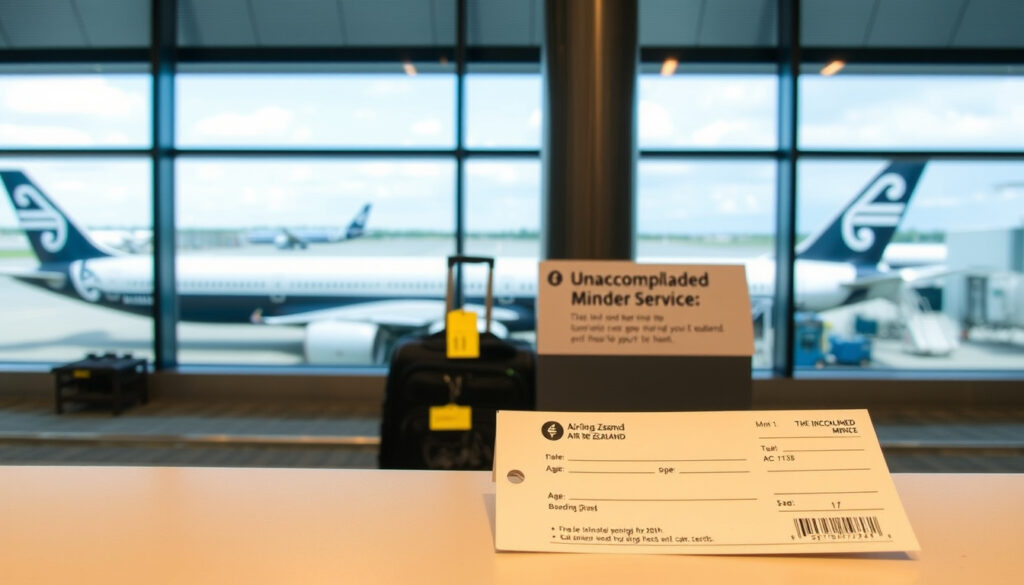
Air NZ Unaccompanied Minor Service: Rules, Fees & Age
Few things make a parent’s heart race like watching their child walk through the departure gate alone. Air New Zealand handles thousands of solo young travellers every peak season, and the rules are more route-specific than most people expect.
Minimum age for unaccompanied minor service: 5 years ·
Maximum connection time: 2 hours (domestic) ·
Expected unaccompanied minors during peak season: 10,000 ·
Service availability: Air New Zealand operated flights only
Quick snapshot
- Children 5–11 can travel alone under unaccompanied-minor conditions (Air New Zealand (official policy page))
- Maximum connection time is 2 hours for domestic flights, 3 hours for flights involving an international sector (Air New Zealand (age chart))
- Airband sends text updates to up to five nominated contacts (Air New Zealand (Airband page))
- Exact fee amount varies by route and date; a 2021 report suggests NZ$30 each way for domestic flights (Newstalk ZB (consumer news outlet))
- International age limits may differ from domestic; the airline provides an age chart for specific routes (Newstalk ZB (consumer news outlet))
- Mid‑December to mid‑February: Air New Zealand expects around 10,000 unaccompanied minors and sets up a dedicated squad (Air New Zealand (policy overview))
- Book the service early; complete the unaccompanied-minor form and provide guardian details (Air New Zealand (Airband & booking details))
- Arrive at the airport with appropriate ID and allow extra time for check-in (Air New Zealand (Airband & booking details))
Four key facts stand out from the policy pages, one pattern: the airline has layered several requirements that depend on the child’s age, the route, and the type of transit.
| Label | Value |
|---|---|
| Minimum age for service | 5 years |
| Maximum connection time | 2 hours (domestic), 3 hours (with international sector) |
| Fee | Varies by route; NZ$30 each way (domestic, 2021) |
| Peak season expectation | 10,000 minors (mid‑Dec to mid‑Feb) |
What are the rules and regulations for travelling with children on Air New Zealand?
What is the unaccompanied minor service?
- Air New Zealand offers a dedicated service for children aged 5 to 11 who travel without an adult aged 15 or older (16 or older for flights to/from Canada) (Air New Zealand (travelling alone page)).
- The service includes Airband tracking, which sends text updates to up to five nominated contacts when the child’s Airband is scanned at key journey stages (Air New Zealand (Airband page)).
- Children aged 12 to 16 may also use Airband at a parent’s request on selected routes (Air New Zealand (Airband & booking details)).
Which flights are eligible?
- Unaccompanied minors are only permitted on Air New Zealand marketed and operated flights, not on codeshare or partner airlines (Air New Zealand agent guide (Sabre)).
- Maximum connection time is 2 hours between domestic flights and 3 hours when an international sector is involved (Air New Zealand (age chart)).
- Transit is permitted where a parent or guardian meets the child at an intermediate point, but the child must be checked in only as far as that point and the adult must stay at the airport until after departure (Air New Zealand (terms and conditions)).
Parents booking a connection through Auckland need to check the transit time: a 2-hour domestic window is tight, and a 3-hour window for international transfers means careful flight selection.
The implication: eligibility is not automatic—it depends on the specific route, the child’s age, and the transit duration. The airline’s age chart is the single source of truth for determining whether a child can fly solo on a given itinerary.
What age can kids fly alone in Air NZ?
Minimum age for unaccompanied minor service
- Children under 5 years old cannot travel alone and must be accompanied by an adult aged 15 or older (16 or older for Canada) (Air New Zealand (travelling alone page)).
- Age is calculated based on the child’s age on the day of travel, not the booking date.
Age for domestic flights
- Children aged 5–11 can travel alone as unaccompanied minors on selected domestic routes, with Airband mandatory (Air New Zealand (Airband & booking details)).
- Children aged 12–16 may travel alone without the service, but Airband can be requested.
Age for international flights
- International age limits may differ; the airline’s age chart specifies the maximum age for which the unaccompanied-minor service is required (Air New Zealand (age chart)).
- For flights to and from Canada, the accompanying adult must be 16 or older (instead of 15) (Air New Zealand (travelling alone page)).
A 12-year-old flying domestically is not required to use the service, but a 12-year-old flying internationally might be—the age chart is the decisive document, and it varies by destination.
The pattern: domestic policy is more flexible for older children, while international routes have stricter age bands and documentation requirements. Parents should check the age chart for each specific itinerary.
How much is the unaccompanied minor fee?
Domestic fee
- In 2021, Air New Zealand reportedly doubled the fee for unaccompanied minors on domestic flights from NZ$15 to NZ$30 each way (Newstalk ZB (consumer news outlet)).
- Checked baggage at NZ$20 each way reportedly became mandatory for young solo travellers at the same time (Newstalk ZB (consumer news outlet)).
International fee
- An archived policy copy (from 2019) indicated the fee was US$150/CAD$150/EUR150 each way, but current amounts may differ.
- Fees are separate from the ticket price and charged per direction.
How to pay
- The fee is added at the time of booking when the unaccompanied-minor service is requested. Payment is made via the same booking channel.
The fee plus mandatory checked baggage can add NZ$50+ to a domestic one-way ticket. For international routes, the cost can be significantly higher, making comparison with other airlines worthwhile.
The trade-off: the fee is not published prominently on the website, so parents often discover the cost at checkout. For a family with two solo minors, the total can add up quickly.
Can a 17 year old and a 13 year old fly together?
Age difference rules
- Children aged 5–11 are required to use the unaccompanied-minor service if there is no adult aged 15+ (16+ for Canada) travelling with them (Air New Zealand (travelling alone page)).
- A 17-year-old is considered an adult for the purpose of accompanying a younger sibling, provided the 17-year-old is at least 15 (or 16 for Canada).
- So a 17-year-old and a 13-year-old can fly together without the unaccompanied-minor service, as long as the 17-year-old is at least 15 (or 16 for Canada).
Booking for siblings
- When booking, the 17-year-old should be listed as the responsible adult. The airline may require a declaration at check-in that the 17-year-old is capable of supervising the younger child.
- If the 13-year-old is under 12, they must be declared as travelling alone at the time of booking if not accompanied by a person aged 15+ (16+ for Canada) (Air New Zealand (Airband & booking details)).
The implication: the airline treats the 17-year-old as a guardian, but the parents should confirm at booking that the age difference is acceptable. A 13-year-old is not required to use the unaccompanied-minor service if travelling with a 17-year-old sibling.
At what age can a child fly internationally alone?
Age limits for international unaccompanied minors
- Air New Zealand provides an age chart on its website that specifies age limits for both domestic and international routes (Air New Zealand (age chart)).
- For most international destinations, the same 5–11 age band applies for the unaccompanied-minor service, but some countries may have additional requirements.
- Children 12 and older may travel internationally without the service, but the airline recommends checking the age chart for each destination.
Documentation needed
- Passport (valid for at least 6 months beyond the travel date).
- Completed unaccompanied-minor form (available at check-in or online).
- Contact details for the guardian at the destination.
- For some countries, a notarised letter of consent from the non-travelling parent may be required.
A 14-year-old flying to Vancouver alone is fine under Air New Zealand’s policy, but the same 14-year-old flying to Los Angeles might need the unaccompanied-minor service if the route requires it. The age chart is the final authority.
The consequence: international solo travel requires more upfront planning than domestic trips. Parents should check the age chart and destination-specific documentation at least two weeks before booking.
Steps to book the unaccompanied-minor service
- Check eligibility – Visit the Air New Zealand age chart to confirm the child’s age and route are eligible.
- Book the flight – Call Air New Zealand’s reservations or book online, then add the unaccompanied-minor service. The service must be requested at the time of booking.
- Complete the unaccompanied-minor form – Provide details of the guardian meeting the child at the destination, including full name, phone number, and address. The form is available on the airline’s website.
- Prepare documents – Print the completed form, the child’s passport (if international), and any required consent letters.
- Arrive at the airport early – Allow at least 90 minutes before departure for domestic flights, 2–3 hours for international. The parent or guardian must stay at the airport until the flight departs.
- Use Airband – The child will receive an Airband bracelet at check-in. It will be scanned at key points, sending updates to up to five nominated contacts (Air New Zealand (Airband page)).
- Plan for delays – If a delay or cancellation occurs, the parent or guardian is responsible for the child’s care (Air New Zealand (terms and conditions)). Ensure the guardian at the destination is reachable and can pick up the child at the new arrival time.
Timeline: Peak season surge
Air New Zealand expects around 10,000 unaccompanied minors during this period and sets up a dedicated squad to handle the volume.
The pattern: the busiest period for solo child travel is the summer school holidays. Parents booking during this window should expect longer check-in times and limited availability of the service on popular routes.
Clarity: what’s confirmed and what’s not
Confirmed facts
- Air New Zealand allows unaccompanied minors aged 5–11 on its own flights (Air New Zealand (travelling alone page)).
- Maximum connection time is 2 hours for domestic flights, 3 hours for flights involving an international sector (Air New Zealand (age chart)).
- A fee is charged for the service; domestic fee was NZ$30 each way as of 2021 (Newstalk ZB (consumer news outlet)).
- Airband is mandatory for children aged 5–11 travelling alone (Air New Zealand (Airband & booking details)).
What’s unclear
- Exact fee may vary by route and date; the airline does not publish a fixed fee on its website.
- International age limits may differ from domestic; the age chart is reliable but not always publicly accessible for every route.
- Documentation requirements for specific countries (e.g., notarised consent) may change without notice.
The confirmed facts give parents a solid basis, but the unclear areas require additional checking before booking.
Quotes: What Air New Zealand says
“We know that sending a child on a flight alone can be a big step for families, so we have a dedicated team and processes to make sure they’re well looked after every step of the way.”
— Air New Zealand spokesperson, as quoted in the airline’s newsroom release on unaccompanied minors
Air New Zealand states that the Airband gives parents peace of mind by providing real-time updates when the child’s Airband is scanned at key journey stages. (Air New Zealand, Airband page)
Two perspectives from the same airline, one consistent message: the service is designed to reduce anxiety, not just compliance. The dedicated squad during peak season backs that up with operational capacity.
Summary
Air New Zealand’s unaccompanied-minor policy is a well‑structured system for children aged 5‑11, but it’s more route‑specific than many parents realise. The age chart, connection limits, and mandatory Airband create a safety net that works well on direct flights but gets tighter on itineraries with connections. For parents in New Zealand planning a solo trip for their child, the choice is clear: book early, check the age chart, and prepare for the extra cost and paperwork, or wait until the child is 12 and can fly without the service entirely.
airnewzealand.com, airnewzealand.com, airnewzealand.com, airnewzealand.com, airnewzealand.com, ia601904.us.archive.org, airlinesunaccompaniedminor.com
Frequently asked questions
Do I need to fill out a form for an unaccompanied minor?
Yes. Air New Zealand requires an unaccompanied-minor form to be completed at the time of booking or at check-in. The form collects guardian details at both ends.
Can I book the unaccompanied minor service online?
Yes, you can request the service during online booking, but you may need to call the airline to confirm availability on certain routes.
What identification does my child need to fly alone?
For domestic flights, a birth certificate or passport is recommended. For international flights, a valid passport is required, plus any visa or consent letters.
Can my child be seated next to an adult stranger?
Air New Zealand policy states that unaccompanied minors are seated near the cabin crew, not next to adult strangers. The airline aims to keep them in a designated area.
What happens if my child’s flight is delayed?
Air New Zealand staff will supervise the child. The parent or guardian is responsible for the child’s care if the delay extends overnight. Ensure the guardian at the destination is updated.
Are there destinations where the unaccompanied minor service is not available?
Yes. The service is only available on Air New Zealand operated flights, not on codeshare partners. Some international destinations may have restrictions; check the age chart.
Can a 16-year-old travel as an unaccompanied minor?
Air New Zealand’s unaccompanied-minor service is designed for children aged 5–11. Children aged 12–16 may travel alone without the service, but Airband can be requested at a parent’s discretion.
The FAQ covers the most common concerns parents have when booking the unaccompanied minor service.
More related posts
 NZ Passport Application Form Online: Step-by-Step Guide 2026
 1 NZ Dollar to INR Today: Live Rate & Conversion Insights
 What Is Profit Margin Ratio? Definition, Formula, and Examples
 Air New Zealand International Flights: Meals, Routes & Tips
 What Is Global Warming? Causes, Effects, and Solutions
 Pete’s Emporium Lower Hutt: Products, Hours, Location Guide
 How to Lower Cholesterol in New Zealand