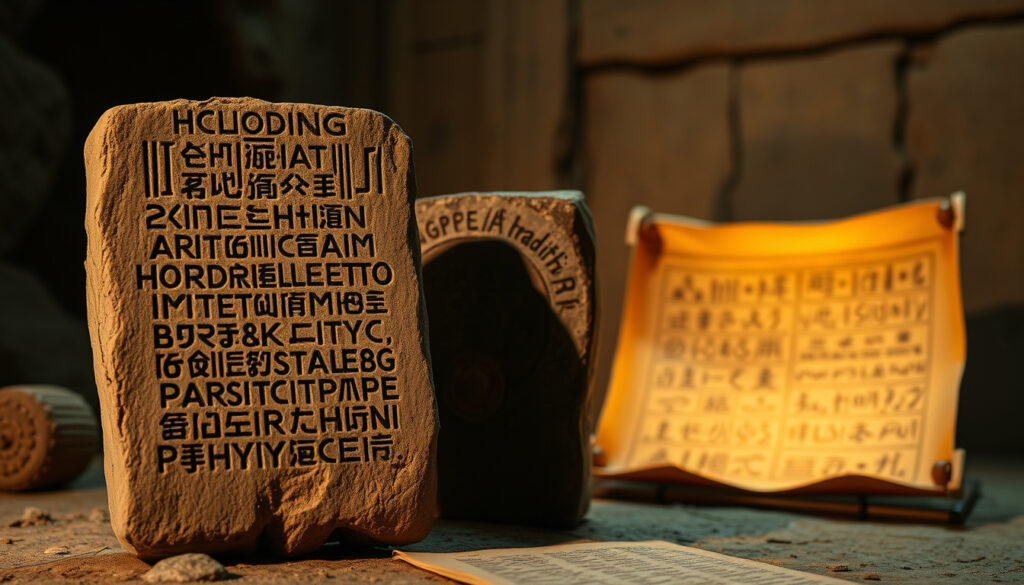
Oldest Language in the World: Written vs. Spoken Facts
Few questions spark as much debate as the oldest language in the world. The answer depends entirely on whether you count written records, continuous spoken use, or religious tradition.
Earliest known written language: Sumerian, c. 3400 BCE ·
Oldest living language (continuous spoken tradition): Tamil, over 2,000 years ·
Number of languages with written records before 1000 BCE: ~10 ·
Oldest language in the Abrahamic tradition: Hebrew (c. 1000 BCE)
Quick snapshot
- Sumerian is the earliest known written language (c. 3400 BCE) (Wikipedia: List of languages by first written account)
- Tamil is the oldest living Dravidian language with continuous literature (Vasco Translator)
- Sanskrit is older than Tamil in written attestation but not in spoken continuity (Berlitz)
- Persian predates Arabic by about 1,000 years (History Facts)
- Which language is the absolute oldest overall (written vs. spoken criteria)
- The exact age of Tamil oral tradition before written records
- The origin of language itself – no scientific consensus
- c. 3400 BCE: Sumerian cuneiform appears (Wikipedia)
- c. 3200 BCE: Egyptian hieroglyphs emerge (History Facts)
- c. 1500 BCE: Earliest Sanskrit texts (Rigveda) (Berlitz)
- Ongoing research into undeciphered scripts (Harappan, Linear A)
- Revival efforts for ancient languages (Sanskrit, Hebrew)
- Continued debate over Tamil vs. Sanskrit for oldest living language
Six major contenders, one key distinction: written evidence versus continuous spoken use. The table below lays out the earliest attestation for each language and its current status.
| Language | Earliest attested | Category | Status |
|---|---|---|---|
| Sumerian | c. 3400 BCE | Written | Extinct |
| Egyptian | c. 3200 BCE | Written | Liturgical (Coptic) |
| Elamite | c. 3000 BCE | Written | Extinct |
| Harappan (Indus) | c. 2600 BCE | Undeciphered | Unknown |
| Sanskrit | c. 1500 BCE | Written/Liturgical | Dead (no native speakers) |
| Hebrew | c. 1000 BCE | Written/Religious | Revived |
| Greek | c. 1450 BCE | Written | Living |
| Chinese | c. 1250 BCE | Written | Living |
| Tamil | c. 300 BCE | Spoken/Written | Living |
| Arabic | 4th century CE | Written | Living |
The implication: no single language holds the crown under all criteria. Written age favors Sumerian; spoken continuity favors Tamil; religious tradition points to Hebrew or Sanskrit.
Which is the oldest language in the world?
What is the oldest written language?
- Sumerian cuneiform appears around 3400 BCE, with proto-literate administrative records at Uruk dating to about 3500 BCE (Wikipedia: List of languages by first written account).
- Ancient Egyptian hieroglyphs follow around 3200 BCE (History Facts).
- Akkadian adapted Sumerian cuneiform from about 2500 BCE (DigVentures).
Sumerian is a language isolate, unrelated to any other known language (DigVentures). It persisted in written form until about 1 CE, long after it died out as a spoken tongue (DigVentures).
Sumerian is universally accepted as the earliest written language, but it offers no insight into spoken continuity — a dead end for anyone asking what the first language spoken by humans was.
What is the oldest language still spoken today?
- Tamil has a continuous literary tradition dating to at least 300 BCE (Tolkappiyam) and is still spoken by over 70 million people (Vasco Translator).
- Hebrew was revived as a spoken language in the 19th century but its written roots go back to around 1000 BCE (Wikipedia).
- Greek has written records from about 1450 BCE (Linear B) and remains a living language (Vasco Translator).
The pattern: living languages with ancient written records are rare. Most ancient written languages are extinct as vernaculars. No language has a continuous spoken history from 5000 years ago (Dynamic Language).
If you want the oldest continuously spoken language, you have to accept that its earliest written evidence may be centuries younger than languages like Sumerian. Spoken age is necessarily inferred, not documented.
The catch: no single language wins under both written and spoken criteria.
Which is older, Sanskrit or Tamil?
When did Sanskrit first appear?
- The Rigveda, the oldest Sanskrit text, is dated to roughly 1500–1200 BCE (Berlitz).
- Panini’s grammar, the Ashtadhyayi, was composed around the 4th century BCE and remains a foundational linguistic work (Berlitz).
What is the evidence for Tamil’s antiquity?
- The Tolkappiyam, the earliest Tamil grammar, dates to about 300 BCE, but oral tradition may extend much further back (Vasco Translator).
- Tamil belongs to the Dravidian family, completely separate from the Indo-Aryan family of Sanskrit (Berlitz).
What this means: Sanskrit has earlier written attestation (by roughly 1,200 years), but Tamil has a stronger claim to continuous spoken use. The debate often conflates the two criteria.
Which language is older, Persian or Arabic?
When did Old Persian appear?
- Old Persian inscriptions, such as those from Darius I, date to the 6th century BCE (History Facts).
- Modern Persian (Farsi) is a direct descendant of Old Persian (History Facts).
What is the timeline for Arabic?
- The earliest evidence of Arabic writing comes from the 4th century CE, in a Nabataean variant (Berlitz).
- Arabic is a Semitic language; Persian is Indo-Iranian (Indo-European). They are not related (Berlitz).
The pattern: Old Persian predates Arabic by about a millennium. But both are still spoken today, making them rare examples of ancient languages that never died out.
What are the 10 oldest languages still spoken?
Which languages have been spoken continuously for over 2,000 years?
- Tamil (Dravidian, spoken in India and Sri Lanka) – continuous literary tradition since 300 BCE.
- Hebrew (Afro-Asiatic, revived but continuously used in religious contexts).
- Greek (Indo-European, Linear B tablets from 1450 BCE).
- Chinese (Sino-Tibetan, oracle bone script from 1250 BCE).
- Arabic (Semitic, written from 4th century CE).
- Aramaic (Semitic, once the lingua franca of the Near East, still spoken in small communities).
- Basque (language isolate, no known relatives, spoken in the Pyrenees).
- Finnish (Uralic, written from the 16th century but spoken much longer).
- Sanskrit (liturgical only – no native speakers, but still used in rituals).
- Armenian (Indo-European, first written in the 5th century CE).
How is language age measured for living languages?
Linguists rely on written records, historical reconstruction, and comparative methods. For languages without early writing, age is estimated through proto-language reconstruction. The catch: without written proof, estimates are speculative. A language like Basque is clearly ancient but its exact age beyond a few thousand years is unknown (Dynamic Language).
What language did Adam and Eve speak?
What does religious tradition say?
- Judeo-Christian tradition often suggests Hebrew, though the Bible never names Adam’s language (Berlitz).
- Islamic tradition considers Arabic the original language of revelation, but the Quran itself does not claim Adam spoke Arabic.
What do linguists think about the origin of language?
Linguistics has no evidence for a single original language. The concept of a “first language” is speculative and untestable. The earliest human language is lost to prehistory.
The implication: the Adam and Eve question belongs to theology, not historical linguistics. No data supports any language being the original human tongue.
Why is Sanskrit a dead language?
Is Sanskrit truly dead?
- Sanskrit is classified as a “dead” language because it has no native speakers as a first language (Berlitz).
- It remains a liturgical language in Hinduism, Buddhism, and Jainism and is studied and spoken by scholars, but not as a mother tongue.
What is the difference between a dead language and an extinct language?
- A dead language has no native speakers but may still be used in writing or ritual (e.g., Latin, Sanskrit).
- An extinct language has no speakers at all (e.g., Sumerian, Hittite).
Modern spoken Sanskrit revival efforts exist but are limited; it is not a living mother tongue.
Calling Sanskrit “dead” does not diminish its cultural significance. But for someone asking about the oldest language still spoken, Sanskrit fails the litmus test: it is not anyone’s first language.
Three major comparisons, one pattern: spoken continuity and written age rarely align. The table below contrasts the most debated pairs.
| Comparison | Older by written record | Older by spoken continuity | Language family |
|---|---|---|---|
| Sanskrit vs. Tamil | Sanskrit (~1500 BCE) | Tamil (likely older as spoken) | Indo-Aryan vs. Dravidian |
| Persian vs. Arabic | Persian (~6th c. BCE) | Persian (direct descendant) | Indo-Iranian vs. Semitic |
| Hebrew vs. Arabic | Hebrew (~1000 BCE) | Hebrew (revived, but continuously spoken in liturgy) | Both Semitic |
The trade-off: If you pick written age, you get languages nobody speaks. If you pick spoken continuity, you accept that the earliest written proof is much younger.
Timeline of oldest language milestones
- c. 3400 BCE: Sumerian cuneiform appears (Wikipedia)
- c. 3200 BCE: Egyptian hieroglyphs emerge (History Facts)
- c. 1500 BCE: Earliest Sanskrit texts (Rigveda) (Berlitz)
- c. 1000 BCE: Earliest Hebrew inscriptions (Wikipedia)
- c. 600 BCE: Old Persian inscriptions (Darius I) (History Facts)
- c. 300 BCE: Earliest Tamil literature (Tolkappiyam) (Vasco Translator)
- 4th century CE: Earliest evidence of Arabic writing (Berlitz)
The pattern: written evidence clusters in the ancient Near East. All spoken languages with written records before 1000 BCE are either dead (Sumerian, Elamite) or have evolved beyond recognition (Egyptian to Coptic).
For a deeper dive into historical periods, you can explore the Middle Ages definition and timeline. Middle Ages definition and timeline
What we know and what we don’t
Confirmed facts
- Sumerian is the earliest known written language.
- Tamil is the oldest living Dravidian language with continuous literature.
- Sanskrit is older than Tamil in written attestation but not in spoken continuity.
- Persian (Old Persian) predates Arabic by about 1,000 years.
What’s unclear
- Which language is the absolute oldest overall (written vs. spoken criteria).
- The exact age of Tamil oral tradition before written records.
- The origin of language itself – no scientific consensus.
Expert perspectives
“Sumerian is widely considered the world’s oldest written language, with evidence dating back to around 3400 BCE.”
— Wikipedia: List of languages by first written account
“The Tamil language is recognized as the oldest language in the world and it is the oldest language of the Dravidian family.”
— Reader blog in Vasco Translator
The contrast: written evidence gives us Sumerian as the oldest. But for a living, breathing language, Tamil is the strongest contender.
For anyone asking which is the oldest language in the world, the honest answer is: it depends. If you want the earliest marks on clay, Sumerian wins. If you want a language your grandmother could speak to you today, Tamil takes the prize. The debate between Sanskrit and Tamil, or Persian and Arabic, will continue — because the criteria will always be chosen by the debater. For the reader in India or Sri Lanka, the implication is clear: Tamil’s continuity is unmatched. For the Western reader steeped in Greco-Latin tradition, Greek and Hebrew offer ancient roots of their own. Choose your criterion, and you choose your answer.
Frequently asked questions
Is Sanskrit the oldest language in the world?
No. Sanskrit has the oldest written texts among Indo-European languages (c. 1500 BCE), but Sumerian and Egyptian are older as written languages, and Tamil has a stronger claim to continuous spoken use.
What is the oldest language in India?
Tamil is widely considered the oldest living language in India, with a continuous literary tradition dating to at least 300 BCE. Sanskrit has older written texts but is no longer a native spoken language.
How old is the Hebrew language?
Hebrew’s earliest inscriptions date to around 1000 BCE. It was revived as a spoken language in the 19th century, but its religious written tradition has been continuous.
Is Chinese older than Tamil?
Chinese has earlier written evidence (oracle bones from ~1250 BCE) than Tamil (~300 BCE). However, Tamil is often argued to be older as a continuously spoken language because its oral tradition likely precedes its writing.
What is the oldest language still spoken in Europe?
Greek is the oldest living European language with written records from about 1450 BCE. Basque is also ancient but lacks early written evidence.
Can a language be older than its first written record?
Yes. All languages existed as spoken forms before writing was invented. The oldest written records give us a minimum age, not the true age.
What is the difference between a dead language and an extinct language?
A dead language has no native speakers but may still be used in writing or ritual (e.g., Latin, Sanskrit). An extinct language has no speakers at all (e.g., Sumerian, Hittite).
Related reading: The longest flight in the world · What is global warming?
More related posts
 What Day Is Today – Tuesday April 7 2026 Facts
 Mitre 10 MEGA Taupo: Store Guide and Product Range
 Glass Air Fryer NZ: Best Non-Toxic Models Compared
 How to Calculate Percentage Increase: Formula, Examples & Tips
 Kimetsu no Yaiba Infinity Castle: Release Dates & Streaming
 GBP to NZD Live Rate: Pound to New Zealand Dollar Today
 BNZ Home Loan Rate Cuts: Rates, Predictions & Fixing
 Ambarsariya Cafe & Restaurant: Menu, Reviews & New Location