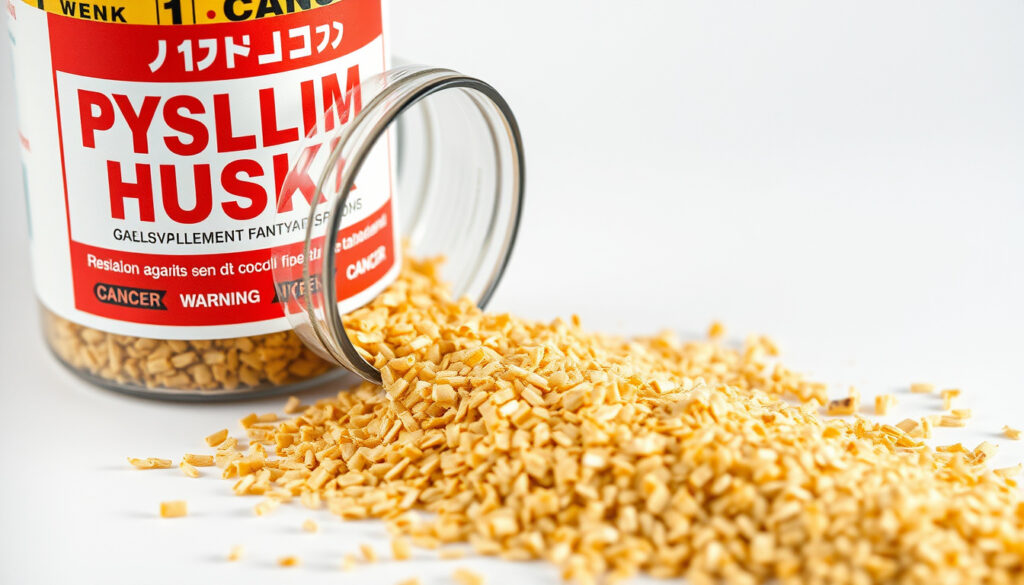
Psyllium Husk Cancer Warning: What You Need to Know
A fiber supplement praised for digestive health carries a California cancer warning — and the disconnect alarms shoppers who pick up a bottle. The warning is real, driven by trace lead levels that trigger Prop 65, but studies show psyllium husk itself does not cause cancer. Here is what that label actually means for your health.
Cancer Link Evidence: None found · Warning Cause: California Prop 65 · Psyllium Safety Consensus: Safe with water · Lead Contamination Risk: Trace levels possible
Quick snapshot
- Prop 65 drives the cancer warning label (ConsumerLab)
- No scientific evidence links psyllium husk directly to cancer (Illuminate Labs)
- Lead levels vary by brand and batch; independent testing limited (ConsumerLab)
- Long-term low-dose lead exposure from supplements remains understudied (Green Matters)
- Regulators continue monitoring psyllium products for heavy metals (California OAG)
- More brands may face Prop 65 enforcement actions in 2025 (California OAG)
- Independent testing organizations like ConsumerLab continue auditing products (ConsumerLab)
- Third-party verified brands may gain market advantage as consumers seek tested options (ConsumerLab)
| Fact | Detail |
|---|---|
| Primary Warning Reason | California Prop 65 |
| Cancer Evidence Level | None |
| Recommended Dose | 5–10g daily |
| Key Benefit | Digestive health |
| Prop 65 Lead Threshold | 0.5 mcg per daily serving |
| FDA Lead Safe Level | 500 mcg daily |
Why is there a cancer warning on psyllium husk?
California Prop 65 explained
California’s Prop 65 law, passed in 1986, requires products sold in the state to carry warnings if they contain chemicals the state lists as carcinogens or reproductive toxicants. Lead is on that list. The law sets the bar low: any product delivering more than 0.5 mcg of lead per daily serving triggers a warning label. That threshold sits 1,000 times below the FDA’s safe daily exposure level of 500 mcg per day, making Prop 65 one of the strictest standards in the country.
The catch is that Prop 65 warnings appear nationwide because manufacturers who sell in California ship the same labeled products everywhere. So a bottle in Ohio carries the same cancer warning as one in Los Angeles — even though no other state requires it.
Prop 65 warnings function as legal precaution labels, not findings of actual harm. A product can carry a cancer warning while posing no measurable cancer risk to consumers.
Trace contaminants in supplements
ConsumerLab tested 9 psyllium products in February 2024 and found lead present in every single one. Four of those products exceeded Prop 65 limits, with the highest detected at 38.7 mcg per maximum serving — more than 60 times the warning threshold. That product would require the cancer label even though no evidence shows psyllium itself causes cancer.
Lead enters psyllium through the environment. Soil contamination from fertilizers, irrigation water, and air deposition introduces trace heavy metals into outdoor-grown plants. Manufacturers do not add lead during processing — the contamination occurs before harvest.
The California Office of the Attorney General filed a complaint against NOW Foods in 2018 for selling multiple psyllium products with undisclosed lead levels that exceeded Prop 65 limits. The company faced a similar enforcement action in 2025 for Organic Psyllium Husk Powder 16 oz. Both cases underscore that the issue is systemic across the industry, not isolated to a single brand.
Lead in psyllium comes from soil, not from manufacturing — and every tested brand shows some level of contamination. The question is how much, not whether any exists.
Is psyllium husk safe, yes or no?
Daily use guidelines
Taken responsibly, psyllium husk carries a strong safety consensus among health authorities. The fiber swells when it absorbs water — typically 10–15 times its weight — which gives it the ability to support regularity, lower cholesterol, and aid weight management. Those benefits come with one non-negotiable rule: always take psyllium with plenty of water. Consuming it dry, without adequate hydration, risks gastrointestinal blockages, particularly for people who do not drink enough fluid throughout the day.
Most guidelines recommend starting with 5 grams daily — about a teaspoon of powder — and gradually increasing to 10 grams if tolerated. Taking psyllium before meals may enhance satiety effects for those using it as part of a weight management routine.
Common side effects
The most frequently reported side effects are digestive: bloating, gas, and cramping when you first start. These typically diminish within a week as your system adjusts. Starting with a lower dose and building up gradually minimizes these effects.
The other risk is interaction with medications. Because psyllium can slow absorption of some drugs and supplements, spacing your doses at least 2 hours apart from prescription medications is standard advice. Anyone on regular medication should consult their doctor before adding psyllium to their routine.
ConsumerLab’s 2024 tests found lead levels that were dose-dependent: some products only exceeded Prop 65 limits at maximum daily serving sizes. Using the lower end of the recommended range may keep exposure below warning thresholds for some products.
What cancers are linked to psyllium husk?
Prop 65 listed chemicals
Lead is the chemical that triggers psyllium’s cancer warning. The CDC, HHS, and EPA classify lead as a possible carcinogen, and there is no established safe blood lead level per the Mayo Clinic. However, no clinical evidence links psyllium husk directly to cancer. The warnings exist because the product contains trace lead — not because anyone has demonstrated that psyllium causes tumors.
This distinction matters: Prop 65 applies a conservative threshold to substances that may pose theoretical risk at certain exposure levels. A product can comply with federal standards, carry no warning in most states, and still require a Prop 65 label for California sales.
Actual studies on psyllium
Research on psyllium’s relationship with cancer tells a different story than the warning label suggests. Studies suggest psyllium husk may lower colon cancer risk and potentially reduce breast cancer risk, though more research is needed to confirm these associations. Those findings sit in tension with the Prop 65 label: one government program warns about trace lead content while peer-reviewed research points to protective effects.
The American Institute for Cancer Research notes that fiber-rich diets correlate with reduced cancer risk in general, and psyllium represents one of the most concentrated fiber sources available. The health benefit evidence is substantial; the cancer link is not.
No studies demonstrate that psyllium husk causes cancer. Lead in supplements presents a separate concern requiring dose awareness and brand selection, not blanket avoidance of the supplement itself.
Is psyllium husk nature’s Ozempic?
Weight loss mechanisms
The “poor man’s Ozempic” label has followed psyllium around wellness circles, but the comparison needs context. Psyllium works as a bulk-forming fiber: it absorbs water in the gut, creates a feeling of fullness, and supports regular digestion. Those properties can aid weight management by reducing appetite between meals.
The parallel to GLP-1 drugs like Ozempic is loose at best. Ozempic works by mimicking hormones that signal fullness directly to the brain, suppressing appetite more forcefully than any fiber can. Psyllium never replicates that mechanism — calling it “nature’s Ozempic” overstates what it does.
Fiber vs GLP-1 drugs
The real comparison is more nuanced: psyllium offers proven digestive health benefits and modest appetite support at a low cost, while Ozempic requires a prescription and delivers significant weight loss results through a completely different biological pathway. Neither is a direct substitute for the other.
The practical difference comes down to regulation. Ozempic is a prescription medication with documented clinical outcomes and medical supervision. Psyllium is a dietary supplement with variable quality control — which circles back to the lead contamination issue. For someone choosing between them, the trade-offs are cost, accessibility, medical oversight, and realistic expectations about what each product delivers.
Psyllium aids satiety and digestion, but calling it an Ozempic alternative misrepresents what it does. It’s a fiber supplement that happens to help with appetite — not a prescription weight-loss drug.
The pattern: three factors separate psyllium from GLP-1 medications — regulation status, mechanism of action, and cost. Ozempic requires a prescription and works through hormone pathways. Psyllium requires no prescription and works through bulk and hydration. And at roughly $10–15 for a month’s supply, psyllium costs a fraction of Ozempic’s monthly co-pay.
How to Use Psyllium Husk
Dosage steps
Start low and go slow. Begin with 5 grams daily — roughly one rounded teaspoon of powder or three capsules — and assess how your body responds. If you tolerate it well after a few days, increase to the standard range of 5–10 grams daily, split into 2 doses if desired.
- Measure 5 grams of psyllium husk powder or use 3 capsules
- Mix with 8–12 oz of water or another liquid
- Drink immediately before it thickens
- Wait 30–60 minutes before taking other medications
Mixing tips
The biggest mistake people make is letting psyllium sit after mixing. It gels within minutes, making it difficult to drink and increasing choking risk. Mix it with a full glass of liquid, drink immediately, then follow with another glass of water to ensure adequate hydration throughout your system.
You can mix psyllium with juice, smoothies, or soups, but the liquid-first approach works best for beginners. Some people prefer capsules for easier dosing control, though powder offers more flexibility in adjusting serving sizes.
Timing matters less than consistency. Taking psyllium with meals may enhance fullness signals; taking it before bed may support overnight regularity. Find what fits your routine and stick with it.
Psyllium’s greatest strength — its water-absorbing bulk — becomes a safety risk without proper hydration. The same property that makes it effective also makes it dangerous if taken dry.
The implication: proper preparation is not optional — it is the difference between a beneficial supplement and a choking hazard.
A direct comparison shows how psyllium and methylcellulose stack up across key parameters. Methylcellulose offers a lead-free alternative but with weaker cholesterol evidence and different fiber mechanics.
| Parameter | Psyllium Husk | Methylcellulose |
|---|---|---|
| Lead Contamination | Possible from soil | None (synthetic) |
| Cancer Warning Risk | Prop 65 applies | No Prop 65 trigger |
| Digestive Benefits | Strong bulk-forming fiber | Moderate soluble fiber |
| Cholesterol Effect | Well-documented | Limited evidence |
| Natural Source | Plant-based | Synthetic |
Nine tested psyllium products each showed detectable lead, while methylcellulose — a synthetic alternative — carries no lead contamination risk. Methylcellulose offers some fiber benefits without the Prop 65 warning, but the cholesterol-lowering evidence is weaker and the mechanisms differ.
Upsides
- Supports digestive regularity and cholesterol lowering
- Increases satiety for weight management
- Affordable and widely available
- May reduce colon cancer risk per some research
Downsides
- All products contain trace lead from environmental sources
- Prop 65 cancer warning appears on most labels
- Choking risk if taken without sufficient water
- Variable quality across brands
What experts say
“We haven’t seen any evidence in research studies that psyllium husk directly causes cancer. The warning is required because of California’s threshold for lead, not because anyone has proven the supplement causes tumors.”
— Registered Dietitian, Illuminate Labs
“Lead Found In Psyllium Fiber Supplements… one product contained more than 60 times the California Prop 65 warning level for lead.”
— ConsumerLab (Independent Testing Lab)
“The minuscule 0.5 mcg of lead is naturally present in the Psyllium Husk ingredient—NOT added through ingredient processing.”
— Health Plus Inc (Supplement Brand)
The pattern across expert sources is consistent: psyllium husk does not cause cancer, but lead contamination is real and varies by product. ConsumerLab’s testing identified products exceeding Prop 65 limits by 60 times the warning threshold, while brand manufacturers argue the lead is unavoidable environmental contamination rather than industrial added content.
The implication: choosing a brand that has undergone third-party testing matters more than avoiding psyllium altogether. The benefits of the fiber — documented cholesterol reduction, digestive support, potential anti-cancer properties — outweigh the risks when consumers make informed purchasing decisions.
Related reading: Ultra Violette Sunscreen Recall · Air New Zealand Power Bank Rules
healthplusinc.com, yerba.com, lesscancer.org, oag.ca.gov, menshealth.com
Frequently asked questions
What food is poor man’s Ozempic?
Foods labeled as “poor man’s Ozempic” typically refer to high-fiber foods that increase fullness without a prescription. Psyllium husk tops this list because of its concentrated soluble fiber content, but foods like oats, beans, and chia seeds offer similar satiety effects at lower cost than prescription medications.
Are there natural alternatives to Ozempic for weight loss?
Natural alternatives include high-fiber foods, protein-rich diets, and regular physical activity. Psyllium husk, chia seeds, flaxseed, and glucomannan are fiber supplements with appetite-suppressing properties. None replicate Ozempic’s hormonal mechanism, but they offer modest support at a fraction of the cost.
What is the closest thing to Ozempic over the counter?
No over-the-counter supplement directly mimics Ozempic’s GLP-1 hormone pathway. Natural options like psyllium husk, berberine, and konjac root offer varying degrees of appetite support and blood sugar management, but none have Ozempic’s clinical potency. Consulting a healthcare provider remains the safest path for significant weight management needs.
Which is better, chia seeds or psyllium husk?
Both provide soluble fiber with similar digestive benefits. Psyllium husk contains more concentrated fiber per serving and carries stronger evidence for cholesterol reduction. Chia seeds add omega-3 fatty acids and slightly more micronutrients. Neither directly causes cancer despite Prop 65 warnings on psyllium products due to trace environmental lead.
What is 90% of cancer caused by?
No single factor accounts for 90% of cancers. Lifestyle factors including smoking, diet, alcohol consumption, and sun exposure contribute to roughly 40% of cancers overall. Genetics, environmental exposures, and infections account for the remainder. Trace lead in supplements represents a minor exposure source compared to these dominant risk factors.
Is psyllium husk safe to take every day?
Daily psyllium use is generally considered safe with adequate hydration. Most guidelines support 5–10 grams daily for digestive health. Spacing doses from medications by at least 2 hours prevents absorption interference. Anyone with underlying digestive conditions should consult a healthcare provider before starting daily use.
Is psyllium husk everyday use safe?
Psyllium husk is safe for everyday use when taken with sufficient water and at recommended doses. The fiber’s benefits — cholesterol reduction, digestive regularity, appetite support — compound with consistent use. The Prop 65 cancer warning reflects California’s conservative lead threshold, not evidence that daily psyllium consumption causes harm.
More related posts
 NZ News Today 2025: Protests, Crime & Emigration
 Fish Stop Glen Eden: Menu, Hours, Gluten-Free Options
 Police Incident in Christchurch Today – Latest on Papanui Death Probe
 BNZ Home Loan Rate Cuts: Rates, Predictions & Fixing
 Best Deals on Phones in Ireland: SIM-Free & Bill Pay
 Best Stourbridge Fish and Chips: Takeaways, Menus & Delivery
 What Is a BSB Number? Bank State Branch Code Guide
 How to Delete Search History: iPhone, Android, Chrome, Google