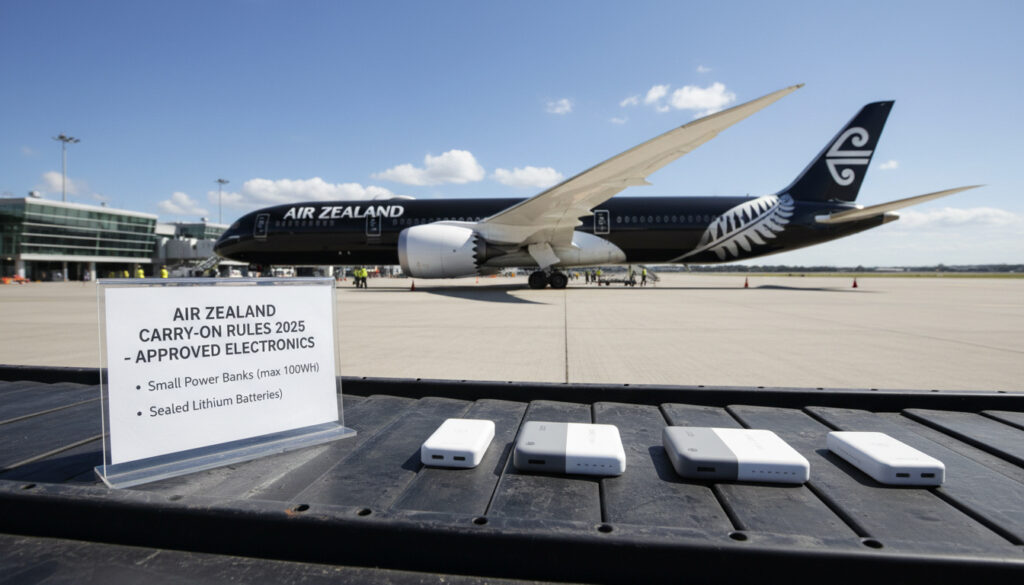
Air New Zealand Power Bank Rules – What You Can Bring in 2025
Air New Zealand permits passengers to carry power banks and spare lithium batteries exclusively within carry-on baggage, subject to strict capacity limits and safety protocols designed to mitigate fire risks during flight operations.
These regulations align with International Air Transport Association (IATA) guidelines and distinguish between battery watt-hour ratings, quantity restrictions, and physical condition requirements. Understanding the specific thresholds ensures compliance at boarding and prevents confiscation of essential charging devices.
Can You Take a Power Bank on Air New Zealand Flights?
Passengers may transport power banks aboard Air New Zealand aircraft, but strict limitations apply based on energy capacity and packaging standards. The carrier categorizes lithium batteries by watt-hours (Wh) for rechargeable units, establishing three distinct regulatory tiers that determine whether devices require approval or face prohibition.
| Up to 100Wh | Allowed in carry-on without approval |
| 100Wh to 160Wh | Allowed in carry-on with airline approval |
| Over 160Wh | Prohibited entirely from all baggage |
| Checked luggage | Power banks not permitted |
- Capacity restrictions apply to the battery’s watt-hour rating, not milliampere-hours (mAh) directly.
- Passengers are limited to two power banks per person.
- Devices must be intended for personal use only; commercial quantities are banned.
- Terminals must be protected from short circuits using tape or原厂 cases.
- Damaged, defective, or recalled batteries are prohibited regardless of capacity.
- Installed batteries within devices face different rules than spare units.
- Recent updates mandate specific in-flight storage locations.
| Specification | Limit | Application |
|---|---|---|
| Standard watt-hour rating | ≤100 Wh | No airline approval required |
| Extended watt-hour rating | 100-160 Wh | Airline approval mandatory |
| Prohibited capacity | >160 Wh | Banned from carry-on and checked |
| Power bank quantity | 2 per person | Carry-on only |
| Total spare batteries | 20 per person | Includes power banks |
| Voltage calculation | 3.7V typical | For mAh conversion formula |
| Terminal protection | Required | Insulation tape or protective case |
| Damaged batteries | Prohibited | All baggage types banned |
| Smart bag batteries (removable) | Carry-on only | If exceeding 0.3g lithium content |
| Smart bag batteries (fixed) | ≤2.7 Wh allowed | Checked only if powered off |
| Usage restriction | Personal use | Not for sale or distribution |
| In-flight charging | Prohibited | During all flight phases |
What Are the Maximum Power Bank Limits for Air New Zealand?
What is the maximum power bank size for Air New Zealand?
Travelers may bring power banks rated up to 100 watt-hours without prior notification to the airline. Devices falling between 100 and 160 watt-hours require explicit approval obtained before travel. The carrier prohibits any power bank exceeding 160 watt-hours from all passenger baggage.
To determine compliance when manufacturers list capacity only in milliampere-hours, passengers should calculate watt-hours by multiplying the mAh rating by the nominal voltage—typically 3.7 volts for lithium-ion cells—and dividing by 1000. For example, a 27,000 mAh power bank at 3.7V approximates 100 watt-hours, placing it at the allowable threshold without requiring special clearance.
How many power banks can I take on Air New Zealand?
The airline restricts travelers to two power banks per person. This allocation forms part of a broader allowance permitting up to twenty spare lithium batteries total within carry-on luggage. These items must remain easily accessible for security screening and potential flight attendant inspection.
Convert milliampere-hours to watt-hours using the formula: (mAh × V) / 1000. Most power banks display voltage on the device label; if absent, assume 3.7 volts for standard lithium-ion cells.
Can Power Banks Go in Checked Luggage on Air New Zealand?
Air New Zealand spare battery policy
Air New Zealand explicitly prohibits packing power banks and spare lithium batteries within checked luggage. This restriction applies regardless of watt-hour rating, protective packaging, or flight duration. Only batteries installed within electronic devices—such as those powering laptops or smartphones—may travel in the hold when carry-on space is unavailable, and even then require declaration at check-in.
Security screening detects loose batteries in checked baggage, resulting in mandatory removal and potential delays. Passengers should pack all portable chargers in hand luggage before arriving at the airport. Official Air New Zealand guidance confirms this prohibition extends to all battery types intended as replacements or backups.
Power banks discovered in checked luggage will be removed by ground staff. The airline does not provide compensation for items surrendered during security screening.
Air New Zealand Power Bank Rules for Charging and Safety
Can I charge my power bank on Air New Zealand flights?
While passengers may bring power banks aboard, charging these devices during flight remains prohibited. Additionally, since December 9, 2024, power banks must be stowed under the seat or in the seatback pocket throughout the journey; placement in overhead compartments is no longer permitted. Updated operational protocols reflect this specific storage requirement.
What if my power bank is damaged Air New Zealand?
Damaged, defective, or recalled batteries pose significant fire hazards and are banned from all Air New Zealand flights. Travelers should verify device integrity before packing, ensuring no swelling, corrosion, or physical deformation exists. Any battery subject to safety recalls must not travel on Air New Zealand aircraft.
Air New Zealand power bank rules for international flights
International services operated by Air New Zealand maintain these same standards, though connecting flights on partner airlines may impose additional restrictions. Passengers should verify specific requirements for codeshare segments, as other carriers might enforce different watt-hour limits or approval processes. Travelers crossing the Pacific should note that regional schedules, such as Samoa vs Tonga 2025 NZ Time, may affect connection planning but do not alter battery safety protocols.
Recent updates mandate that power banks remain in the passenger seat area rather than overhead bins, enabling rapid crew access should thermal runaway occur. Battery and device policies specify this placement restriction.
Timeline of Air New Zealand Battery Safety Developments
- 2016: IATA establishes standardized 100Wh threshold for spare lithium batteries in passenger cabins, forming the basis for current Air New Zealand regulations. FAA guidelines provide parallel benchmarks.
- 2021: Global aviation authorities tighten restrictions following documented lithium battery fire incidents on commercial flights.
- 2024: Air New Zealand confirms current policy framework remains unchanged, maintaining alignment with international safety standards.
- December 9, 2024: Implementation of revised in-flight storage protocols requiring power banks to remain in seat areas rather than overhead bins during all flight phases.
Verified Facts and Remaining Policy Questions
| Established Information | Information Remaining Unclear |
|---|---|
| Power banks allowed only in carry-on baggage | Specific documentation required for 100-160Wh approval |
| Maximum two power banks per passenger | Procedures for batteries missing manufacturer labels |
| In-flight charging explicitly prohibited | Exact voltage assumptions for unlabeled multi-cell devices |
| Damaged batteries banned from all flights | Enforcement consistency across all partner airline networks |
Context Behind Air New Zealand Lithium Battery Restrictions
Lithium-ion batteries present thermal runaway risks—rapid overheating that can ignite fires difficult to extinguish in pressurized cargo holds. Air New Zealand’s carry-only mandate for spares reflects IATA Dangerous Goods Regulations designed to keep potential ignition sources within the cabin where crew can access fire suppression equipment. These measures parallel Federal Aviation Administration standards and reflect incident data showing battery-related smoke events occur more frequently than previously recorded.
Aviation authorities worldwide maintain these restrictions consistently across 2024 and 2025, with no anticipated regulatory relaxation. For travelers considering large equipment purchases, understanding transport limitations becomes as crucial as knowing Land Rover Defender Price NZ when planning remote driving expeditions requiring electronic gear.
Official Sources and Regulatory Guidance
“Power banks and spare lithium batteries are only permitted in carry-on baggage. They must be protected from damage and short circuit.”
— Air New Zealand Dangerous Goods Policy
“Spare batteries must not be placed in checked luggage. Approval is required for lithium ion batteries exceeding 100Wh but not exceeding 160Wh.”
Summary
Air New Zealand permits power banks up to 160 watt-hours in carry-on luggage only, with a strict limit of two units per passenger and specific storage requirements during flight. Travelers should verify capacity ratings using the watt-hour calculation, protect terminals from short circuits, and confirm devices show no damage before departure. Policies align with international IATA standards and remain consistent across domestic and international routes.
Frequently Asked Questions
Can I take a power bank on Air New Zealand domestic flights?
Yes. Domestic and international flights share identical lithium battery restrictions. Power banks must travel in carry-on baggage with the same watt-hour limits and quantity restrictions applying across all Air New Zealand services.
Do Air New Zealand power bank rules apply to AirPods cases?
Yes. Rechargeable device cases containing lithium batteries follow spare battery regulations. When packed separately from the device, these cases count toward your two power bank limit and must remain in carry-on luggage.
What happens if my power bank is confiscated at security?
Confiscated items are disposed of according to dangerous goods protocols. Air New Zealand does not compensate for surrendered power banks exceeding capacity limits or improperly packed in checked luggage.
Are solar power banks treated differently by Air New Zealand?
No. Solar power banks containing lithium batteries face identical restrictions based on watt-hours and packaging. The charging mechanism does not exempt these devices from carry-on requirements or capacity limits.
Can I bring power banks for sale or distribution?
No. Air New Zealand limits batteries to personal use only. Commercial quantities or devices intended for resale violate dangerous goods policies and will be refused boarding.
How do I calculate watt-hours if my power bank only shows mAh?
Multiply the mAh rating by the voltage (typically 3.7V) and divide by 1000. For example, 20,000mAh at 3.7V equals 74Wh. Contact the manufacturer if voltage is unstated.
Does Air New Zealand allow power banks on connecting flights with partner airlines?
Partner airlines may enforce additional restrictions. Verify specific requirements for codeshare segments, as other carriers might impose different watt-hour limits or approval processes.
More related posts
 What Is Recovery Mode on Android & iPhone? Explained
 Vape Stores in Hamilton: Shops, Delivery & Health Tips
 Job Check Processing Time: NZ AEWV & Irish Permit Wait Times
 Download Free Logo Canva Freelogopng: Step-by-Step Guide
 2degrees Top Up Online: How to Top Up 2degrees Prepay
 Foot and Mouth Disease: HFMD vs FMD Symptoms & Treatment
 Online Casino NZ Real Money: Best Sites & Payout Guide 2026
 Whale Watch Kaikoura Reviews: Price, Seasickness, and Is It Worth It