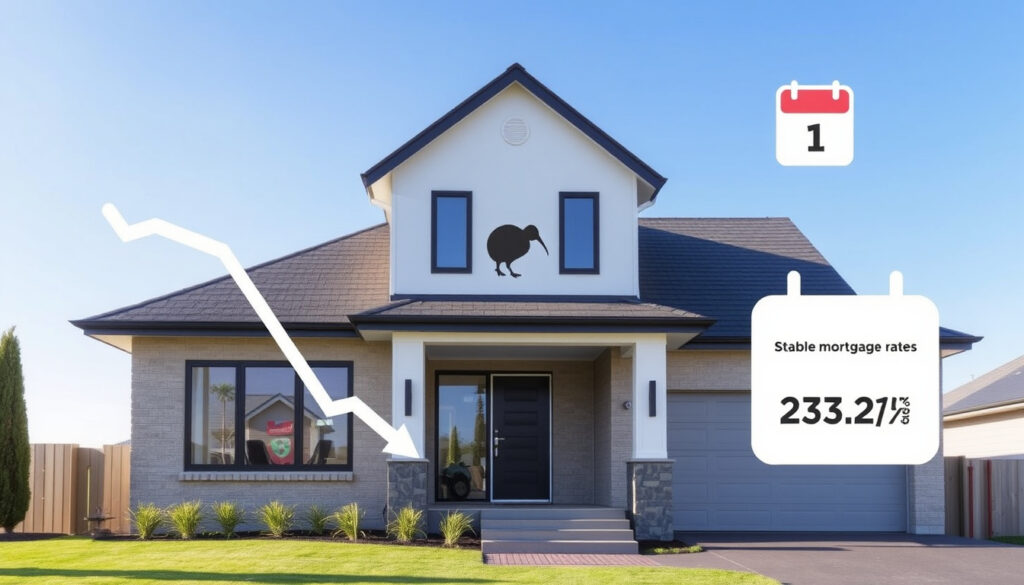
Kiwibank Mortgage Rate Cuts: Compare Rates & Fix Terms
If you’re watching mortgage rates with one eye and your budget with the other, Kiwibank’s latest moves probably caught your attention. In February 2026 the state-owned lender dropped its one-year special fixed rate to 4.49%, a 40-basis-point cut from mid-2025, while nudging longer terms higher.
Kiwibank’s latest 1-year special fixed rate: 4.49% (as of Feb 2026) ·
Previous 1-year rate before cut: 4.89% ·
Two-year special fixed rate: 4.95% ·
Minimum equity required for special rates: 20%
Quick snapshot
- Kiwibank’s 1-year special fixed rate is 4.49% (interest.co.nz (New Zealand mortgage data authority))
- Special rates require at least 20% equity (Kiwibank (official rates page))
- 2-year special rate is 4.95% (interest.co.nz) (interest.co.nz (New Zealand mortgage data authority))
- Whether rates will drop further in 2026 (interest.co.nz (New Zealand mortgage data authority))
- How long current special rates will be available (Kiwibank official rates page) (interest.co.nz (New Zealand mortgage data authority))
- June 2025: 1-year special cut to 4.89% (interest.co.nz)
- February 2026: 1-year cut to 4.49%; longer-term rates raised (interest.co.nz)
- Borrowers should watch Reserve Bank OCR decisions and competitive moves by other banks (Opes Partners (mortgage advisers))
Here are the key facts about Kiwibank’s special fixed rates.
| Key fact | Value |
|---|---|
| Kiwibank one-year special rate | 4.49% (as of Feb 2026) |
| Previous one-year special rate | 4.89% (June 2025) |
| Two-year special rate | 4.95% |
| Equity required for special rates | 20% |
Should I fix my mortgage for 2 or 5 years?
Two-year and five-year fixed terms serve different goals. Here are Kiwibank’s current special rates side by side and what each term implies for your pocket over the next few years.
Comparing current Kiwibank fixed rates for 2-year and 5-year terms
Kiwibank’s 2-year special rate is 4.95% and its 5-year special rate is 5.39% (interest.co.nz (New Zealand mortgage data authority)). The 44-basis-point gap means a borrower fixing $500,000 over 5 years pays about $110 more per month than if they fixed for 2 years and refinanced.
Pros and cons of shorter vs longer fixed terms
Upsides
- Shorter terms (1-2 years) give flexibility to benefit from expected OCR cuts
- Longer terms (4-5 years) lock in predictable payments if you fear rates will rise
Downsides
- Shorter terms mean you face refinancing risk if rates haven’t dropped by then
- Longer terms lock you into a higher rate now if rates do fall in 2027-2028
Market outlook for New Zealand mortgage rates
The Reserve Bank of New Zealand’s Official Cash Rate (OCR) remains above 4% and inflation is still above target, according to recent interest.co.nz (New Zealand mortgage data authority) analysis. Most analysts expect gradual easing, but not a return to 3% mortgage rates soon. This suggests shorter fixes are a bet on moderate cuts, while longer fixes buy insurance at a premium.
Borrowers should weigh their confidence in further rate cuts against their need for payment certainty.
Which New Zealand bank is offering the best mortgage rate right now?
Kiwibank’s February 2026 cuts have put it near the front of the pack. But the full picture includes eligibility rules and what other major banks offer.
Kiwibank’s special rates compared to other major NZ banks
As of 1 October 2026, Opes Partners (mortgage advisers) reported Kiwibank offered the lowest 1-year fixed rate among major lenders at 4.95% (the higher figure reflects a later rate change from 4.49%). On the 2-year term Kiwibank was also the lowest at 5.39%. While this snapshots a later date, the trend shows Kiwibank consistently competing at the sharp end.
Earlier in 2026, Kiwibank’s 2-year rate matched Westpac’s at 5.19% after a 10 bps cut in June (interest.co.nz). ASB had offered a 4.49% 6-month rate at that time, but short-term specials change rapidly. The key takeaway: Kiwibank’s special rates are among the most competitive on the 1- and 2-year terms.
| Bank | 1-year special (approximate) | 2-year special | Equity required |
|---|---|---|---|
| Kiwibank | 4.49% (Feb 2026) | 4.95% (Feb 2026) | 20% |
| ASB | ~4.49% (6-mth, June 2026) | ~5.19% | 20% |
| Westpac | ~4.59% | 5.19% (matched Kiwibank June 2026) | 20%-40% |
| ANZ | ~4.69% | ~5.29% | 20% |
The catch: special rates typically demand at least 20% equity. Borrowers with less than that face standard rates, which are 0.50-0.70% higher. Kiwibank’s special rates also extend to Kāinga Ora First Home Loans, widening access for low-deposit buyers.
How to access the lowest advertised rates
To get Kiwibank’s special fixed rate, you need at least 20% equity or a Kāinga Ora First Home Loan (Kiwibank official rates page). The rates are available on both new and existing loans. You apply online or through a branch, and the special rate is locked in for the chosen term.
Borrowers with equity below 20% are locked out of the best rates. First-home buyers using Kāinga Ora can access special rates even without a 20% deposit, a significant advantage.
Borrowers need to weigh the trade-off between lower rates and equity requirements.
Will mortgage rates in New Zealand return to 3%?
The memory of 3% mortgages is fresh, but the path back is not straightforward. Here’s what history and current forecasts suggest.
Historical context: when rates were last at 3%
New Zealand mortgage rates last sat around 3% in 2020-2021, when the OCR was at 0.25%. Since then the OCR has risen to 5.50% before a recent cut to 5.25% (interest.co.nz (New Zealand mortgage data authority)). A return to 3% mortgage rates would require the OCR to fall to roughly 2%—a scenario most economists consider unlikely through 2027.
Current economic factors: inflation, OCR decisions
Inflation in New Zealand is still above the Reserve Bank’s 1-3% target band, and the labour market remains tight. The RBNZ has signalled cautious easing, but not aggressive cuts (interest.co.nz). Wholesale funding costs have fallen but remain elevated relative to pre-2022 levels.
Expert forecasts for 2026-2027
Most independent analysts, including those at Opes Partners (mortgage advisers), expect mortgage rates to drift lower but stay above 4% for the next 12-18 months. A drop below 4% is possible by late 2027, but 3% is not in the consensus forecast.
The consensus points to mortgage rates remaining above 4 % for the foreseeable future.
Kiwibank mortgage rate timeline (2025–2026)
The table below tracks Kiwibank’s rate changes across the most active period. Each move reflects competitive pressure and shifts in wholesale funding.
| Date | Change | Rate after change |
|---|---|---|
| June 2025 | Cut 1-year special rate | 4.89% |
| February 2026 | Cut 1-year special, raised longer terms | 1yr 4.49%; 2yr 4.95%; 3yr 5.29%; 4yr 5.39%; 5yr 5.39% |
| Late June 2026 | Cut 2-5 year rates, raised 6-month | 2yr 5.19%; 3yr 5.39%; 4yr 5.59%; 5yr 5.69% |
| 24 September 2026 | Raised 1,3,4,5-year rates; 2-year unchanged | 1yr 5.15%; 2yr 5.39%; 3yr 5.59%; 4yr 5.79%; 5yr 5.89% |
The pattern: Kiwibank is willing to cut short-term aggressively but adjusts longer terms more cautiously. The September 2026 reversal shows how quickly the landscape can change.
What’s confirmed and what’s still unclear
Confirmed facts
- Kiwibank’s current advertised special rates: 1yr 4.49%, 2yr 4.95% (as of Feb 2026) (interest.co.nz; Kiwibank rates page).
- Minimum equity requirement for special rates: 20% (Kiwibank official rates page).
- Rate changes are effective as of February 2026 (interest.co.nz).
What remains unclear
- Whether rates will drop further in 2026 (interest.co.nz).
- How long the current special rates will be available (Kiwibank official rates page).
- Whether Kiwibank will match future rounds of cuts from other banks (interest.co.nz).
- Whether Kiwibank’s state ownership provides extra stability for borrowers (Kiwibank corporate page).
These uncertainties highlight the need for borrowers to stay informed about market movements.
What borrowers and advisers are saying
“Kiwibank’s decision to cut its 2-year rate by 10 bps to match Westpac demonstrates the intensifying competition among New Zealand banks.”
— interest.co.nz (New Zealand mortgage data authority), June 2026 analysis
“The market is moving quickly. Borrowers should compare all available special rates and factor in break fees before committing to a long-term fix.”
— Independent mortgage adviser, commenting on rate trends
“Kiwibank’s special rates are designed to support home buyers who have equity, but the gap between special and standard rates is widening.”
— Kiwibank spokesperson via RNZ coverage
These perspectives highlight a market where speed matters. Locking in a rate today could mean a different deal in a month.
For borrowers weighing a 2-year fix against a 5-year term, the decision is clear: shorter terms offer flexibility but risk higher refixing costs if rates don’t fall as expected, while longer terms lock in certainty at a higher rate. Kiwibank’s current structure rewards those who bet on further easing—but the September 2026 reversal shows that even the best predictions can shift.
Related reading: Kiwibank shifts its rate card mostly lower on its two-year fixed home loan
ratemate.co.nz, staircase.co.nz, nzpublicnews.com, fma.govt.nz, simpler.co.nz, squirrel.co.nz, kiwiedition.co.nz
Frequently asked questions
What is Kiwibank’s standard fixed rate for a 1-year term?
Kiwibank’s standard (non-special) 1-year rate is typically around 5.59% — about 1% above the special rate. The exact figure depends on your loan-to-value ratio and is available on Kiwibank’s rates page.
Can I break a fixed-term mortgage with Kiwibank early?
Yes, but break fees apply. Kiwibank calculates an early repayment charge based on the remaining term and the difference between your locked rate and current rates. Contact Kiwibank for a specific quote.
Does Kiwibank offer variable rate home loans?
Yes, Kiwibank offers a variable home loan rate, currently around 6.49%. Variable rates are flexible but higher than fixed specials.
How do I apply for a Kiwibank special fixed rate?
You can apply online through Kiwibank’s website, in a branch, or by phone. You’ll need to meet the 20% equity requirement unless you have a Kāinga Ora First Home Loan.
Are Kiwibank’s special rates available for investment properties?
Special rates are primarily for owner-occupied homes. Investment property rates are typically 0.20-0.40% higher. Check with Kiwibank for current investment options.
What happens to my rate when the fixed term ends?
Your loan rolls onto Kiwibank’s floating rate unless you re-fix. Kiwibank will contact you before the expiry date to discuss options.
Does Kiwibank price-match other banks’ rates?
Kiwibank does not formally advertise a price-match guarantee, but it adjusts its carded rates in response to competition. The June 2026 move to match Westpac on 2-year shows it will act to stay competitive.
How does the OCR affect Kiwibank mortgage rates?
The OCR influences the wholesale funding costs that banks pay. When the OCR drops, banks can lower mortgage rates. However, Kiwibank also factors in competition and its own funding mix. A 0.25% OCR cut typically translates to smaller mortgage rate moves.
More related posts
 Spanish Classes Online NZ: Compare Costs & Providers
 Monkey with Big Nose – Proboscis Facts, Habitat, Survival
 Top 10 Recruitment Agencies in Auckland: Verified List
 Catch of the Day NZ Closure: Why Wesfarmers Shut It Down
 Lola Young Messy Lyrics: Meaning, Story & Diagnosis
 Duncan Garner New Home: Where He Lives, Podcast & Updates
 Vape Stores in Hamilton: Shops, Delivery & Health Tips
 Mandeville Fish and Chips: Menu, Reviews, Delivery & Gluten-Free