O+ Blood Type: Facts, Rh Factor, Rarity and Compatibility
Most people can name their blood type, but far fewer know what the plus sign at the end actually changes. The plus sign matters most in transfusions and pregnancy, and that is exactly where online claims get careless.
Share of population with O-negative blood: About 7% · Share of population with O-positive blood: About 37-38%, the most common blood type · Rh factor rule: RhD antigen present = Rh positive; absent = Rh negative · Universal red cell donor type: O negative
The table below sets the verified figures side by side, so each number can be traced to a named source.
| Item | Verified value | Scope |
|---|---|---|
| O positive share | About 37-38% | US and global estimates |
| O negative share | About 7% | US population |
| Rh-positive share | About 85% | US |
| Rh-negative mothers at risk | About 15% of US women | US |
| AB negative rank | Rarest of the eight common types | US |
| O positive share | About 38% | Australia |
| Rh-null (golden blood) | Fewer than 50 known people | Worldwide |
| Rh immune globulin timing | Around 28 weeks, and within 72 hours after delivery of an Rh-positive baby | Current practice, undated in source |
Quick snapshot
- O positive is one of the most common blood types, at about 37-38% of people (WebMD (health information publisher))
- According to BloodBook (online blood-type reference), O negative is the universal red cell donor type
- Population shares differ by country and source, and the figures in this guide are US or Australian (Healthdirect Australia (national health service))
- Rh-null, known as golden blood, is held by fewer than 50 known people (Verywell Health (health information publisher))
- Some sources list rarer types as high in transfusion demand, but the figures were not verified against donor data (Healthdirect Australia (national health service))
- Stanford Children’s Health updated its blood-types-in-pregnancy page on (Stanford Children’s Health (academic medical center))
- Rh immune globulin timing is listed as current practice without a date, according to Blood Analysis (online blood-type guide)
- Rh-negative mothers should have Rh status checked at the first prenatal visit (UC Davis Health (academic medical center))
- Regional frequencies beyond the US and Australia are thinly documented in the sources reviewed (imedic.health (online health education site))
What is the Rh factor in blood types?
The Rh factor is a protein on red blood cells, specifically the RhD antigen. Blood with the antigen is Rh positive (+). Blood without it is Rh negative (−). The American Red Cross describes blood type as inherited from parents and unchanged over a lifetime.
Rh status sits alongside the ABO group. A person’s ABO group (A, B, AB, or O) and Rh status are separate labels, so O positive and O negative share the O group but differ on RhD.
How does Rh-negative differ from Rh-positive?
Rh-negative blood lacks RhD. Rh-negative people can make anti-Rh antibodies after exposure to Rh-positive blood, through a transfusion or a pregnancy. That is why Rh status is checked before blood is given.
“Rh-negative patients should only get Rh-negative red blood cells, except in emergencies.”
American Cancer Society transfusion guidance
What does the Rh factor mean for O+ versus O-negative blood?
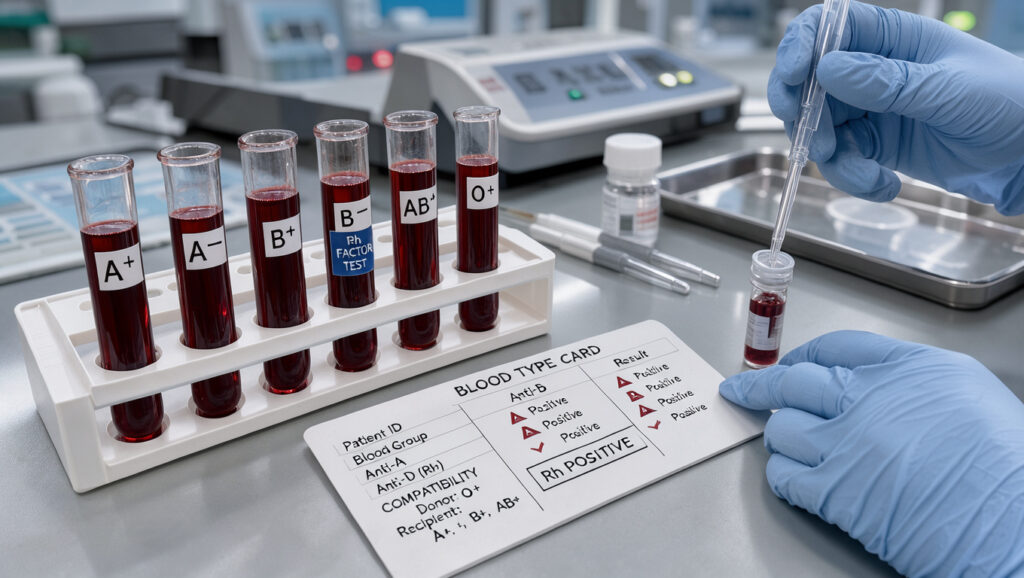
Both types carry the O group, so neither carries A or B antigens. O-positive red cells can go to Rh-positive recipients, which includes O+, A+, B+, and AB+ patients, according to a Ubie Health compatibility note. O-negative red cells lack RhD, which makes them the emergency choice when a patient’s Rh status is not yet known.
What are the most rare blood types?
Healthline ranks AB negative as the rarest of the eight common types in the US, at about 0.6-1%. O positive sits at about 37-38%, which makes it the most common. Cleveland Clinic defines a rare blood type as one that appears in roughly 1 in 1,000 people. By that cutoff, AB negative at about 1% is uncommon rather than truly rare, so the rarity label depends on which list you use.
Is O negative the rarest blood type?
No. O negative is about 7% of the US population. That is less common than O positive, but it is not the rarest of the eight common types. AB negative holds that position.
Which blood types are in highest demand for transfusion?
O negative is in highest demand for emergencies, because it is the universal red-cell donor type, according to the American Red Cross. Some sources also describe B-negative as in strong demand. The research reviewed did not verify that figure, so treat it as unconfirmed.
Why is O-negative blood so rare?
ABO and Rh are inherited independently of each other. Being Rh negative requires inheriting two copies of the Rh-negative allele, which is less frequent in most populations. The result is that O-negative blood combines a common ABO group with an uncommon Rh status.
Frequencies also vary by ancestry. The American Red Cross reports that about 45% of Caucasians are type O, while 51% of African Americans and 57% of Hispanics are type O (any Rh status). National figures therefore differ from global averages.
How common is O-negative blood across populations?
A low-confidence secondary source reports that about 15% of White Americans are Rh negative, compared with about 7-8% of Black Americans and 1-3% of Asian and Hispanic Americans. Verify these figures against a primary source before citing them.
Is type O the healthiest blood type?
No established evidence shows that type O is overall healthier than other types. Blood type is not a general measure of health. Some associations with specific conditions appear in research, but they are not clinical rules.
Type O’s role as the universal red-cell donor type is a transfusion fact. It is not a health ranking.
Is O negative the worst blood type to have?
No source reviewed supports that claim. Rh-negative status matters for transfusion matching and pregnancy checks. It does not place a person at a general health disadvantage.
What diseases are O-negative blood prone to?
Blood group associations with infection and disease are studied. The reported differences are small and inconsistent across studies. Clinical guidance does not treat O-negative status as a disease risk marker on its own.
Is type O negative blood less likely to get COVID?
The sources reviewed do not link O-negative blood to COVID-19 risk in either direction. A claim about O-negative blood and COVID needs a controlled study, not a blood-type chart.
How transfusion and pregnancy checks work
Blood typing and cross-matching come before any transfusion. The steps below follow the sequence in the sources reviewed.
- Blood typing identifies the ABO group and Rh status, which the MedlinePlus entry (NIH) describes as needed for a safe transfusion or transplant.
- Cross-matching checks donor blood against the recipient before it is given. ABO-incompatible transfusion can cause a severe, sometimes fatal hemolytic reaction.
- Rh-negative patients receive Rh-negative red cells, except in emergencies.
- Rh-negative pregnant people have Rh status checked at the first prenatal visit, with antibody screening as recommended by UC Davis Health.
- Rh immune globulin is given around 28 weeks of pregnancy and within 72 hours after delivery of an Rh-positive baby, per Blood Analysis.
The pattern: the checks are routine, and they prevent harm when they are done on schedule. Missing the 72-hour window after delivery leaves the protection window open.
“Blood typing is done so you can safely receive a blood transfusion or a transplant.”
MedlinePlus blood typing entry (NIH)
Rh incompatibility can cause fetal anemia, jaundice, and abnormal heart rate in untreated cases. The American Red Cross also notes that O-negative blood is in high demand for emergencies. A mother who is Rh negative and carries an Rh-positive baby can develop anti-D antibodies, which is the risk that Rh immune globulin prevents, as Stanford Children’s Health explains.
“If you are Rh-negative and your unborn baby is Rh-positive, problems may develop during that pregnancy or future pregnancies.”
UC Davis Health rhesus incompatibility guidance
Related reading: Is couscous gluten free? Health facts
redcrossblood.org, cancer.org, superpower.com, medlineplus.gov, blood-analysis.com, my.clevelandclinic.org, sciencenotes.org
Frequently asked questions
Is O negative called golden blood?
No. Golden blood refers to Rh-null, an extremely rare phenotype. Fewer than 50 people in the world are known to have it, according to Verywell Health.
Is there a difference between O+ and O blood types?
Yes. Both belong to the O group, but O positive carries the RhD antigen and O negative does not.
Which blood groups can O negative blood donate red cells to?
The American Red Cross calls O negative the universal red-cell donor type. Compatibility still depends on the recipient’s group and Rh status, so clinical teams confirm the match before transfusion.
Is O positive the most common blood group?
Yes. WebMD reports that O positive is found in about 37-38% of people, which makes it one of the most common types.
Why does Rh status matter during pregnancy?
An Rh-negative mother carrying an Rh-positive baby can develop anti-D antibodies. Those antibodies can cause hemolytic disease of the fetus and newborn, which Rh immune globulin helps prevent.
Before you act on a blood-type claim, check it against a Tier 1 source like the American Red Cross or MedlinePlus. For a related practical example, see the Medic Alert Bracelet NZ guide, since blood type is often recorded on medical ID.
More related posts
 What Is a Protein Shake? Definition, Benefits & Safety
 What Is Global Warming? Causes, Effects, and Solutions
 Q Card Credit Card Promotions: $0 Fee, $80 Cashback & 3 Months
 How to Calculate Percentage Increase: Formula, Examples & Tips
 How to Edit a PDF: Free & Paid Methods for Any Device
 Medic Alert Bracelet NZ: Cost, Engraving & Where to Buy
 Auckland to Honolulu Flight Time: 8h 25m Direct Guide
 Suspicious Item Nelson Evacuation: Waimea Road Incident