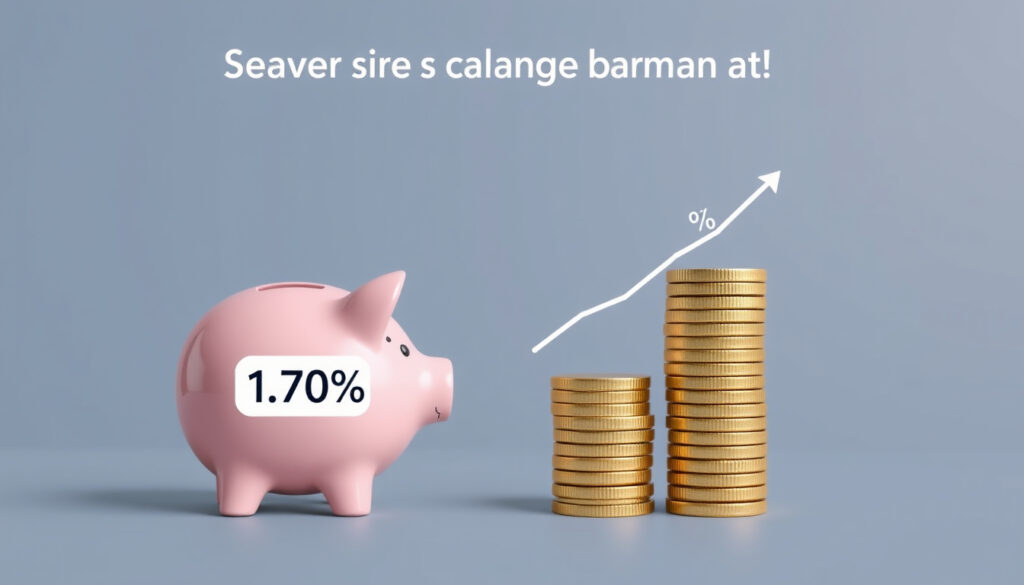
BNZ Rapid Save Interest Rate: 1.70% vs Better Alternatives
If you’ve been stashing cash in a BNZ Rapid Save account, you may have noticed your interest hasn’t kept up with what other banks are offering — at 1.70% p.a., BNZ’s online saver is now trailing several alternatives in New Zealand’s savings market. This article breaks down the current rate, how it works, and where you could earn more in 2025.
Current BNZ Rapid Save interest rate: 1.70% p.a. · Minimum balance: $0 · Monthly fee: $0 · Access method: Instant via mobile app or online banking · Interest calculation: Daily balance, paid monthly
Quick snapshot
- Interest rate: 1.70% p.a. (BNZ official product page)
- No monthly fee (BNZ)
- One free withdrawal per bank month, then $3 each (Canstar NZ)
- Interest calculated daily, paid monthly on bank month-end (BNZ support – bank-month schedule)
- Exact historical rate changes (no official timeline available)
- Future rate changes
- Whether promotional or bonus rates exist alongside the base rate
- Accuracy of third-party aggregator claims (e.g., Money Compare lists 3.2% – unconfirmed)
- Rate last confirmed via BNZ product page as 1.70% p.a. — no recent change announced
- Comparison sites (Interest.co.nz, Canstar) all quote the same figure
- Compare BNZ Rapid Save with higher-paying accounts like Westpac Notice Saver (3.00%) or Rabobank 6-month term (3.65%)
- Consider switching or opening a second account to boost returns (Westpac Notice Saver (3.00%))
Eight key facts, one takeaway: BNZ Rapid Save is simple and fee-free but pays below most competitors.
Here is a quick reference of BNZ Rapid Save’s key features.
| Label | Value |
|---|---|
| Account name | BNZ Rapid Save |
| Current interest rate | 1.70% p.a. |
| Minimum balance to open | $0 |
| Monthly base fee | $0 |
| Transaction fees | None (one free withdrawal per bank month, $3 thereafter) |
| Access methods | Online banking, mobile app |
| Interest calculation | Daily balance, paid monthly |
| Link to official page | BNZ Rapid Save official product page |
What is the current BNZ Rapid Save interest rate?
The BNZ Rapid Save accounts interest rate is 1.70% p.a., as confirmed by BNZ official product page. This rate applies to every dollar in the account, regardless of balance. The same figure is reported by Interest.co.nz comparison site and Canstar NZ financial comparison service.
How is BNZ Rapid Save interest calculated?
- BNZ calculates interest on the daily closing balance and pays it monthly on what the bank calls a “bank month” — not a calendar month. BNZ support page explains bank-month schedule.
- Example: $10,000 at 1.70% p.a. earns roughly $170 per year before tax, paid in twelve monthly chunks.
Does BNZ Rapid Save have any fees?
- No monthly account fee. BNZ confirms $0 base fee.
- Withdrawals: one free per bank month; each additional withdrawal costs $3 (Canstar NZ.
What is the BNZ Rapid Save interest rate history?
- No official historical rate table is publicly available from BNZ. Comparison sites and user forums suggest the rate has dropped over the past few years, but exact dates are not documented.
- As of early 2025, 1.70% p.a. is the recognised rate across all major aggregators.
The implication: BNZ Rapid Save is straightforward and cheap to hold, but the rate is fixed only until BNZ decides to change it — and history suggests it moves slowly.
Which bank has the best savings interest rate in NZ?
Three competitors, one pattern: most major banks now offer higher headline rates than BNZ, though many come with conditions.
Compare BNZ Rapid Save with other savings accounts below.
| Account | Interest rate | Conditions / notes |
|---|---|---|
| BNZ Rapid Save | 1.70% p.a. | No minimum, no fees, one free withdrawal per month |
| Westpac Notice Saver | 3.00% p.a. | 30-day notice required to withdraw without penalty (Westpac NZ) |
| ANZ Online Saver | 0.40% p.a. | Instant access, no fees (ANZ NZ) |
| Kiwibank FastSaver | 1.80% p.a. | Instant access, $0 min balance |
| Rabobank Online Saver (1-month) | 2.00% p.a. | No notice period, but may have introductory timing (Rabobank NZ) |
| Heartland Bank Notice Saver (90 days) | 2.95% p.a. | 90-day notice required (MoneyHub NZ) |
Which bank gives 7% interest for a savings account?
No standard New Zealand savings account currently offers 7% interest. Such rates are sometimes seen in promotional term deposits or high-risk investments, but not in a regular on-call or notice saver. The highest verifiable rate among major banks is Westpac Notice Saver at 3.00%, and Rabobank’s 6-month term deposit at 3.65%.
Who has 5% interest on savings?
No mainstream NZ savings account offers 5% interest in early 2025. Some credit unions or bonus-saver accounts may reach that level with strict conditions, but they are not listed by the major comparison sites. For example, Westpac Bonus Saver offers up to 1.25% only if conditions are met (Westpac NZ).
Is Westpac or BNZ better?
- For savings growth: Westpac offers higher rates (3.00% Notice Saver vs BNZ’s 1.70%).
- For flexibility: BNZ Rapid Save allows one free withdrawal per month with instant access; Westpac Notice Saver requires 30 days’ notice.
- For fees: both have $0 monthly fees.
The pattern: BNZ wins on instant access, but loses on rate by a wide margin.
How much interest will $100,000 make in a savings account?
Four rates, one conclusion: the difference between 1.70% and 3.50% on $100,000 is nearly $2,000 per year before tax.
- At BNZ Rapid Save (1.70%): $1,700 per year
- At 3.50% (an achievable notice-saver rate): $3,500 per year
- At 5.00% (not currently available in NZ savings): $5,000 per year
- At Westpac Notice Saver (3.00%): $3,000 per year
Source: interest calculations based on rates from Westpac NZ and Interest.co.nz.
At what age should you have $200,000 saved?
Retirement savings benchmarks suggest having roughly $200,000 by age 35, though this varies by lifestyle and income. The MoneyHub NZ guide on savings notes that “the earlier you start, the more compounding works in your favour.” If you’re earning only 1.70% on that $200,000, you’d earn $3,400 a year — far less than what a 3.50% account would yield ($7,000).
How does compounding affect savings growth?
With BNZ Rapid Save, interest is paid monthly and added to the balance, so compounding occurs. At 1.70%, the effect is modest. Over 10 years, $100,000 at 1.70% compounded monthly grows to about $118,500 — still less than the same sum at 3.50% (about $141,800). The compounding gap widens as rates rise.
Why this matters: a low base rate means your savings lose purchasing power after inflation. With NZ inflation above 2%, a 1.70% return is negative in real terms.
For a saver with $100,000, sticking with BNZ Rapid Save costs you roughly $1,300 a year in lost interest compared to a 3.00% account like Westpac Notice Saver. That’s real money — enough for a family break or a year of insurance premiums.
Can I have multiple BNZ Rapid Save accounts?
Yes, BNZ allows customers to open more than one Rapid Save account according to its product page BNZ Rapid Save product page. Each account operates independently with its own balance and interest.
How do I open a BNZ Rapid Save account?
- You must already hold a BNZ everyday transaction account (or open one alongside).
- Apply online via BNZ’s internet banking, or visit a branch.
- No minimum deposit required — you can start with $0.
- Account is usually available within minutes if applying online.
What are the rules of BNZ Rapid Save?
- No minimum balance.
- No monthly fee.
- One free withdrawal per bank month; $3 per extra withdrawal.
- Interest calculated daily, paid monthly on bank month-end.
- Must be linked to an eligible BNZ transaction account for deposits/withdrawals.
The trade-off: multiple accounts let you bucket savings goals, but each extra account still earns the same 1.70% — so you’re not increasing your rate.
Is 3.5% a good savings account rate?
In the current NZ environment, 3.5% is above the average savings rate but not extraordinary. New Zealand’s official cash rate sits at 5.50% (as of early 2025), so a savings rate of 3.5% represents a discount of about 2 percentage points. Compared to BNZ Rapid Save’s 1.70%, 3.5% is excellent — nearly double the return.
What is a good interest rate on a savings account?
A “good” rate should at least keep pace with inflation. The Reserve Bank of New Zealand’s inflation target is 1–3%, so any rate above 3% is currently reasonable. Term deposits can reach 4–5%, but lock up your money. MoneyHub NZ’s guide to best savings accounts notes that “rates above 2.5% are considered competitive” in the current market.
How does inflation affect the real return?
With inflation at 2.5–3%, a savings account earning 1.70% is losing purchasing power each year. The real return is negative. Even 3.5% only yields a small positive real return. That’s why many savers turn to notice savers or term deposits to lock in higher rates.
The catch: a 3.5% rate is good, but only if the bank maintains it. Notice accounts often have variable rates.
If you value instant access above all else, BNZ Rapid Save’s 1.70% is the price you pay for liquidity. But if you can plan withdrawals a month ahead, Westpac Notice Saver’s 3.00% offers nearly twice the return with minimal sacrifice.
Pros and cons of BNZ Rapid Save
Upsides
- No minimum balance — start with $0
- No monthly fees
- One free withdrawal per month
- Instant access via mobile or online banking
- Interest paid monthly, compounding automatically
Downsides
- Low base rate (1.70% p.a.) — below most competitors
- Only one free withdrawal per month; $3 fee for extra withdrawals
- No bonus or introductory rate available
- Negative real return after inflation
- Requires an existing BNZ transaction account
Steps to open a BNZ Rapid Save account
- Log in to BNZ internet banking, or visit a branch.
- If you don’t have a BNZ transaction account, open a BNZ One account first.
- Choose “Rapid Save” from the savings account options.
- Confirm your details: name, address, tax number.
- Transfer money from your transaction account to start earning interest — no minimum needed.
- Set up automatic regular transfers if you want to build the balance.
Why this matters: opening is simple, but the real decision is whether 1.70% is worth the effort. For many, the answer is no — unless you need instant access.
What’s confirmed and what’s unclear
Confirmed facts
- BNZ Rapid Save pays 1.70% p.a. (BNZ official product page)
- No monthly fee (BNZ)
- One free withdrawal per bank month; $3 each extra (Canstar NZ)
- Interest calculated daily and paid monthly on bank month-end (BNZ support page)
What’s unclear
- Exact historical rate changes (no official timeline available)
- Future rate changes
- Whether promotional or bonus rates exist alongside the base rate
- Accuracy of third-party aggregator claims (e.g., Money Compare lists 3.2% – unconfirmed)
The editor’s take: what is verified is solid, but the lack of rate history transparency makes it harder for savers to judge BNZ’s long-term competitiveness.
What others are saying
BNZ Rapid Save pays interest on every dollar in the account, regardless of balance, with no monthly account fee.
— BNZ official product page
“At 1.70% it’s no longer worth keeping money there. You can get 3% with Westpac if you can wait 30 days.”
— Reddit user on r/PersonalFinanceNZ community
“A good savings account rate should at least keep pace with inflation. In New Zealand, anything above 2.5% is currently considered competitive.”
— MoneyHub NZ independent financial comparison site
The consensus: BNZ Rapid Save is safe and simple, but the rate is a weak point that many savers are outgrowing.
Summary: is BNZ Rapid Save right for you?
BNZ Rapid Save offers immediate access and zero fees, which suits emergency funds or short-term goals. But at 1.70% p.a., it’s one of the lowest on-call rates among major NZ banks. For New Zealand savers looking to grow their money, the choice is clear: either accept the convenience and low return, or switch to a notice saver like Westpac’s (3.00%) or Rabobank’s term deposits (up to 3.65%) and earn nearly twice as much — sacrificing a few days’ notice for hundreds or thousands more in interest each year.
Related reading: BNZ Rapid Save · Understanding a bank month – how interest and withdrawals work
Frequently asked questions
What is the difference between BNZ Rapid Save and BNZ Online Call?
BNZ Rapid Save is an online savings account designed for everyday savers, while BNZ Online Call (now discontinued for new customers) was a similar instant-access account. Rapid Save replaced it and has the same fee structure.
Can I link my BNZ Rapid Save to my everyday transaction account?
Yes. You need an active BNZ transaction account (such as a BNZ One account) to deposit into and withdraw from Rapid Save. You cannot use it as a standalone account.
How often is interest paid on BNZ Rapid Save?
Interest is paid monthly, on what BNZ calls “bank month-end” dates. These are not the same as calendar months – you can find your specific dates in internet banking or on BNZ’s bank-month explanation page.
Is there a maximum balance limit on BNZ Rapid Save?
No maximum limit is stated on BNZ’s product page, but very large balances may trigger additional security checks or be better served by term deposits.
Can I withdraw money from BNZ Rapid Save anytime without penalty?
You can withdraw once per bank month for free. Each additional withdrawal in the same bank month costs $3. Interest continues to be earned on the remaining balance.
How do I close a BNZ Rapid Save account?
You can close it by transferring all funds out via internet banking and then contacting BNZ customer service or visiting a branch to formally close the account.
Are BNZ Rapid Save accounts covered by the deposit guarantee scheme?
Yes, BNZ is registered with the New Zealand Government’s deposit guarantee scheme, which covers deposits up to NZ$100,000 per customer per institution (as of 2025).
More related posts
 AA Car Insurance NZ: Contact, Renew & Cancel Guide
 Power Dividend 2025 Payout Date: Full Schedule
 Get a Free Business Insurance Online Quote in Ireland
 Top 10 Recruitment Agencies in Auckland: Verified List
 Houses for Sale in Masterton: Listings & Prices
 Best Stourbridge Fish and Chips: Takeaways, Menus & Delivery
 Tides Auckland North Shore – Today, Tomorrow & Beach Guide
 Air NZ Premium Economy Review: Is It Worth It? Practical Guide for 2024/2025