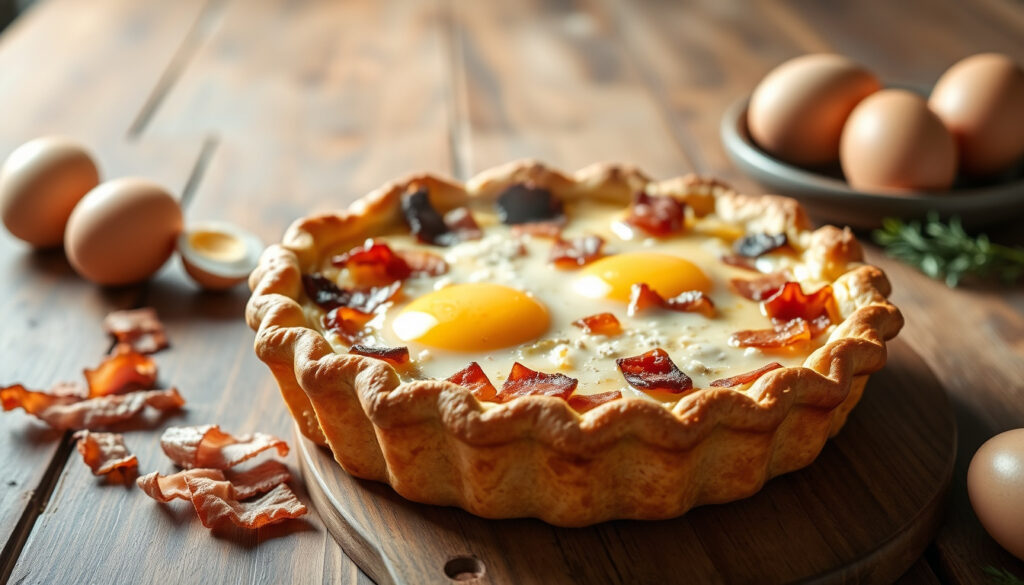
Bacon and Egg Pie Recipes: Crisp Bottom Tips
Few things beat the smell of a bacon and egg pie coming out of the oven — unless you slice into a soggy, sweat-soaked base. It’s a classic New Zealand favourite, but getting that crisp pastry isn’t just luck — a few targeted techniques, like blind-baking, using the right dish, and managing steam, can turn a good pie into a great one.
Average prep time: 15 minutes · Average cook time: 40 minutes · Typical servings: 6 · Standard oven temperature: 180°C (350°F) · Most used pastry: Puff pastry · Key ingredient ratio (eggs per pie): 6–8 eggs
Quick snapshot
- Pre-bake the lower pastry until crisp before adding filling (Delectabilia (recipe blog))
- Metal or enamel pie dishes retain heat better for a crisp base (VJ Cooks (home-cooking site))
- Place pie on a preheated baking tray for extra bottom heat (The Flavor Bender (recipe developer))
- Cut a slit in the top pastry so steam vents instead of soaking the base (Kraft Heinz Food in a Minute (NZ recipe publisher))
The implication: each technique targets a specific moisture source.
Six key facts, one pattern: the battle against a wet bottom is won before the pie ever goes into the oven.
| Fact | Detail |
|---|---|
| Traditional origin | New Zealand home cooking |
| Primary pastry type | Puff pastry (NZ standard) |
| Eggs per standard pie | 6–8 eggs |
| Typical dairy addition | 2–3 tablespoons milk or cream |
| Common vegetable addition | Onions, leeks, or capsicum |
| Proven soggy-bottom remedy | Blind-baking the pastry base |
Do you cook bacon before putting it in a bacon and egg pie?
Why pre-cooking is widely recommended but not universal
- Many New Zealand recipes call for lightly frying the bacon first to render excess fat (Kraft Heinz (NZ recipe publisher) makes no explicit instruction — the technique appears in anecdotal blog sources).
- Pre-cooking bacon reduces moisture that can seep into the pastry, though no controlled test has verified the difference (VJ Cooks (home-cooking site) simply layers raw bacon in its version).
For NZ home cooks, pre-cooking bacon adds a step but ensures crispy bits throughout. If you skip it, the bacon releases fat during baking — which can be a friend or foe depending on your pastry shield.
The implication: pre-cooking bacon is a common-sense fix, but it’s not the only path. Many classic recipes layer raw bacon and rely on blind-baking alone to keep the base dry.
What pastry do I use for bacon and egg pie?
Puff pastry vs. shortcrust — what NZ cooks reach for
- Puff pastry is the default in most New Zealand recipes (Delectabilia (recipe blog) and The Foodie Affair (home-cooking site) both specify flaky/puff).
- Shortcrust offers a sturdier base but requires blind-baking just as much (VJ Cooks (home-cooking site) uses puff only).
- Roll the bottom sheet to about 2 mm thickness for even cooking (The Flavor Bender (recipe developer)).
A thin, even base crisps faster than a thick one. Whether you choose puff or shortcrust, the thickness and the blind-bake matter more than the pastry type itself.
The pattern: puff pastry wins for its flaky texture; shortcrust for structural integrity. Both work — but only if you treat the bottom layer as a pre-baked crust.
Do you put milk in bacon and egg pie?
Milk, cream, or none — the texture trade-off
- Many NZ recipes add a splash of milk or cream — typically 2–3 tablespoons — to the beaten eggs for a softer, custard-like filling (Kraft Heinz (NZ recipe publisher) uses no milk in its classic recipe; The Foodie Affair (home-cooking site) includes a small amount).
- Classic versions without milk produce a denser, eggier texture — closer to a quiche but less custardy.
- The exact ratio of eggs to milk is not standardized across recipe databases, so results vary.
The catch: more liquid means more moisture that can compromise the pastry seal. If you use milk, ensure your blind-bake is thorough and you don’t overfill the pie.
How to stop bacon and egg pie from going soggy?
Four combat-proven tactics from the experts
- Blind-bake the bottom pastry until it puffs and begins to colour before adding the filling (Delectabilia (recipe blog)).
- Use a metal or enamel pie dish that conducts heat to the base (VJ Cooks (home-cooking site)).
- Preheat a baking tray and place the pie dish on it for extra bottom heat (The Flavor Bender (recipe developer)).
- Cut a steam slit in the top crust so moisture escapes rather than condensing (Kraft Heinz (NZ recipe publisher)).
Even with all four tactics, a too-wet filling — from raw vegetables or excessive dairy — can still seep through. Keep wet additions to a minimum or sauté them first.
The pattern: a crisp bottom comes from heat management, not luck. Each technique adds a layer of protection against the moisture that naturally releases during baking.
Do you put onions in bacon and egg pie?
Onions, leeks, and other vegetable additions
- Onions are optional but appear in many NZ versions — sautéing them first removes excess moisture that could make the base soggy.
- Leeks offer a milder flavour and hold less water than standard onions when cooked down.
- No research source explicitly tests onion inclusion; the advice comes from general cooking logic and recipe collections.
The implication: if you add vegetables, cook them off before layering. Raw onion releases liquid mid-bake and creates the exact problem you’re trying to avoid.
Step-by-Step Guide to the Perfect Bacon and Egg Pie
- Preheat your oven to 200°C (fan-assisted) and place a baking tray inside to heat up (Kraft Heinz (NZ recipe publisher) uses 200°C for 35-40 minutes).
- Roll out pastry to about 2 mm thickness (The Flavor Bender (recipe developer)). Lay it into a metal or enamel dish (VJ Cooks (home-cooking site)).
- Blind-bake the bottom until it starts to crisp and puff — about 10-12 minutes (Delectabilia (recipe blog)).
- Prepare the filling: cook bacon until some fat renders (if using) and sauté any onions/leeks. Whisk 6-8 eggs with a splash of milk or cream if desired.
- Layer the filling onto the blind-baked base: bacon, vegetables, then pour the egg mixture over the top. Add cheese if preferred.
- Cover with top pastry, seal edges, and cut at least one slit in the centre (Kraft Heinz (NZ recipe publisher)).
- Bake on the preheated tray at 190-200°C for 40-50 minutes, depending on your oven (The Flavor Bender (recipe developer) bakes at 190°C for 50 minutes; VJ Cooks (home-cooking site) bakes at 180°C for 50 minutes).
- Rest on a rack for 10 minutes before slicing (Delectabilia (recipe blog)).
The pattern: following these steps ensures a consistently crisp result.
Clarity: What’s confirmed — and what’s not
Confirmed facts
- Blind-baking the pastry base significantly reduces soggy bottom risk (Delectabilia (recipe blog)).
- Puff pastry is the most common choice in New Zealand recipes (Kraft Heinz (NZ recipe publisher); Delectabilia (recipe blog)).
- Using a metal or enamel dish improves bottom crust crispiness (VJ Cooks (home-cooking site)).
- Baking on a preheated tray adds intense heat to the base (The Flavor Bender (recipe developer)).
What’s unclear
- Whether pre-cooking bacon makes a measurable difference compared to raw bacon has not been rigorously tested.
- The exact optimal ratio of eggs to milk for a non-soggy yet tender texture is not agreed upon across NZ recipe collections.
- The 5-5-5 egg rule (poached egg timings) has no documented application to bacon and egg pie.
- Whether cheese addition lengthens bake time or causes moisture pooling is anecdotal only.
The pattern: confirmed techniques are well-documented, while other variables remain untested.
Expert perspectives on the perfect pie
Pre-bake the lower pastry until it starts getting a little crisp and puffing up before adding the filling.
— Delectabilia (recipe blog), on building a dry base
Line the base and sides of a 24 cm x 20 cm ovenproof dish with pastry and make a slit in the top so steam can escape.
— Kraft Heinz Food in a Minute (NZ recipe publisher), on steam management
Roll the bottom puff pastry to about 2 mm thickness and place the pie on a preheated baking tray for a crisp finish.
— The Flavor Bender (recipe developer), on thickness and bottom heat
For the home cook in New Zealand, the choice is clear: invest 15 minutes in blind-baking and preheating your tray, or resign yourself to a wet base every time. The difference between a flaky triumph and a sad slice is that short, targeted effort.
For a flawless finish, our tips for a crispy crust guide expands on blind-baking and bacon prep.
Frequently asked questions
Can I make bacon and egg pie without milk?
Yes. Leave out the milk and use only beaten eggs — the filling will be denser and eggier, closer to a traditional baked egg pie.
What cheese goes best with bacon and egg pie?
Grated cheddar or mozzarella are common; add after layering bacon so it melts into the egg mixture.
How long does bacon and egg pie last in the fridge?
Up to 3 days in an airtight container. Reheat in a moderate oven to restore crispness.
Can I freeze bacon and egg pie?
Yes. Bake fully, cool, wrap tightly, and freeze for up to 2 months. Thaw in the fridge before reheating.
Should I use streaky or back bacon?
Streaky bacon renders more fat, which can contribute to sogginess if not pre-cooked. Back bacon is leaner and more common in NZ recipes.
How do I know when bacon and egg pie is cooked?
The pastry should be golden and the filling set — a knife inserted near the centre should come out clean. Internal temperature should reach about 165°F (74°C).
Can I add vegetables like mushrooms or spinach?
Yes, but sauté them first to remove moisture, otherwise they risk making the pastry base wet.
More related posts
 Good Cop Bad Cop – How the Technique Works
 Opening a Bank Account in New Zealand: Guide for Foreigners
 Pak n Save Logo: History, Colors, and Download (PNG, SVG)
 One NZ Trade-In: Upgrade Before the 3G Shutdown
 USB-C to USB-C Cable: Uses, Speeds, and Buying Tips
 Auckland Airport Valet Parking: Rates, Process & Options
 Toyota Corolla Hybrid NZ: Prices, Reliability & Reviews
 Open Bank Account Online: Easiest Options & Minimum Fees