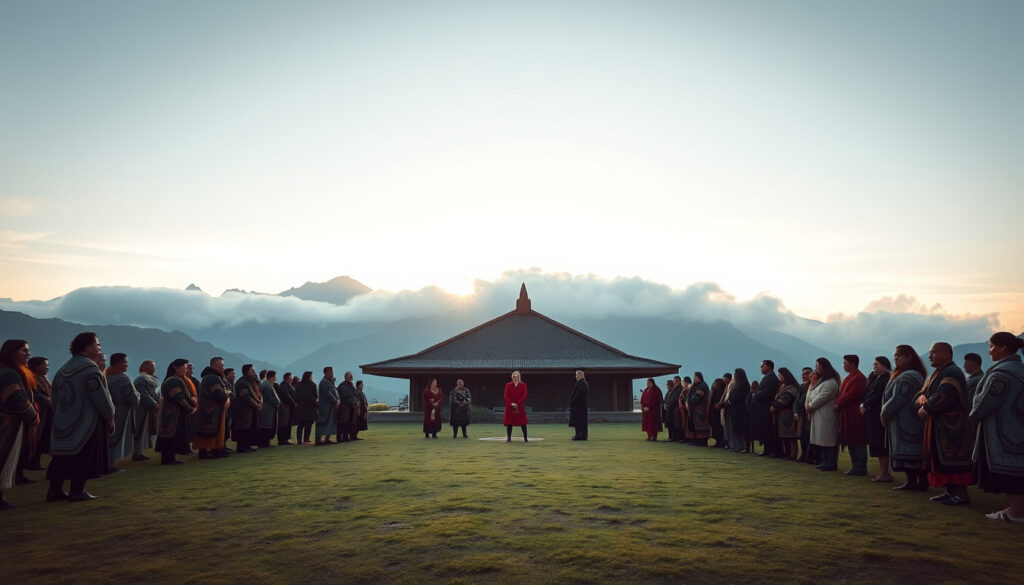
Tūtira Mai Ngā Iwi Lyrics: Meaning, Translation & Response
Tūtira Mai Ngā Iwi doesn’t just ask listeners to hear—it commands them to stand together and respond. This article unpacks the lyrics, response phrases, and cultural weight of this waiata as a unity anthem.
Song Name: Tūtira Mai Ngā Iwi ·
Language: Māori ·
Meaning: Come together, people (unity) ·
Common Use: School assemblies, Waitangi Day celebrations ·
Response Phrase: Tātou tātou e
Quick snapshot
- The lyrics are in Māori (NZ Folk Song)
- The response is “Tātou tātou e” (NZ Folk Song) (NZ Folk Song)
- “Hi aue hei” is a common ending (Māori Song / Maori.cl)
- Widely sung in schools and at Waitangi Day for decades (Te Kete Ipurangi / Te Reo Māori)
- Recorded by Dennis Marsh on Spotify (YouTube)
- Continues to be taught in kura and early childhood centres (University of Waikato resource)
- Used in community singing and sports events as a unity anthem (NZ Human Rights Commission)
Five key facts about this waiata, one takeaway: the song’s power lies in its simplicity and its call-and-response structure that invites everyone to participate.
| Label | Value |
|---|---|
| Song Name | Tūtira Mai Ngā Iwi |
| Language | Māori |
| Meaning | Come together, people |
| Common Response | Tātou tātou e |
| Notable Performance | Dennis Marsh recording on YouTube |
What does tūtira mai ngā iwi mean?
Literal translation of tūtira mai ngā iwi
- Tūtira – “line up” or “stand in rows” (NZ Folk Song)
- Mai – “toward the speaker” (directional particle)
- Ngā – plural definite article “the”
- Iwi – “people, tribes, nations” (Stimmvolk (cultural page))
The full phrase translates to “Stand together, people” or “Line up together, people.” The University of Canterbury (teaching resource) renders it as “Stand together people, in unity.” The University of Waikato (te reo resource) gives “Join together, the people.”
Cultural significance of the phrase
This is not a passive lyric. The imperative “tūtira mai” is a direct call to action. In Māori oral tradition, waiata often serve as communal instructions – they teach, unite, and reinforce collective identity. The New Zealand Human Rights Commission (advocacy body) described the song as a waiata about unity that encourages people to come together. The implication: singing this song is itself an act of gathering.
What is the tutira mai nga iwi chant?
Structure of the chant
The piece is a waiata-a-ringa – a song with actions – as noted by the Te Kete Ipurangi / Te Reo Māori (Ministry of Education resource). It follows a clear call-and-response pattern. The leader calls “Tūtira mai ngā iwi” and the group responds “Tātou tātou e.” The song ends with “Hi aue hei.”
Tūtira mai ngā iwi, tātou tātou e
Whai-a te marama-tanga me te aroha— NZ Folk Song (folk-song archive)
The NZ Ukulele Songbank (teaching resource) translates the next line as “Seek after knowledge and love of others.”
Call and response pattern
This is the heart of the waiata. The leader’s call is a command, and the response is an affirmation. “Tātou tātou e” means “all of us, all of us” – a collective answer that binds the group. The Māori Song / Maori.cl (cultural site) stresses that the response is not optional; it completes the phrase.
The call-and-response structure turns every singer into a participant. In a school assembly or a hui, no one is a passive audience member. The response “Tātou tātou e” literally says “we are all in this together.”
The pattern: call-and-response waiata like this turn collective singing into a binding ritual.
What is the response to Tūtira Mai Ngā Iwi?
The response phrase ‘tātou tātou e’
“Tātou” means “we (including the listener)” and “e” is a vocative particle. The NZ Folk Song (folk-song archive) translates it as “all of us, all of us.” It is the community’s pledge: we answer together.
Meaning of ‘Whai-a te marama-tanga me te aroha’
This line appears in the full waiata. “Whai-a” = “seek after,” “te marama-tanga” = “enlightenment/knowledge,” “me te aroha” = “and love.” The Māori Song / Maori.cl (cultural site) translates it as “Seek after knowledge and love of others.” The NZ Ukulele Songbank (teaching resource) agrees. The implication: unity is not just about standing together but about pursuing wisdom and care as a collective.
Some online lyric sheets drop macrons entirely, which can lead to mispronunciation. For learners, using a source like the Te Kete Ipurangi (Ministry of Education resource) ensures accuracy.
The takeaway: the response completes the call, turning individual voices into a unified chorus.
What is the famous Māori song?
Other famous Māori songs
Tūtira Mai Ngā Iwi is one of the best-known waiata, alongside E Ihowā Atua (the national anthem) and Pokarekare Ana. The Wikipedia (encyclopedia) notes its widespread use in schools and community events. For those interested in Translate English to Tongan: Free Tools & Apps Compared, the same principles of language preservation and education apply.
Role of waiata in Māori culture
Waiata are not just songs – they are vehicles for history, values, and language. The Te Kete Ipurangi / Te Reo Māori (Ministry of Education resource) describes this waiata as a teaching tool for reo Māori. The pattern: waiata embed language in melody, making it easier to remember and pass on.
Tutira mai nga iwi lyrics in English
Full lyrics with English translation
Based on the NZ Folk Song (folk-song archive) and Māori Song / Maori.cl (cultural site):
| Māori | English |
|---|---|
| Tūtira mai ngā iwi | Line up/stand together, the people |
| Tātou tātou e | All of us, all of us |
| Whai-a te māramatanga | Seek after knowledge |
| Me te aroha | And love |
| Kia tapatahi | Be united |
| Kia kotahi rā | As one |
The University of Canterbury (teaching resource) includes the line “Kia tapatahi” as “Be united.” The NZ Ukulele Songbank (teaching resource) adds “Puritia kia mau” – “Hold fast.”
Pronunciation guide
- tūtira – “TOO-tee-rah” (long ū as in “boot”)
- ngā – “ngah” (ng as in “singer”) – the Stimmvolk (cultural page) notes this is like the ‘ng’ in ‘singen’
- iwi – “EE-wee”
- whai – “fai” (wh is a soft ‘f’ sound)
- tātou – “TAH-toh” (long ā)
Macrons matter: they lengthen the vowel and change meaning. “Tūtira” without the macron would be a different word.
Some online lyric sheets drop macrons entirely, which can lead to mispronunciation. For learners, using a source like the Te Kete Ipurangi (Ministry of Education resource) ensures accuracy.
The implication: accurate pronunciation preserves the song’s meaning and cultural integrity.
Clarity
Confirmed facts
- The lyrics are in Māori (NZ Folk Song)
- The response is “Tātou tātou e” (NZ Folk Song)
- “Hi aue hei” is a common ending (Māori Song / Maori.cl)
What’s unclear
- The exact origin date of the song (Wikipedia)
- Whether “hi aue hei” has a specific literal meaning (Māori Song / Maori.cl)
- The song is a waiata about unity (Wikipedia)
Quotes
Tūtira Mai Ngā Iwi is a waiata about unity – encouraging people to come together.
— New Zealand Human Rights Commission (Facebook post)
Tūtira mai ngā iwi, tātou tātou e – line up together, people, all of us.
— NZ Folk Song (folk-song archive)
For those exploring New Zealand culture through film, the Uproar (2023) film guide offers a modern story about Māori identity and standing up for what matters – a theme that echoes the waiata’s call to unity.
scribd.com, alicebulmermusic.com, reddit.com, mm.dreamineering.com
Frequently asked questions
What is the correct pronunciation of ‘Tūtira Mai Ngā Iwi’?
TOO-tee-rah MYE NGAH EE-wee. The macrons lengthen the vowels. The ‘ng’ is like the ‘ng’ in ‘singer’ (Stimmvolk (cultural page)).
Is ‘Tūtira Mai Ngā Iwi’ a traditional Māori song?
It is widely considered a traditional waiata, though its exact origins are unclear (Wikipedia).
What does ‘tātou tātou e’ mean?
“All of us, all of us” – the collective response affirming unity (NZ Folk Song).
What does ‘whai-a te marama-tanga’ mean?
“Seek after knowledge” or “seek after enlightenment” (Māori Song / Maori.cl).
What does ‘hi aue hei’ mean?
It is an exclamation used to end the waiata; its literal meaning is not well documented (Māori Song / Maori.cl).
When is this song typically sung?
At school assemblies, Waitangi Day celebrations, hui, and community gatherings (Te Kete Ipurangi (Ministry of Education resource)).
Who wrote Tūtira Mai Ngā Iwi?
The composer is unknown; it is regarded as a traditional waiata (Wikipedia).
Are there recordings of the waiata?
Yes, including a version by Dennis Marsh on YouTube and many educational videos.
More related posts
 Tongariro Alpine Crossing Map: Distance, Time & Difficulty
 Tide Times New Plymouth: Today’s High & Low Tides (2025)
 Gutter Cleaning in Auckland: Costs, Frequency & Pro Tips
 Independent Earner Tax Credit 2026: How to Claim & Amount
 Black Snow Season 2 – Renewal, Premiere, Cast and Plot
 Mitre 10 MEGA Taupo: Store Guide and Product Range
 Free APA 7 Reference Generator: How to Use & Top Tools
 Shipping Containers for Hire: Costs & Guide for Ireland