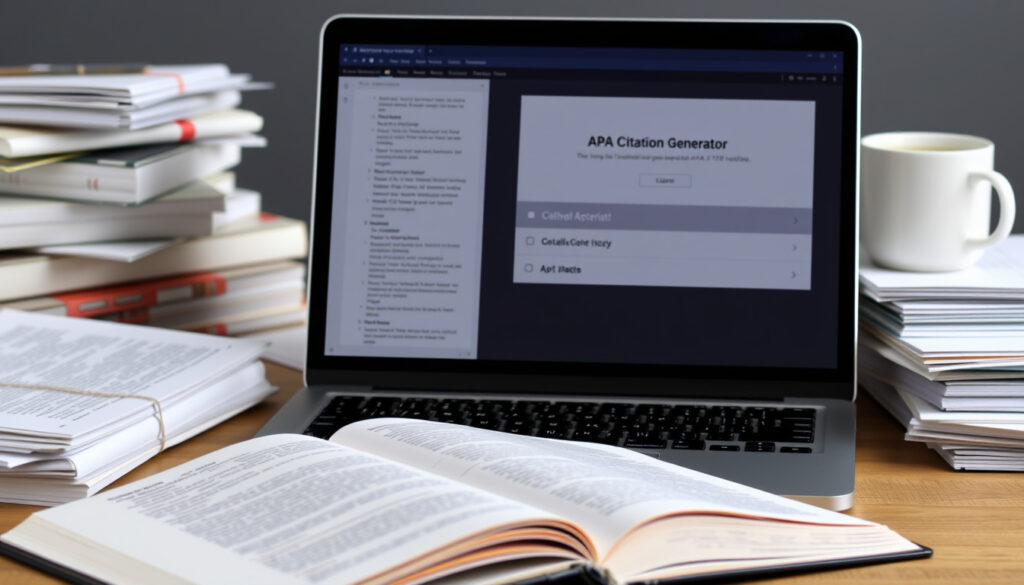
Free APA 7 Reference Generator: How to Use & Top Tools
Anyone who’s spent an evening wrestling with a bibliography knows the feeling: one misplaced comma and the whole page feels wrong. APA 7th edition brought clearer rules, but worrying about formatting can still eat into your writing time, and free citation generators promise to handle the grunt work, yet they’re only as reliable as the data they pull.
APA 7th Edition Release Year: 2019 ·
Number of Free APA 7 Generators in Top 5: 5 ·
Supported Source Types per Generator: Up to 50 ·
Most Common Citation Error: Missing publication year
Quick snapshot
- APA 7 is the current edition (since 2019) (CrucibleIQ – tech review site)
- Free generators like Scribbr, MyBib, and ZoteroBib exist (Scribbr – academic writing platform)
- Most tools support 50+ source types (MyBib – free citation tool)
- Metadata from CrossRef is used by several generators (Research Tools Lab – open source tool)
- Which single generator is most accurate across all source types (CrucibleIQ – tech review site)
- Whether free tools handle 21+ authors and organizational authors without error (Research Tools Lab – open source tool)
- How often DOI retrieval fails for older articles (Southern Review – academic writing guide)
- APA 7 became the standard in 2019; most generators now default to it (Scribbr – academic writing platform)
- Tools that still offer APA 6 show declining demand (MyBib – free citation tool)
- New generators prioritize metadata quality over web scraping (PapersFlow – citation tool)
- Expect more browser-based offline generators for privacy (Research Tools Lab – open source tool)
- Integration with reference managers (Zotero, Mendeley) will likely improve (CrucibleIQ – tech review site)
- AI-assisted metadata extraction may reduce errors (CiteGenie – citation tool)
Five free generators, one common pattern: they all rely on external metadata databases, but the accuracy varies by source type.
| Feature / Fact | Details | Source |
|---|---|---|
| Current APA edition | 7 | CrucibleIQ – tech review site |
| Generators compared in one review | 5 | CrucibleIQ – tech review site |
| Most accurate in that review | ZoteroBib | CrucibleIQ – tech review site |
| Supports APA 6 & 7 | Scribbr | Scribbr – academic writing platform |
| No sign‑up required | PapersFlow, Research Tools Lab, CiteMe | PapersFlow – citation tool; Research Tools Lab – open source tool; CiteMe – citation tool |
| Metadata source | CrossRef (journals); WorldCat (books) | Koke AI – citation tool; Research Tools Lab – open source tool |
| Edge cases claimed (21+ authors, org authors) | Research Tools Lab | Research Tools Lab – open source tool |
| Search methods | DOI, URL, ISBN, title | CiteGenie – citation tool; Koke AI – citation tool |
How does an APA 7 reference generator work?
Most free generators follow a similar workflow: you feed them a source identifier, they look up metadata, and they spit out a formatted reference plus an in-text citation. The key difference is where they fetch that metadata.
What types of sources can it handle?
- Books, journal articles, websites, and reports are standard (Scribbr – academic writing platform).
- Some generators also handle films, podcasts, and social media posts (MyBib – free citation tool).
- Tools like CiteMe search over 250 million works from OpenAlex, Semantic Scholar, and CrossRef (CiteMe – citation tool).
How to input URLs or search terms?
- Most tools accept a URL, DOI, ISBN, or a title search (CiteGenie – citation tool).
- Koke AI uses a three‑step process: enter sources, review and select, then generate bibliography (Koke AI – citation tool).
- PapersFlow pulls metadata from CrossRef rather than web scraping, which reduces formatting errors (PapersFlow – citation tool).
How to generate in-text citations?
- Most generators output both a parenthetical (Author, Year) and a narrative version (Scribbr – academic writing platform).
- CiteGenie and Koke AI provide a copy‑ready in-text citation alongside the reference (CiteGenie – citation tool; Koke AI – citation tool).
- You can typically export the whole list to Word or BibTeX (MyBib – free citation tool).
A generator that fetches from CrossRef, WorldCat, or OpenAlex gives you a head start. But no tool catches every edge case — especially when a source has missing fields or 21+ authors.
The implication: the best generator for one source type may be the worst for another. Always cross-check with a second tool.
What is the APA 7th edition reference format?
APA 7 uses an author‑date system with a specific structure for each source type. The official manual published in 2019 introduced several changes from APA 6.
Basic structure for different source types
- Book: Author, A. A. (Year). Title of work. Publisher. (Southern Review – academic writing guide)
- Journal article: Author, A. A. (Year). Title of article. Title of Periodical, Volume(Issue), page–page. DOI (Scribbr – academic writing platform)
- Website: Author, A. A. (Year, Month Date). Title of page. Site Name. URL (MyBib – free citation tool)
Key differences from APA 6
- APA 7 allows up to 20 authors before using ellipsis; APA 6 stopped at 7 (Southern Review – academic writing guide).
- Publisher location is no longer required for books (Scribbr – academic writing platform).
- DOIs are formatted as hyperlinks (https://doi.org/…) (MyBib – free citation tool).
Many free generators still default to APA 6 formatting for some source types. Always check the output against the official APA 7 examples — especially for DOIs and author names.
What this means: if your generator outputs “Retrieved from” or includes the publisher’s city, it’s stuck in APA 6 mode. That’s the most common error flagged by the CrucibleIQ review.
How do I format an APA 7 reference list?
The reference list appears at the end of your paper and includes every source you cited. APA 7 specifies three formatting rules.
Alphabetical order by author
- List all references alphabetically by the last name of the first author (Southern Review – academic writing guide).
- If no author, use the title (ignoring “A,” “An,” “The”) (Scribbr – academic writing platform).
Hanging indent
- Every reference should have a hanging indent of 0.5 inches (1.27 cm) (MyBib – free citation tool).
- Most generators don’t apply this automatically; you’ll need to set it in Word or Google Docs (CrucibleIQ – tech review site).
Double spacing
- The entire reference list should be double‑spaced (Southern Review – academic writing guide).
- No extra space between entries (Scribbr – academic writing platform).
The trade-off: generators save you typing time, but you still have to format the page layout. A tool that exports to Word with proper indentation and spacing — like MyBib — reduces that friction.
What is the correct APA citation format?
APA 7 uses two types of in‑text citations: narrative (where the author’s name is part of the sentence) and parenthetical (where the author and year are in parentheses).
In-text citation (Author, Year)
- Parenthetical: (Smith, 2020) (Scribbr – academic writing platform).
- Narrative: Smith (2020) found that … (Southern Review – academic writing guide).
- For works with no date, use (n.d.) (MyBib – free citation tool).
Multiple authors
- Two authors: (Smith & Jones, 2020) (Scribbr – academic writing platform).
- Three or more authors: (Smith et al., 2020) from the first citation (Southern Review – academic writing guide).
- Group authors: abbreviate after first mention (e.g., World Health Organization [WHO]) (MyBib – free citation tool).
The pattern: for two authors, always use “&” in parentheses; never use “and” in the parenthetical form. Generators get this right most of the time, but check the comma placement.
How to cite sources in APA 7 with examples?
Seeing the exact format helps you spot what a generator should produce. Here are three common source types.
Book example
Smith, J. (2020). The psychology of learning. Academic Press.
- Note: no publisher location, no “Retrieved from” (Southern Review – academic writing guide).
- If the book has a DOI, add it at the end (Scribbr – academic writing platform).
Journal article example
Johnson, L., & Lee, M. (2021). Cognitive load in online learning. Educational Psychology Review, 33(2), 145–162. https://doi.org/10.1007/s10648-021-09600-5
- Include the DOI in hyperlink format (MyBib – free citation tool).
- No “Retrieved from” before the DOI (Southern Review – academic writing guide).
Website example
American Psychological Association. (2020, January). APA style guide. https://apastyle.apa.org
- Include a retrieval date only if the content is likely to change (Scribbr – academic writing platform).
- For a page with no individual author, use the organization as author (MyBib – free citation tool).
Why this matters: a generator that outputs “Retrieved from” for a stable webpage is still using APA 6 rules. That’s a red flag for accuracy.
Step-by-Step: How to Use an APA 7 Reference Generator
Using a free generator is straightforward, but a systematic approach reduces errors. Here’s a workflow based on the CrucibleIQ review and Southern Review guide.
- Choose a generator that uses metadata from CrossRef or WorldCat (e.g., ZoteroBib, Research Tools Lab, Koke AI).
- Enter the source identifier — paste a DOI, URL, ISBN, or title. If you’re unsure, start with the DOI.
- Review the auto‑filled fields — check the author names, publication year, and title. Many generators miss the subtitle or capitalize incorrectly.
- Generate the reference and in-text citation — copy both into your document.
- Cross‑check with a second generator — use a different tool (e.g., Scribbr or MyBib) to see if the output matches. If they differ, consult the APA Style manual.
- Format the reference list — apply hanging indent and double spacing in your word processor.
Use the CrucibleIQ review method: compare outputs from three generators for the same source. If two agree, that’s likely the correct format.
The pattern: the more generators you compare, the higher your confidence in the final citation. This is especially important for sources with missing fields.
Clarity: What’s confirmed and what’s still unclear
Confirmed facts
- APA 7 is the current edition (since 2019) (CrucibleIQ – tech review site)
- Free generators exist and support dozens of source types (Scribbr – academic writing platform)
- Metadata from CrossRef improves accuracy (PapersFlow – citation tool)
- Generators can produce errors, especially with APA 6 defaults (CrucibleIQ – tech review site)
What’s unclear
- Which generator is most accurate for all source types (CrucibleIQ – tech review site)
- Whether free tools handle 21+ authors without error (Research Tools Lab – open source tool)
- How often DOI retrieval fails for older articles (Southern Review – academic writing guide)
- Most tools support 50+ source types (MyBib – free citation tool)
The pattern: the confirmed list provides a solid foundation, but the unclear items highlight where generators still fall short.
What experts say about citation generators
“Automatic citation generators can be useful starting points but should not replace review of the official style manual.”
Southern Review – academic writing guide
“Free citation tools can produce errors, including outdated APA 6 formatting and DOI or author‑name mistakes.”
CrucibleIQ – tech review site
The consensus: treat generators as a time‑saving assistant, not a replacement for understanding the rules. The APA Style official website emphasizes that “accuracy is the responsibility of the author.”
For students and researchers who need to produce a reference list quickly, free APA 7 generators are a legitimate shortcut — provided you’re willing to spend five minutes verifying the output. The risk of a missing year or a misplaced DOI is real, but the workflow of comparing two generators and checking against the APA Style manual catches the vast majority of errors. For anyone writing a paper this semester, the choice is clear: use a generator that pulls from CrossRef, cross‑check with a second tool, and always manually review the final list. Skip one of those steps, and your grade — or your publication — may suffer.
Frequently asked questions
Is a citation generator accurate enough for academic papers?
Free generators are accurate for common source types (books, journal articles) but can produce errors for less common sources (conference papers, reports). Always cross‑check with a second tool or the APA Style manual.
Do I need to include a DOI in APA 7?
Yes, if the source has a DOI. APA 7 requires the DOI in both the reference list and in‑text citation. Format it as a hyperlink: https://doi.org/xxxx.
How do I cite a PDF in APA 7?
Cite the PDF according to its source type. If it’s a journal article, use the journal article format. If it’s a report, use the report format. Include the DOI if available, or the URL.
Can I use an APA generator for MLA?
Most generators offer multiple styles, including MLA. Simply switch the style selector from APA to MLA before generating. Some tools (like MyBib) support dozens of styles.
What is the difference between APA 6 and APA 7 citation format?
Key differences: APA 7 allows up to 20 authors (vs. 7 in APA 6), removes publisher location, formats DOIs as hyperlinks, and uses “(n.d.)” for no date. Generators often default to APA 6, so check the edition.
Are there any free APA 7 generators that don’t require signup?
Yes. PapersFlow, Research Tools Lab, and CiteMe are completely free with no account needed. They also have no usage limits and no ads.
How do I export APA 7 citations to Word?
Most generators offer a copy‑to‑clipboard button or an export as .txt/.bib. Some, like MyBib, have a Word add‑in. You can also paste the references into Word and manually apply hanging indent.
The bottom line: using a generator correctly means verifying every output against the official style guide.
More related posts
 Big Save Furniture NZ: Sale, Reviews & Store Locations
 Cheap Caravans for Sale NZ Private Under $10,000 – Best Platforms and Buying Guide
 Must Be Won Powerball: NZ’s Guarantee & Draw Rules
 Nepal vs West Indies 2025 T20 series: results and scorecards
 Stranger Things Season 5 Episode 9: Real or Fake?
 How to Lower Cholesterol in New Zealand
 Hear Me Out Characters: Best, Weirdest & Tier List Guide
 Foot and Mouth Disease: HFMD vs FMD Symptoms & Treatment