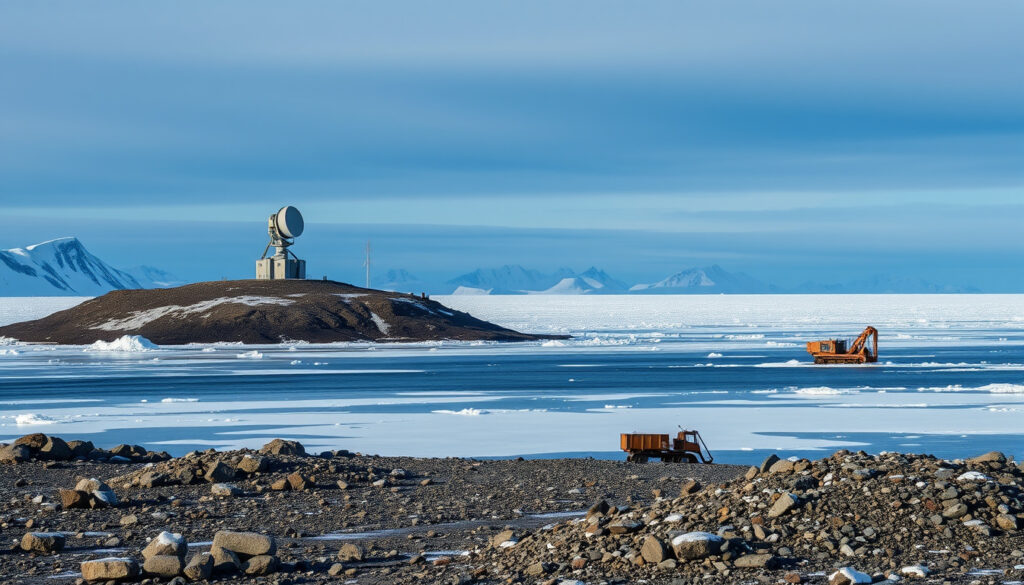
Why Does Trump Want Greenland? National Security & Rare Earths (2026)
Why does the United States want to buy Greenland, a frozen island with a population of 57,000? The answer in 2026 is a blend of Arctic military strategy, rare earth minerals, and geopolitical competition with China and Russia.
Area: 2.16 million sq km (836,330 sq mi) · Population: approximately 57,000 · Year US first offered to buy Greenland: 1946 · Current US military presence: Pituffik Space Base (formerly Thule Air Base) · Trump first public expression of interest: August 2019 · Estimated untapped mineral resources value: $1 trillion+ (rare earths, oil, gas)
Key Facts at a Glance
| Label | Value |
|---|---|
| Population | approximately 57,000 |
| Year US first offered to buy Greenland | 1867, by Secretary of State William H. Seward |
| First US attempt to buy Greenland | 1867 |
| Year Denmark sold US Virgin Islands instead | 1917 |
| Thule Air Base establishment year | 1951 |
| Trump first public expression of interest | August 2019 |
| Greenland’s status | Autonomous territory within the Kingdom of Denmark |
The table above distills the timeline into its stark essentials, showing a pattern of US interest that predates the current president by over a century, yet has now come to a head in a new geopolitical climate.
Snapshot: The Big Ticket Items
- Pituffik Space Base is vital for early warning systems. The base provides missile detection and space surveillance capabilities critical to North American defense (U.S. Space Force).
- Arctic is a growing theater for Russian military activity. Russia has reopened Soviet-era bases and conducts regular patrols near Greenland (BBC News).
- US wants to secure strategic chokepoints. Control of Greenland would allow monitoring of sea lanes through the Greenland-Iceland-UK gap (Council on Foreign Relations).
- Largest untapped rare earth deposits outside China. Greenland holds 25 of 34 minerals classified as critical raw materials by the European Commission (BBC News).
- Oil and gas reserves estimated at billions of barrels. The U.S. Geological Survey estimates significant offshore hydrocarbons (USGS).
- Climate change is making extraction more feasible. Melting ice opens longer windows for mining and drilling (Nature).
- Arctic sea routes could cut shipping times by 30%. The Northern Sea Route reduces distance from Asia to Europe by up to 40% (Maritime Executive).
- Melting ice opens new trade paths. The Northwest Passage becomes increasingly navigable in summer (BBC News).
- China is building a ‘Polar Silk Road’. Beijing has invested in Arctic infrastructure and research stations (Reuters).
- Acquisition would strengthen US presence against rivals. A permanent foothold counters Russian and Chinese influence in the Arctic (CNN).
- Could pressure Denmark to invest more in Arctic defense. Trump’s threats have pushed Copenhagen to increase military spending in Greenland (The Guardian).
- Aligns with Trump’s ‘America First’ foreign policy. The deal is framed as a national security imperative, not a colonial venture (CNBC).
Why is Greenland so important for the USA?
To understand the current administration’s insistence, we have to look at the strategic map through the lens of 21st-century competition, not the Cold War alliances of the last century. The island’s appeal isn’t just about its massive size or its sparse population of around 57,000 people; it’s about location and what lies beneath the ice.
Geopolitical and military importance
This isn’t a colonial throwback; it’s a hard-nosed calculation about future leverage. As the Arctic ice retreats, new shipping lanes open up, cutting transit times between Asia and the West. Simultaneously, the island sits astride the shortest route for intercontinental ballistic missiles, making it a crucial early-warning and defense location for North America.
The US has operated the Thule Air Base (now Pituffik Space Base) on the island since 1951, underscoring a long-standing military relationship distinct from political negotiations.
Natural resources and rare earth elements
But the most pressing driver in 2026 is resources. Greenland holds vast untapped reserves of rare earth elements—essential for manufacturing everything from smartphones to advanced military hardware. With the US seeking to reduce its reliance on China for these critical minerals, Greenland’s potential makes it a strategic prize.
“Greenland is not for sale and will never be for sale.” — Múte B. Egede, Prime Minister of Greenland
Shipping routes and Arctic strategy
The takeaway here is that the American interest is a fusion of old-school strategic depth and new-age tech economics. It’s about ensuring that if the ice melts and the world’s supply chains shift, the US isn’t on the sidelines in a region where it has spent billions on defense.
The implication: Greenland’s strategic location and resources have made it a central piece in Arctic geopolitics; the US sees control as vital to counter China and Russia.
What is the Greenland deal with Trump?
Origin of the 2019 proposal
President Trump first publicly floated the idea of purchasing Greenland in August 2019, which was swiftly rejected by both Denmark and Greenland. At the time, Trump said it was “a large real estate deal” and that Greenland was “strategically interesting.” The offer surprised his own cabinet and was met with derision in Copenhagen and Nuuk.
“It’s a large real estate deal. We’re interested in it because it’s strategic.” — Donald Trump, 2019
2026 renewed interest and negotiations
In January 2026, Trump again raised the issue, linking it to national security and NATO spending. According to CNBC, Trump said the framework was tied to the “entire Arctic Region” and that he would not impose tariffs scheduled for February 1 after a “Greenland framework understanding.” Later in September 2026, Trump announced an agreement with Denmark to secure “permanent control over security” in Greenland, as reported by NBC News.
Denmark and Greenland’s response
Denmark and Greenland have rejected any sale, a stance reiterated by Greenlandic Prime Minister Múte B. Egede. Danish Prime Minister Mette Frederiksen called the 2019 purchase idea “absurd” and affirmed Greenland’s right to self-determination. The 2026 statements came with a sharper edge, including threats of tariffs, but the official response from both governments remained firm: Greenland is not for sale.
What this means: Trump’s 2026 push is more aggressive than in 2019, but the legal and political barriers from Denmark and Greenland remain intact.
What happens if the US takes Greenland?
Impact on Greenland’s self-governance
Greenland’s self-rule act of 2009 grants the right to declare independence from Denmark. Any US acquisition would require a Greenlandic referendum for independence first, followed by a separate agreement with the US. This process has no historical precedent for colonial transfer in the modern era.
International reaction and legal frameworks
International law generally prohibits forced territorial acquisition. Any US attempt to purchase Greenland would need the consent of both Denmark and Greenland. The UN Charter and various treaties uphold the principle of self-determination. NATO allies have expressed dismay at the idea, emphasizing that Greenland is a part of Denmark and a key part of Western defense architecture.
Potential economic changes for Greenland
If the US were to acquire Greenland, economic benefits could include massive US investment, jobs, and infrastructure. However, Greenlanders largely oppose US ownership. A 2019 survey showed that nearly 70% of Greenlanders opposed being bought, and the 2025 law banning foreign political donations reflects deep concerns about external influence.
The catch: Even if the US offered a trillion dollars, the political and legal hurdles make a purchase extraordinarily unlikely in the current climate.
Why does Trump want Greenland for national security?
US strategic military interests in the Arctic
The Pituffik Space Base is a crucial early-warning radar site, but it is not a full-spectrum military installation. Trump’s statements suggest a desire for a larger, more permanent footprint beyond the current agreements. According to CNBC, the US would “immediately begin” developing a large military presence in Greenland.
Russia’s military buildup in the Arctic
Russia has reopened and modernized Soviet-era Arctic bases, and its Northern Fleet conducts regular patrols near Greenland. The US wants to ensure it can counter Russian activity in the region.
China’s Arctic ambitions
China is expanding its polar research and claims “near-Arctic” status. Trump’s Greenland plan is intended to secure US access to strategic minerals and block China’s access, according to a BBC report.
The pattern: The US views Greenland as a necessary bulwark against Russian and Chinese encroachment in the melting Arctic.
What does Greenland think of Trump?
Greenlandic government official statements
Greenland’s Prime Minister Múte B. Egede has repeatedly stated that Greenland is not for sale. In 2026, he reiterated that any change in status is a matter for the Greenlandic people. The government has pursued closer cooperation with Denmark and the EU, not the US.
Public opinion surveys in Greenland
A 2019 survey showed that nearly 70% of Greenlanders oppose US acquisition. The sentiment remained strong in 2026, with many seeing the US interest as a threat to their sovereignty.
Reactions from indigenous Inuit communities
Inuit leaders have voiced concerns about environmental damage from mining and military expansion. Some politicians see the US interest as leverage for independence negotiations with Denmark, but the majority view is firmly against joining the US.
The consequence: Greenlandic leaders are united in rejecting US ownership, though some see the attention as a bargaining chip in independence talks.
Timeline: From Seward to Star Wars
To see how we got here, a timeline is essential. The common frame is that Trump is an anomaly, but the historical record shows a consistent strand of American attempts and a fluctuating strategic calculus.
- 1867: Secretary of State William Seward, fresh off the Alaska purchase, sets his sights on Greenland and Iceland, but the Senate fails to act.
- 1917: The US buys the Danish West Indies (now the US Virgin Islands) from Denmark for $25 million in gold, but Greenland remains off the table during WWI.
- 1946: President Harry Truman offers $100 million for Greenland, a move that is leaked and subsequently denied by Copenhagen, which maintains a firm “no.”
- 1951: The US establishes the Thule Air Base under a bilateral defense agreement, giving the US a permanent military foothold without ownership.
- 2009: Greenland gains self-government from Denmark, including control over natural resources, a move that solidifies the local government’s authority to say “no” to a US deal.
- August 2019: President Trump revives the idea, surprising his own cabinet. Prime Minister Kim Kielsen of Greenland states unequivocally, “Greenland is not for sale and will never be for sale,” a sentiment echoed by Danish PM Mette Frederiksen.
- January 2026: Trump escalates, linking the issue to NATO and tariffs, threatening to use economic pressure if Denmark doesn’t concede, according to CNBC.
Since 2009, Greenland has held the cards to its own resources, which means the Danish government can’t sell them out from under them. Any “framework” the US thinks it has with Copenhagen is trumped by Nuuk’s veto.
The historical pattern shows that whenever the US has pushed hard on this, Denmark has deftly pivoted, offering security concessions (like the base in 1951) instead of a sale. The 2026 difference is that the previous answers no longer satisfy the strategic demands of a world reorienting around great-power competition.
The Rare Earth Factor and Global Competition
Beyond the geopolitical stagecraft, there’s a very literal race for resources happening. The demand for rare earth elements is exploding, driven by the green energy transition and the production of advanced electronics. Greenland holds some of the world’s largest undeveloped reserves of these critical minerals, including what could be the largest deposit of rare earths outside China, according to industry estimates.
Currently, China dominates the global supply chain, refining a majority of the world’s rare earths. For the US, reducing this dependency is a bipartisan priority, which explains the sudden focus on a nation that has the resources but lacks the infrastructure and the political will to develop them quickly without breaking environmental or social promises.
The conversation isn’t just about buying the island; it’s about who gets to mine it, process it, and sell it. Greenland’s self-rule government is keen to attract foreign investment, but it has also banned uranium mining and imposed strict limits on rare earth extraction due to environmental concerns and the presence of radioactive byproducts. This creates a paradox for Washington: the prize is massive, but the locals don’t want to turn their pristine land into a giant open-pit mine, and they are skeptical of foreign ownership.
The trade-off here is stark. The US wants the resources without the occupation, while Greenland wants the investment without the American cultural and political baggage. That’s a hard divide to bridge, and it’s why the 2026 framework is more likely to focus on a security agreement and a joint-development task force than a conventional land sale.
The pattern: Rare earths are the economic engine behind Trump’s push, but environmental and sovereignty concerns in Greenland make a simple purchase impossible.
nypost.com, bloomberg.com, aljazeera.com, nypost.com, thenationalnews.com, cnn.com
Frequently Asked Questions
Has any US president successfully bought territory from Denmark?
No. The US bought the Danish West Indies (US Virgin Islands) from Denmark in 1917 for $25 million, but Greenland has never been sold. A 1946 attempt by President Truman was rebuffed. The idea is seen as obsolete by both Danish and Greenlandic officials.
Why does the US need Greenland if it already has a base there?
The Pituffik Space Base (formerly Thule Air Base) is a crucial early-warning radar site, but it’s not a full-spectrum military installation. A permanent military presence would allow the US to counter Russian and Chinese activity in the Arctic, secure new shipping lanes, and project power over the North Atlantic. Trump’s statements suggest a desire for a larger, more permanent footprint beyond the current agreements.
Is Greenland part of the EU?
No, but it has a unique relationship. Greenland is an autonomous territory within the Kingdom of Denmark, which is an EU member. However, Greenland voted to leave the European Economic Community (EEC) in 1982, and it is now an Overseas Country and Territory (OCT) associated with the EU, giving it access to EU funding for trade.
What does Denmark get out of Greenland?
Denmark provides an annual block grant to Greenland as part of a “self-rule” agreement, funding a significant portion of Greenland’s public budget. In return, Denmark maintains control of foreign affairs and defense, and claims an exclusive economic zone around the island that has significant fisheries. The relationship is a source of contention as Greenland seeks greater autonomy.
What are the implications of the 2026 framework for NATO?
The 2026 framework has alarmed European allies. Trump’s linking of tariffs to Greenland’s security status suggests he might use the alliance as a bargaining chip, which feels coercive to Copenhagen. It raises questions about whether NATO solidarity can withstand unilateral US actions, even with a close ally like Denmark, and whether Europe can rely on US guarantees if it doesn’t comply with broader demands on trade and spending.
The upshot: The FAQ answers show that the legal, political, and social barriers to any US purchase of Greenland are insurmountable in the near term.
Summary: A New Kind of Imperialism
In the end, the 2026 push for Greenland isn’t just about a piece of real estate; it’s a test of the international order. The US is asking its oldest ally to cede territorial control over a vast region to address a resource and strategic gap, while Greenlanders are increasingly asserting that they are a people with rights, not assets to be traded for power. The coming months will show whether this is diplomatic brinkmanship or the start of a new, more transactional era in the Arctic—where might makes right, and even the smallest voices can block the superpowers.
For further reading on independent media strategies, see How Kiwi independent media can build trust through smarter link analysis and Air New Zealand Boeing 777-300ER: Seat Map, Best Seats & Fleet Age.
More related posts
 Was essen nach dem Training? The Best Post-Workout Nutrition
 What Day Is Today – Tuesday April 7 2026 Facts
 Fiji Things to Do: Must-See, Cost, Safety & Best Time
 Tide Times New Plymouth: Today’s High & Low Tides (2025)
 Toyota Corolla Hybrid NZ: Prices, Reliability & Reviews
 Dinner Ideas for Two: Quick, Lazy, Romantic & Hearty
 How to Cancel Uber One: Step-by-Step Guide
 Florence + the Machine: Band Profile & Guide