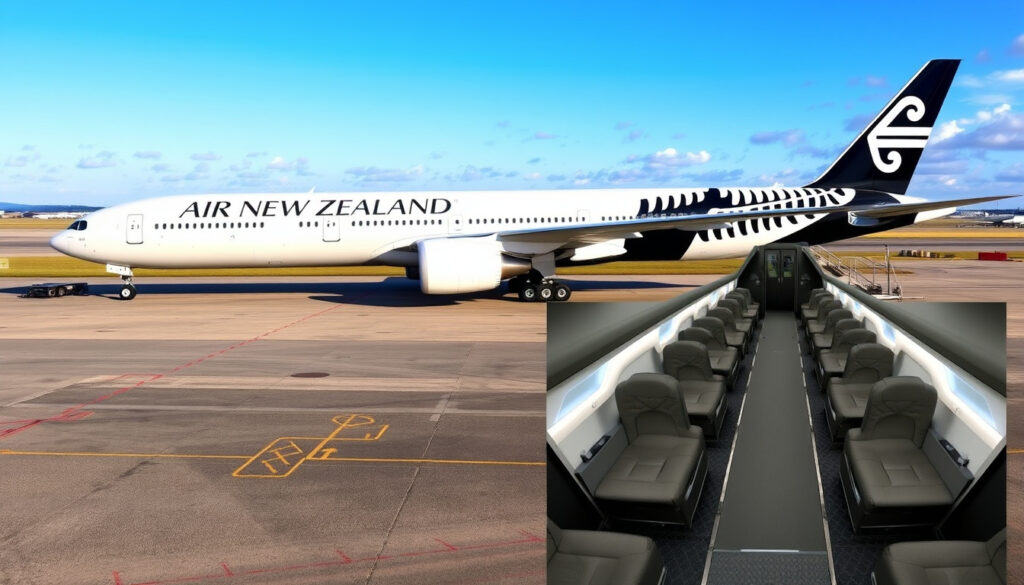
Air New Zealand Boeing 777-300ER: Seat Map, Best Seats & Fleet Age
Anyone who has booked a long-haul flight has stared at a seat map a little too long, hoping the little squares will reveal which row is the quiet one. Air New Zealand’s Boeing 777-300ER rewards that attention: the best rows change depending on which version of the aircraft you’re flying, and the airline’s fleet operates more than one cabin layout (AeroLOPA, seat-map specialist). This guide maps the rows worth choosing, the seats worth avoiding, and the fleet facts behind the plane that still anchors Air New Zealand’s Pacific network.
Fleet size: 7 aircraft ·
First delivery: 2011 ·
Business class seats: 44 lie-flat ·
Premium Economy seats: 54 ·
Economy seats: 209 (3-3-3) ·
WiFi: Available on most aircraft
Quick snapshot
- Air New Zealand’s 777-300ER is an international aircraft type with several cabin layouts across the fleet (AeroLOPA, seat-map specialist)
- Original delivery layout: 44 business, 54 premium economy, 244 economy — a different map from today’s standard (Cranky Boss, seat-map analysis)
- Third-party databases disagree on total seats: 342, 294, and 368 across three logged versions (SeatMaps, seat-map database)
- The exact WiFi installation timeline across all seven aircraft isn’t published
- Deliveries ran from 2011 to 2015 (Cranky Boss, seat-map analysis)
- Retirement is expected around 2027, with 787 Dreamliners taking over (Economy Class & Beyond, aviation news)
- A reported refresh — 342 seats with 44 business, 50 premium economy, and 246 economy — would change today’s map (Economy Class & Beyond, aviation news)
- Until then, check the seat map of your exact flight, since layout varies by aircraft
One pattern worth knowing: the 777-300ER doesn’t come with a single spec sheet — the rows below list Air New Zealand’s primary published configuration, and the variants matter more than the model number (Air New Zealand, official seat maps).
| Aircraft type | Boeing 777-300ER |
|---|---|
| Airline | Air New Zealand |
| Fleet size | 7 |
| First delivered | 2011 |
| Last delivered | 2015 |
| Total seats | 307 (Business 44, Premium Economy 54, Economy 209) |
| Wing span | 212 ft 7 in (64.8 m) |
| Range | 7,825 nautical miles (14,490 km) |
That mix of fixed engineering and shifting layouts is exactly why the seat map matters more than the model number.
Is the Boeing 777-300ER a good plane?
Short answer: yes — with one asterisk. This is one of the most proven long-haul airframes flying, but the experience depends on which Air New Zealand variant you end up on.
General reputation of the 777-300ER
- Range: 7,825 nautical miles (14,490 km), enough for nonstop Pacific sectors without tech stops.
- Comfort: a wider, quieter cabin than the earlier 777s, designed around 300-plus-seat long-haul missions.
- Track record: a long-haul workhorse for Pacific carriers, and a familiar sight on Air New Zealand’s network.
The 777-300ER’s reputation is built on reliability and economics. For Air New Zealand, the reliability part holds; the economics part is why the airline keeps investing in the cabin even as the type heads toward retirement.
Air New Zealand’s specific configuration
- Business: 44 lie-flat seats in a 1-2-1 layout, rows 1-12, direct aisle access for every passenger.
- Premium economy: 54 seats in a 2-4-2 layout, rows 23-30, in a separate cabin.
- Economy: 209 seats in a 3-3-3 layout, rows 40-67 in the standard map.
That 44/54/209 split is what most guides now treat as the standard Air New Zealand 777-300ER, but it’s not the only one on record. The original delivery layout, documented by Cranky Boss, had 54 premium economy seats and 244 economy seats, and a second variant scales business down to 40 seats while pushing economy to 296 — with Safran Cirrus II business seats on that version (AeroLOPA, seat-map specialist). SeatMaps lists three versions of the aircraft totaling 342, 294, and 368 seats (SeatMaps, seat-map database). Seat-selection advice that ignores these variants is guessing.
The implication: “Is the 777-300ER a good plane?” is the wrong question. The right question is “Which 777-300ER am I on?” — because the answer changes the seat you should book.
How old are Air New Zealand’s 777-300ER aircraft?
The short answer: old enough to be a deal, young enough to still feel modern.
Delivery timeline
- First 777-300ER delivered in 2011.
- Seven aircraft in total, with the last delivered in 2015.
- That puts the fleet between 10 and 14 years old as of 2025.
The delivery wave lines up with Air New Zealand’s long-haul growth in the early 2010s. A 777-300ER is designed for a working life well past 20 years, so at 10-14 years these aircraft are middle-aged in engineering terms — and exactly the age when airlines decide whether to refresh or replace.
Fleet age and retirement plans
Air New Zealand has said the 777-300ER will exit the fleet around 2027. The catch: a reported cabin refresh suggests the plane is still getting investment before it goes.
- Retirement target: around 2027, with 787 Dreamliners taking over long-haul flying.
- Reported refresh: 342 seats — 44 business, 50 premium economy, 246 economy — with 16 seats convertible into Skycouches (Economy Class & Beyond, aviation news).
Those two signals point in opposite directions, and that’s the real story. A fleet heading for retirement in 2027 shouldn’t need new seats unless Air New Zealand sees a longer service life than the original announcement implied. The reported refresh would add two economy seats compared with the original 244-seat economy layout while trimming premium economy from 54 to 50.
What this means: the 777-300ER is in its final act, but it isn’t being left to rot. The window for flying it well is now.
Which rows on Air New Zealand’s Boeing 777-300ER have the best seats?
Everything hinges on the variant, but the standard map gives you a clear shortlist: row 1 in business, row 23 in premium economy, exit rows in economy.
Best business class seats
- Rows 1-12: all lie-flat, all with direct aisle access in a 1-2-1 layout.
- Row 1: bulkhead row with the most open foot space and the quietest position in the cabin.
- Row 11, seats A and K: closer to the galley and the door, so expect more crew traffic.
In the standard configuration, the seat hardware is consistent across rows 1-12; the differentiator is location. Row 1 wins on space and quiet, while the rear of the cabin picks up more galley noise. If the choice is between row 1 and row 12, take row 1.
Best premium economy seats
- Rows 23-30: 54 seats in a 2-4-2 layout.
- Row 23: bulkhead row with extra legroom.
- Window pairs in rows 24-28: the quietest option for couples, with no one climbing over you.
The 2-4-2 layout is premium economy’s quiet win: every pair of travelers can take a window side, and even the center block is only four seats wide. Air New Zealand’s official seat-map guide labels the premium economy cabin separately from standard economy, which makes the rows easy to identify when you’re selecting (Air New Zealand, official seat-map guide).
Best economy seats
- Exit rows 40-42: extra legroom and the closest thing to premium space in the main cabin.
- Window seats in the rear half of the cabin: less foot traffic and a better chance of an empty neighbor on quiet flights.
- Aisle seats in the 3-seat blocks: the practical pick for anyone who doesn’t want to climb over strangers.
Economy is where the variants bite hardest. The standard 209-seat economy map runs rows 40-67 in a 3-3-3 arrangement; denser configurations push economy into the 290s and change the row numbers entirely, as the databases above show. Exit rows are the reliable pick on any version, but you have to book them early.
What is the 3 seat economy trick?
The 3-seat trick means booking the aisle and window in the same economy row, then leaving the middle seat unassigned — and hoping a full flight doesn’t fill it.
It works because airlines expect most solo travelers to book aisle or window seats first, leaving middles for last. On a lightly loaded flight, the middle can stay empty and you gain the whole row. The risk: if someone books it, you’re back to a normal three-seat row — which is why the trick pairs best with low-demand flights, like midweek departures or late-night sectors.
The pattern: Air New Zealand’s 777-300ER gives you clear winning rows in every cabin, and the catch is always the variant. Confirm the aircraft’s layout before you select, and the best-seat list above holds.
Are there seats to avoid on a 777-300ER?
Yes, and they follow a pattern: anything next to a galley, a lavatory, or a wall that blocks recline.
Seats near lavatories and galleys
- Economy row 56: beside the lavatories on the standard layout, with noise and foot traffic all flight.
- Business row 12: backs onto the galley and the premium economy divider.
- Premium economy row 30: last row in the cabin, closest to the economy galley.
- Seat 11A in business: flagged by seat reviewers as near the galley and noisier than its row-mates.
The galley problem gets worse on redeyes, when crew activity and light spill don’t stop. If your flight crosses the Pacific overnight, these rows cost more sleep than the seat map suggests.
Seats with limited recline
- Row 12 in business: recline can be limited by the wall behind the last lie-flat seat.
- Row 30 in premium economy: the bulkhead behind restricts the recline angle.
- Row 67 in economy: last row, reduced recline, and the rear galley right behind you.
Limited recline sounds minor until you try to sleep for eight hours. The seats themselves are identical; the wall behind you changes the math.
Which seat on a Boeing 777 is considered the worst?
The worst seat on Air New Zealand’s 777-300ER is the middle seat in the last row of economy: limited recline, galley glare, lavatory traffic, and a stranger on each side.
If you book late and the only options left are row 67 middles, consider shifting to a different flight or a different aircraft type. A full row of strangers, no recline, and the rear galley is a combination no seat map will make pretty.
Does Air New Zealand’s 777-300ER have WiFi?
Yes, and it’s priced to match a long sector rather than a quick hop.
WiFi availability and pricing
- WiFi is available on Air New Zealand’s 777-300ER fleet, listed alongside the aircraft’s international seat-map information (Air New Zealand, international seat maps).
- The service runs on Panasonic Avionics hardware.
- Full-flight passes typically cost $15 to $30, depending on the length of the sector.
The full-flight pass changes the value equation: one purchase covers the whole sector, so the longer the flight, the less it costs per hour. On a 13-hour trans-Pacific run, the pass is the cheapest comfort upgrade in the cabin.
Coverage and performance
- Coverage extends across most long-haul routes, including the trans-Pacific sectors the 777-300ER flies.
- WiFi can be limited over polar regions, where satellite coverage is thinner.
- Expect the service to handle messaging and browsing well on most sectors.
For anyone booking a 777-300ER specifically for the connectivity, the fix is simple: pick a route that stays away from polar tracks and buy the pass as a full-flight option.
Why this matters: WiFi turns a 12-hour sector into a workday with a view. On this fleet, the $15-$30 pass is the single upgrade that keeps you connected for the whole sector.
Boeing 777-300ER specifications at a glance
One number explains the whole aircraft: 7,825 nautical miles of range, which lets Air New Zealand fly the Pacific’s longest sectors without a fuel stop — and the mix of specs and variants below is why seat selection on this plane is more art than science.
| Aircraft type | Boeing 777-300ER |
|---|---|
| Airline | Air New Zealand |
| Fleet size | 7 aircraft |
| First delivered | 2011 |
| Last delivered | 2015 |
| Standard seat count | 307 (44 business, 54 premium economy, 209 economy) |
| Documented variants | 342, 294, and 368 seats across three logged versions |
| Wing span | 212 ft 7 in (64.8 m) |
| Range | 7,825 nautical miles (14,490 km) |
| Business cabin | Lie-flat, 1-2-1 layout; Safran Cirrus II seats on one variant |
| Economy layout | 3-3-3 on the standard version; denser variants run 3-4-3 |
The trade-off: Air New Zealand gains flexibility with three documented layouts, and passengers pay for it with confusion at seat-selection time. The model number is only half the story — the variant is the other half.
The upsides and downsides of Air New Zealand’s 777-300ER
Upsides
- Lie-flat business class with direct aisle access in the standard layout.
- Dedicated premium economy cabin in 2-4-2, a rare comfort-per-dollar win on Pacific routes.
- WiFi on board with a fixed-price full-flight pass.
- Proven long-haul range that covers trans-Pacific nonstops.
Downsides
- Layout varies across the fleet, so “best seat” isn’t stable between flights.
- Economy is 3-3-3 on the standard version and 3-4-3 on denser variants.
- Aging fleet (10-14 years) with retirement planned around 2027.
- Seat-map databases disagree with each other and with the airline’s own numbers.
The trade-off: you’re choosing a plane with real comfort strengths and real consistency weaknesses. Checking the map for your exact flight solves most of the downside; booking blind leaves it to luck.
What’s confirmed, and what’s still unclear
Confirmed facts
- Air New Zealand operates seven 777-300ERs, first delivered in 2011.
- The standard international layout is 44 business, 54 premium economy, 209 economy.
- WiFi is available across the fleet.
- Three documented variants exist, with total seat counts from 294 to 368 depending on the database (SeatMaps, seat-map database).
- Retirement is planned around 2027.
What’s unclear
- The exact WiFi installation timeline across all seven aircraft.
- Whether the reported 342-seat refresh happens before retirement.
- Which variant you’re actually booked on until check-in.
- Economy seat pitch, which is published as a range across the 777 family and varies by aircraft.
- Whether Air New Zealand extends the 2027 retirement window if the refresh goes ahead.
The pattern: the high-confidence facts come from the airline’s own published documents, and the low-confidence gaps are exactly the ones passengers hit at seat-selection time.
What the airline and seat-map analysts say
Air New Zealand has said its 777-300ERs will be phased out around 2027, replaced by additional 787 Dreamliners on the airline’s long-haul routes.
— Air New Zealand, official fleet statement
The original three-class layout was easy to recommend. Once the fleet started operating multiple configurations, the honest advice changed: check the map for your exact flight before you pick a row.
— Cranky Boss, seat-map analysis (777-300ER seat map review)
The reported refresh — 44 business, 50 premium economy, 246 economy, with 16 seats convertible into Skycouches — would keep the 777-300ER competitive in the cabin market right up to its retirement window.
— Economy Class & Beyond, aviation news
The pattern: the airline frames the 777-300ER as a bridge to the 787 era, while the analysts keep pointing at the same practical problem — the layout you get is the layout you must live with.
The practical takeaway
The 777-300ER is a genuinely good long-haul plane, and Air New Zealand’s business and premium economy cabins are reasons to choose it. The weakness is consistency: with multiple layouts across a seven-aircraft fleet and a retirement window around 2027, the seat you think you booked may not exist on the plane you board. For travelers on Air New Zealand’s Pacific routes, the implication is clear: verify the seat map of your exact flight before choosing a row, or accept that you’re rolling the dice on a variant.
Related reading
If you’re planning a route on this aircraft or travelling with kids, start here: Auckland to Vancouver Flight Time and Air NZ Unaccompanied Minor Service.
airnewzealand.com, airnewzealand.com, seatmaps.com, airnewzealand.com, aerolopa.com, airnewzealand.com, seatcompare.ai, aerolopa.com, aerolopa.com, seatinfo.com, cabin.coach
Frequently asked questions
Is Air New Zealand’s 777-300ER a safe aircraft?
Yes. The type has a well-established track record across Pacific carriers, and Air New Zealand operates the 777-300ER under the same standards as the rest of its international fleet.
What is the best economy seat on Air NZ 777-300ER?
Exit rows 40-42 offer the most extra legroom in the standard layout. Window seats in the rear half of the cabin see less foot traffic. Avoid row 56 near the lavatories and row 67, where recline is limited.
Does Air NZ 777-300ER have power outlets?
Yes. In the standard layout, economy seats include personal in-flight entertainment and USB power, according to the airline’s seat maps.
How many seats are in premium economy on Air NZ 777-300ER?
54 seats in the standard layout, arranged 2-4-2 across rows 23-30. Some documented variants have fewer, including a reported refresh with 50 seats.
Can I select seats for free on Air NZ 777-300ER?
Seat-selection rules depend on your fare type, with exit-row and other preferred seats often carrying an extra fee. Your booking confirmation on the Air New Zealand site will show whether a fee applies.
Is there a first class on Air New Zealand’s 777-300ER?
No. Air New Zealand’s standard 777-300ER product is three classes: Business Premier, Premium Economy, and Economy. Some third-party databases log a rare variant with an extra cabin, but the airline’s published maps show three cabins.
More related posts
 Golden Kpop Demon Hunters – Netflix Film Facts Explained
 ANZ Term Deposit Rates 2025: Current Rates & Comparison
 When Do Girls Stop Growing? Age, Signs and Full Timeline
 NATO Scrambles Fighter Jets: What It Means in 2026
 Le Creuset Sale NZ: Best Deals, Colors, Is It Worth
 What’s the Weather Tomorrow – NYC Highs Reach 83-85°F
 How to Draw a Girl – Step-by-Step Beginner Guide
 The Fellowship of the Ring: Movie, Book, and J.R.R. Tolkien Facts