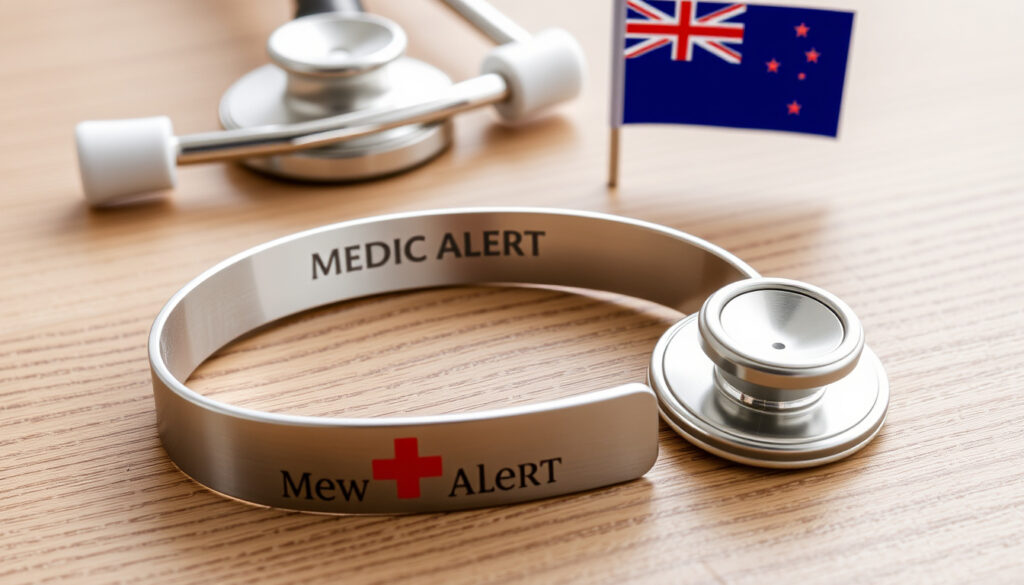
Medic Alert Bracelet NZ: Cost, Engraving & Where to Buy
A medical ID bracelet is one of those purchases you hope never actually has to do its job, but for anyone living with an allergy, a heart condition, diabetes, or epilepsy, that small engraved plate can be the fastest way to give a paramedic the information they need. In New Zealand, choosing one involves weighing a monitored service like MedicAlert against a straightforward engraved band, and the cost difference is significant.
Typical price for a MedicAlert silicone bracelet in NZ: $39 (down from $69 on promotion) ·
Number of conditions accepted by MedicAlert: Over 400 ·
Primary emergency service partner in NZ: Hato Hone St John ·
Recommended wrist for wearing medical ID: Left wrist (by paramedic training)
Quick snapshot
- Primary medical condition (e.g., diabetes, epilepsy)
- ICE (In Case of Emergency) contact number
- Medication allergies
- Name is optional but helpful (Healthify)
- MedicAlert Foundation NZ (official provider)
- Select pharmacies and engraving stores
- Free options through charities for specific conditions
- Online specialists like Mediband ship to NZ (Mediband New Zealand)
- Silicone bracelets from $39
- Metal bracelets up to $199
- Membership includes 24/7 emergency response (MedicAlert New Zealand)
- Standard engravable bracelets from $54.95 (Giftware & Engravers)
- Paramedics in NZ check left wrist first
- Medical ID speeds up diagnosis by seconds
- St John partners with MedicAlert for alert verification
- ICE engraving gives immediate contact
Key facts at a glance
A few numbers to anchor the decision before we get into the trade-offs.
| Label | Value |
|---|---|
| National Provider | MedicAlert Foundation New Zealand |
| Emergency Partner | Hato Hone St John |
| Price Range | $39 – $199 |
| Common Engraving | Medical condition + ICE |
| Annual Membership (MedicAlert) | From $70/year plus $62 enrolment fee (MedicAlert New Zealand) |
| Mediband Active Classic | NZ$69.31 (Mediband New Zealand (medical ID specialist)) |
| Stainless steel expandable Medic ID bracelet | NZ$54.95, Napier store (Giftware & Engravers) |
| MedicAlert custom engraving | Complementary Medical Information Device on joining (MedicAlert New Zealand) |
| Engravable plate (Giftware & Engravers) | 42.7 mm × 12 mm with red medical sign (Giftware & Engravers) |
The pattern: you can spend under $60 on a purely informational tag, or $200+ for a monitored service that keeps your medical file one phone call away. Both have a place, but they answer different problems.
What should a medic alert bracelet say?
This is the question that separates a genuinely useful medical ID from jewellery that merely looks medical. A first responder scanning your wrist needs the few details that could change how they treat you in the first 60 seconds.
Do you put your name on a medical alert bracelet?
- Your primary condition (e.g., “Type 1 Diabetes” or “Epilepsy”)
- ICE (In Case of Emergency) contact number
- Medication allergies (e.g., “Penicillin allergy”)
- Name: optional but recommended — it helps confirm identity when you can’t speak (Mediband New Zealand)
A name isn’t the most critical field, but combined with an NHI number and a contact, it gives a paramedic a complete starting point. Healthify lists My Identity as one option offering a one-off engraved tag with name, NHI number, condition, allergy, and emergency contact (Healthify). If space allows, the NHI number is a powerful addition because it lets clinicians pull your records directly.
What does ICE mean on a medical alert bracelet?
ICE stands for In Case of Emergency. The label was popularised by British paramedic Bob Brotchie in 2005, and it’s now standard practice in many countries. An ICE number gives responders someone to call when you can’t – a partner, a parent, or a friend who knows your medical history. MedicAlert goes a step further: its bracelets carry a membership ID and a 24/7 hotline that dispatchers can call to pull your full medical profile (MedicAlert New Zealand).
Common medical conditions to include
- Diabetes (Type 1 and Type 2)
- Epilepsy or seizure disorders
- Severe allergies (anaphylaxis risk)
- Heart conditions, including arrhythmias and pacemaker dependence
- Anticoagulant use (e.g., warfarin)
- Autoimmune disorders and rare diseases
Where do you get a medic alert bracelet?
New Zealand buyers have three distinct routes: the official MedicAlert Foundation, dedicated online specialists, and local engraving stores. Each offers a different balance of medical credibility, price, and speed.
MedicAlert New Zealand official store
The MedicAlert Foundation New Zealand is the country’s primary provider and a recognised non-profit. Its bracelets carry three things: your critical medical information, a membership ID, and a 24/7 emergency hotline that authorised medical staff can call (MedicAlert New Zealand). Membership starts at NZ$70 per year with a NZ$62 enrolment fee. A five-year option costs NZ$280 plus the same enrolment fee (MedicAlert New Zealand).
When you join, MedicAlert says a complimentary custom-engraved Medical Information Device such as a bracelet or pendant is available, subject to the membership terms (MedicAlert New Zealand). That changes the value equation: the annual fee buys the 24/7 service, and the bracelet itself is effectively included.
You’re paying for the monitoring infrastructure as much as the bracelet. For someone with a complex condition or a rare allergy, that could be the difference between a paramedic calling the hotline and guessing.
Where can I get free medical alert bracelets?
A genuinely free medical alert bracelet is rare in New Zealand, but not impossible. Some health charities and condition-specific organisations provide basic silicone bands to registered members, particularly for diabetes, epilepsy, and severe allergies. Healthify’s guide to personal medical alarms and IDs lists several charities that offer engraved tags as part of their support programmes (Healthify). The “free” bracelet usually comes with strings attached: you may need to prove a medical need, attend a program, or accept a simpler design. In practice, most people end up paying at least for shipping or engraving.
Do Boots sell medical alert bracelets?
Boots is a UK pharmacy chain, and its presence in New Zealand is minimal. The short answer: no, Boots does not operate a network of NZ stores stocking medical alert bracelets. Instead, local pharmacies and engraving shops cover that ground. Chemist Warehouse and other NZ pharmacy chains have been known to stock basic silicone medical ID bands, but the range is limited and design choices are few. Giftware & Engravers in Napier offers an alternative: a stainless-steel Medic ID bracelet for NZ$54.95 with click-and-collect from its Hastings Street store (Giftware & Engravers (NZ engraving retailer)).
St John medical alarm options
Hato Hone St John works in this space, but its medical alarms are monitored devices rather than engraved bracelets. The distinction matters: a St John alarm is an active device you press when you need help, while a medical ID bracelet passively informs a responder. The two are complementary rather than replacements. St John partners with MedicAlert in New Zealand, meaning paramedics can verify a MedicAlert membership ID during an emergency response (MedicAlert New Zealand).
If you only need something to tell a paramedic about your allergy, a $55 local engraving bracelet works. If you need your full medical file available to a hospital overseas or an unfamiliar emergency team, only a monitored service like MedicAlert can deliver that.
How much does it cost for a medical alert bracelet?
Prices in New Zealand range from under $50 for a basic engravable band to nearly $200 for premium metal with full membership. Here’s how the options actually compare.
| Product | Price (NZD) | What you get | Source |
|---|---|---|---|
| MedicAlert silicone bracelet | $39 (promotional price), $69 standard | Engraved silicone band + 24/7 hotline with membership | MedicAlert New Zealand |
| MedicAlert membership (annual) | $70/year + $62 enrolment | 24/7 emergency hotline, medical file, complimentary device | MedicAlert New Zealand |
| Mediband Active Classic silicone | $69.31 | Silicone band with engraved steel plate | Mediband New Zealand |
| Giftware & Engravers stainless steel | $54.95 | Expandable stainless bracelet, 42.7mm × 12mm plate | Giftware & Engravers |
| Mediband stainless slim | $102.75 | Stainless bracelet, engraving included | Mediband New Zealand |
| Mediband Star of Life badge | From $8.22 | Universal medical identifier symbol | Mediband New Zealand |
Four pricing patterns, one takeaway: you can buy a passive tag from $55 or a monitored membership from around $132 in year one. The silicone-versus-metal price gap is real, but the membership fee, not the bracelet, is the real cost driver.
Price range for basic silicone vs metal bracelets
- Silicone: $39–$70 — flexible, waterproof, durable, good for active use
- Stainless steel: $55–$103 — more formal, harder-wearing, better engraving surface
- Premium metal: $150–$199 — typically titanium, gold-toned, or leather-and-metal hybrids
Membership fees for MedicAlert NZ
MedicAlert’s pricing starts at NZ$70 per year with a NZ$62 enrolment fee. A five-year membership costs NZ$280 plus the same $62 fee. That breaks down to roughly NZ$10.50 per month for the 24/7 hotline and medical records access (MedicAlert New Zealand).
Do paramedics actually look for medical bracelets?
Yes — but they look in a specific place. Emergency medical training in New Zealand and internationally emphasises checking the left wrist during a primary assessment. This is why the left wrist is the recommended position for a medical ID bracelet.
What wrist do you wear a medical alert bracelet on?
The left wrist is the standard answer in paramedic training. The reasoning is practical: the majority of people are right-handed, so the right wrist is more likely to be occupied by a watch or obscured during assessment. St John paramedics in New Zealand are trained to check for medical ID jewellery as part of their secondary survey when a patient is unresponsive (MedicAlert New Zealand). If you’re left-handed, the left wrist is still the conventional choice — an engraved plate facing outward is what matters most.
How paramedics are trained to check for medical IDs
- Check left wrist and both ankles during the secondary survey
- Look for the Star of Life symbol or the word “MEDIC ALERT”
- Read the engraving aloud to confirm details
- Call the MedicAlert hotline if a membership ID is present (MedicAlert New Zealand)
A person with anaphylaxis has roughly the time it takes to set up an IV line before treatment decisions matter. A bracelet that says “No known allergies” followed by a name and a condition is worth more than a 2,000-word medical file that nobody can access.
The implication: simple engravings work, but monitored services provide the backup detail that complex conditions need.
What conditions qualify for a medical alert bracelet?
The honest answer: any condition that could render you unable to communicate. The more specific answer is that MedicAlert maintains a list of over 400 conditions that can be engraved, and for a monitored membership, the service will log any condition a doctor confirms (MedicAlert New Zealand).
Common conditions: diabetes, allergies, epilepsy, heart conditions
- Diabetes: the single most common engraving worldwide
- Severe allergies: penicillin, latex, bee stings, peanuts
- Epilepsy: informs seizure handling
- Heart conditions: AFib, pacemaker, anticoagulant use (e.g., warfarin)
Autoimmune disorders and rare diseases
Rare diseases are a special case: a condition a paramedic may never have encountered in training could completely change a treatment decision. MedicAlert’s medical records service exists partly for this reason. The engraved tag shows the condition name, and the 24/7 hotline gives access to a fuller file if needed (MedicAlert New Zealand).
If your condition is rare, the engraving is only the trigger — the value is in the phone number behind it.
Which is better, a medical alert bracelet or necklace?
Both formats have survived decades of medical practice because both work. But they work in different situations, and the right answer depends on your daily life and comfort.
Bracelet
- High visibility to paramedics — left wrist is a standard check point
- Lower risk of being misplaced during daily activities
- Wide variety of styles (silicone, metal, leather)
- May irritate some skin types with continuous wear
Necklace
- Better for those who dislike wearing items on their wrist
- Metal chains are typically very durable and low-profile
- Medium visibility to paramedics — depends on clothing coverage
- Higher risk of being removed during sports, sleep, or showers
| Factor | Bracelet | Necklace |
|---|---|---|
| Visibility to paramedics | High — left wrist is a standard check point | Medium — depends on clothing |
| Risk of being misplaced | Lower — wrist is always exposed | Higher — can be removed during sports or sleep |
| Comfort for daily wear | Good for most; may irritate some skin types | Better for those who dislike wrist items |
| Durability | Silicone is waterproof and tough | Metal chains are typically very durable |
| Style options | Wide — silicone, metal, leather | Narrower — pendants and chains |
Visibility and comfort comparison
MedicAlert’s own device range includes both bracelets and pendants, which suggests the organisation regards both as clinically valid. The decisive factor for visibility is whether the device is worn every day without fail. A pendant tucked under a shirt during a workday is less useful than a silicone bracelet that stays on through a shower and a workout (Mediband New Zealand (custom ID bracelets)).
Style options for men and women
- Men: stainless steel expandable bracelets, leather-band styles
- Women: slim silicone bands, gold-tone necklaces, pendant tags
- Kids: small silicone bands, brightly coloured options
- Active people: Mediband Active X Band, silicone classics
Comparison table: MedicAlert vs Mediband vs Local Engravers
Because the choice in NZ often comes down to these three routes, here’s how they stack up.
| Criteria | MedicAlert NZ | Mediband NZ | Local Engravers |
|---|---|---|---|
| Core model | Membership + 24/7 hotline | One-off product purchase | One-off product purchase |
| Bracelet price | $39 (promo) / $69 (standard) | $69.31 – $102.75 | $54.95 |
| Ongoing cost | $70/year + $62 enrolment | None | None |
| Emergency records | Yes — full medical file on call | Web-based profile access | No |
| Engraving flexibility | Condition + ID + hotline | Condition, allergies, meds, blood type, contact | Standard engraving per plate size |
| Speed | 2–3 weeks | Immediate for Active Range; 10–14 days custom | Same day or next day via click-and-collect |
How to take off a medic alert bracelet
Medical alert bracelets are designed to stay on through daily life, but there will be moments when you need them off — imaging scans, surgery, or replacing a worn band.
Removing a silicone band
Removing a metal clasp bracelet
- For a silicone toggle closure: twist the two ends gently until the toggle releases.
- For a solid silicone cuff: slide the bracelet over your hand with fingers curled tightly.
- Do not pull the engraving plate hard against the wrist — ease it over the hand at an angle.
- For a metal safety clasp: press the release button or slide the bar sideways to open the clasp.
- If the bracelet has a fold-over clasp: lift the small latch with a fingertip or a flat-edged tool.
If a bracelet is too tight to remove easily, it’s too tight. A medical ID should fit snugly but allow one finger to slip underneath (Mediband New Zealand).
Confirmed facts vs what’s unclear
Not everything about medical alert bracelets is settled, even among the professionals who rely on them.
Confirmed facts
- MedicAlert NZ offers a 24/7 emergency response hotline (MedicAlert New Zealand)
- ICE stands for In Case of Emergency (Healthify)
- A medical ID is distinct from a monitored personal alarm (Healthify)
What’s unclear
- Whether all paramedics check for bracelets on unconscious patients in every situation, or how consistently they check the left wrist
- The exact number of New Zealanders wearing medical alert bracelets
- How often the MedicAlert hotline actually changes a treatment decision in the field
The uncertainty matters for one reason: a bracelet is a tool, not a guarantee. It increases the odds of correct treatment but doesn’t replace a medical professional’s assessment.
What experts and services say
“Medical IDs are engraved with critical medical information, a membership ID, and a 24/7 emergency hotline.”
— MedicAlert New Zealand
“A medical ID is a bracelet, necklace, or tag displaying information that other people can see and access; it is distinct from a monitored personal alarm.”
“Custom signature designs generally take 10–14 business days to produce, plus shipping.”
Summary
For the New Zealand couple choosing a gift for an elderly parent, or the young adult managing a new epilepsy diagnosis, the right medical alert bracelet is the one that will still be on the left wrist at 2am when the paramedics arrive. A passive engraved band at $55 does that job today. A MedicAlert membership at around $132 in year one adds a hotline, a medical file, and a credible brand. For a person with a complex condition, the decision is clear: pay for the monitoring, not just the metal.
Frequently asked questions
How quickly does a medical alert bracelet work in an emergency?
In the field, a medical ID is read in seconds during the secondary survey. The engraved details are visible immediately, and if it’s a MedicAlert bracelet, the hotline number on the reverse gives responders a path to your full medical file within minutes (MedicAlert New Zealand).
Can I wear a medical alert bracelet in the shower?
Most silicone medical ID bracelets are fully waterproof and designed for continuous wear. Metal bracelets with plated engraving can often tolerate water, but prolonged chlorine exposure may dull the finish. If a necklace is more practical for wet environments, that’s a valid reason to choose one (Mediband New Zealand).
Do I need a prescription for a medical alert bracelet in NZ?
No prescription is required. Medical alert bracelets are widely available through MedicAlert, online specialists, and local engravers. A doctor’s confirmation is needed for some charity-supplied bracelets or for logging a condition on a MedicAlert membership file (Healthify).
Are medical alert bracelets covered by insurance?
Not automatically. Some health insurers in NZ may reimburse the cost of a medical alert bracelet or membership if a doctor recommends it, but this is benefit-specific. The MedicAlert enrolment fee is usually the part covered, if any. Check your policy wording before assuming coverage (MedicAlert New Zealand).
What is the difference between MedicAlert and St John medical alarms?
MedicAlert is a medical ID and records service: the bracelet passively tells responders your condition, and the hotline provides your file on demand. St John medical alarms are active devices that you press to call for help. They solve different problems — the first informs, the second summons (Healthify).
Can children wear medical alert bracelets?
Yes. Many providers offer smaller silicone bands sized for children. A child with a severe allergy or a condition like Type 1 diabetes can benefit from a medical ID if they are old enough to understand not to remove it. Some charities that support children with specific conditions offer free or subsidised bracelets (Mediband New Zealand).
How to clean a medical alert bracelet?
For silicone bands, warm soapy water and a soft cloth are sufficient. For stainless steel, a gentle jewellery cleaner or isopropyl alcohol wipe works well. Avoid abrasive scrubs that could wear down the engraved lettering over time.
Do medical alert bracelets need batteries?
No. A standard engraved medical ID bracelet is a passive device and requires no maintenance. A MedicAlert membership uses a radio-frequency identification (RFID) chip in some models, but the chip is powered by the responder’s reader, not by a battery. Monitored personal alarms are the devices that require charging (MedicAlert New Zealand).
More related posts
 Right Side Pain Under Ribs Female: Causes & Treatment
 Whale Watch Kaikoura Reviews: Price, Seasickness, and Is It Worth It
 The Knight and the Moth: Plot, Spice Level, and Series Info
 Honey Soy Chicken Marinade: 5 Best Recipes Compared
 Immigration NZ Contact 24 Hours: Phone Numbers & Hours
 Bed Bath and Beyond Sheets: Brands, Quality & Afterlife
 2degrees Top Up Online: How to Top Up 2degrees Prepay
 Small Business for Sale Auckland: Costs, Taxes & Legal Guide